
A supercapacitor is not a better battery — it is a different promise: a small amount of energy, delivered almost instantly, almost forever. Because the two devices sit in the same cabinets, back the same loads and appear in the same tenders, buyers keep being asked to choose between them as if they were rivals. Mostly they are not. A battery stores energy in chemical bonds and pays it out over minutes and hours; a supercapacitor stores energy as static charge and pays it out in seconds. Confuse the two and you either buy a capacitor bank that dies — electrically speaking — before the diesel starts, or a battery asked to do violence to itself ten thousand times a day. This guide explains what a supercapacitor actually is, where it beats any battery ever made, where it cannot compete at all — and why the honest answer in several duties is now “both”. It joins our series of fair examinations of rival technologies, alongside sodium-ion and flow batteries.
Static charge, enormous surface: how it works
An ordinary capacitor stores charge on two metal plates separated by an insulator — the same electricity that crackles off a carpet, tamed. Its capacity is tiny: microfarads. The supercapacitor’s trick, described in principle by Helmholtz in the nineteenth century, is the electrical double layer: dip an electrode into an electrolyte, apply a voltage, and charge accumulates in a layer at the surface mere molecules thick. Make that electrode from activated carbon — a material so porous that a few grams unfold into a surface area measured in football pitches — and the tiny layer multiplies into farads by the thousand. Crucially, in the pure double-layer device no chemical reaction occurs: nothing is plated, dissolved or converted, which is why the electrodes do not wear out the way our guide to how batteries die describes plates wearing out. Where a battery’s voltage is set by its chemistry — the thermodynamic certificate our electrochemistry guide explains — a capacitor’s voltage is simply wherever you left it, sliding down as charge leaves. That one difference drives almost everything that follows.
A short history with a familiar smell
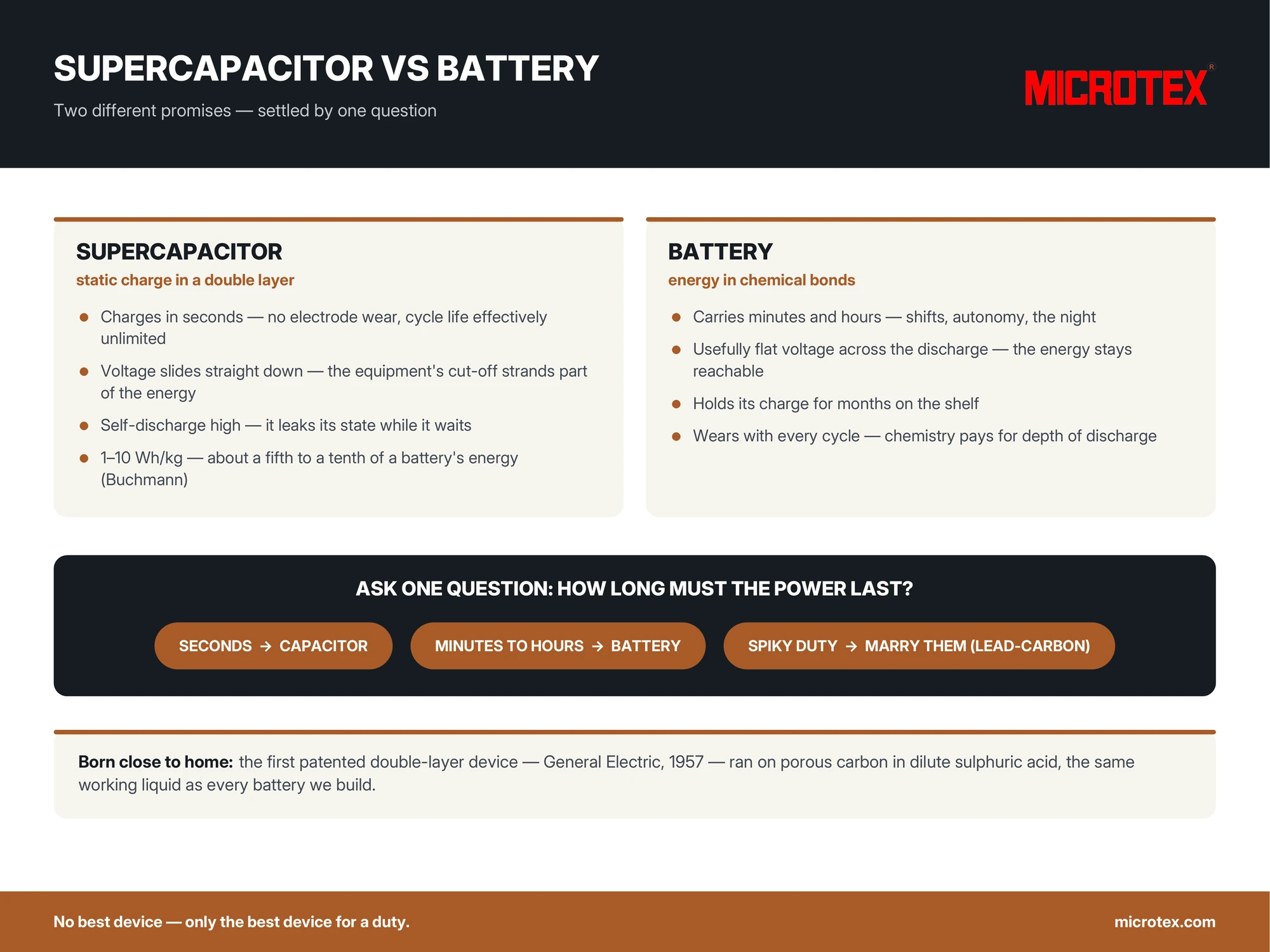
The supercapacitor was born surprisingly close to home. The first patented double-layer storage device — H.I. Becker’s, at General Electric in 1957 — used porous carbon electrodes in an aqueous electrolyte of sulphuric acid: the same working liquid as every battery we build, asked to do a completely different job. Becker’s cell never reached market; the practical format came from Robert Rightmire at Standard Oil of Ohio, whose 1962 filing (granted 1966) set the pattern later devices followed, and the technology finally went commercial after NEC licensed it in 1971 — as a coin-sized guardian keeping the memory alive in electronics, under the trade name that became the whole family’s everyday word. From memory backup the device has spread wherever short, sharp bursts of power matter more than stored energy: bridging the seconds before a generator accepts load, catching regenerative braking, smoothing pulse loads, assisting cold engine starts. The standard references now give it a chapter of its own — Linden’s Handbook of Batteries devotes one to electrochemical capacitors — which is the literature’s way of saying the device has earned permanent citizenship in the power world.
The honest bill: what the speed costs
Now the ledger, with figures from Buchmann’s reference text on portable power. Energy: a supercapacitor stores roughly one to ten watt-hours per kilogram — about a fifth to a tenth of what an electrochemical battery of the same weight holds. That is the headline and it is disqualifying for every energy duty: no supercapacitor carries a forklift shift or a substation’s autonomy hours. Voltage: a single cell is low — around one volt with aqueous electrolyte, two to three with organic — so working voltages mean long series strings, and beyond three or four cells in series the string needs balancing electronics to keep any one cell from over-voltage: familiar territory for readers of our series and parallel guide. Discharge shape: where a battery holds a usefully flat voltage across its discharge, the capacitor’s voltage falls in a straight line from full to empty — so the equipment’s cut-off voltage strands part of the stored energy; in Buchmann’s example, a load that must cut off at three-quarters voltage reaches that threshold within the first quarter of the discharge. And the quiet cost: self-discharge considerably higher than a battery’s — a charged supercapacitor left alone leaks its state visibly, where a healthy lead-acid cell holds for months. Against all that stand the superpowers: charging in seconds, effectively unlimited cycle life with no electrode wear, power delivery no chemistry can match — and, pleasingly, charging habits Buchmann notes resemble lead-acid’s: voltage-limited, tolerant of a trickle, no fussy full-charge detection.
Seconds or hours: the decision rule
So the choice is not battery or supercapacitor any more than a workshop chooses hammer or screwdriver. Ask one question: how long must the power last? If the duty is seconds — ride-through until the generator takes load, a crane’s regenerative catch, a pulse the supply cannot follow — the capacitor is in its kingdom, and a battery given that duty will cycle itself to death doing work it hates. If the duty is minutes to hours — a shift, an autonomy period, a night — it is a battery job, full stop, and the capacitor is not even a candidate. The interesting engineering lives at the border, where the two marry: capacitor handles the spikes, battery carries the energy, and each protects the other — the thinking that put capacitor-style carbon electrodes inside a lead-acid cell in the lead-carbon hybrids our lead-carbon guide describes. Treat any datasheet that promises battery energy with capacitor cycle life in one device with the scepticism our comparison of battery chemistries recommends for every too-good column. And if your duty sits awkwardly between seconds and hours — a heavy crank, a punishing pulse load over a real shift — describe the duty to us: we will tell you plainly whether it is a battery job, a capacitor job, or a marriage — including when the answer is not something we sell.