
Push current into a lead-acid battery faster than it can accept, and the excess does not charge the battery at all — it splits water and makes heat. That single sentence explains most hot batteries, most watering bills, and a surprising share of premature battery failures. On a recent visit to an underground mine, we watched the pattern at full scale: batteries charged hard for eight hours, coming off the charger too hot to work, then parked for a full eight-hour shift with one job — cooling down. The “fast” charge was costing a third of every day.
A battery can only drink so fast
A discharged lead-acid battery is greedy: it will happily absorb very large currents, converting lead sulphate back to active material almost as fast as the charger can supply it. But as the battery fills, its charge acceptance falls — there is less sulphate left within reach, and the conversion slows. From that point, whatever current the charger forces above the acceptance line has nowhere useful to go. It electrolyses the water in the electrolyte into hydrogen and oxygen, and it heats the battery.
This is not a new discovery. George Wood Vinal’s Storage Batteries — the standard reference of the industry for half a century — states the two practical limits on charging rate plainly: temperature rise to excessive values, and excessive gassing. And it records the working rule, from J. Lester Woodbridge’s tests, that the industry still lives by. It is called the ampere-hour law: keep the charging current in amperes below the number of ampere-hours the battery still lacks. A battery that is 200 Ah short can accept nearly 200 A without distress; when it is 50 Ah short, more than 50 A is asking for gas and heat; near full, only a trickle converts anything at all. Follow that falling line and, as Vinal notes, the conditions of gassing and temperature look after themselves.
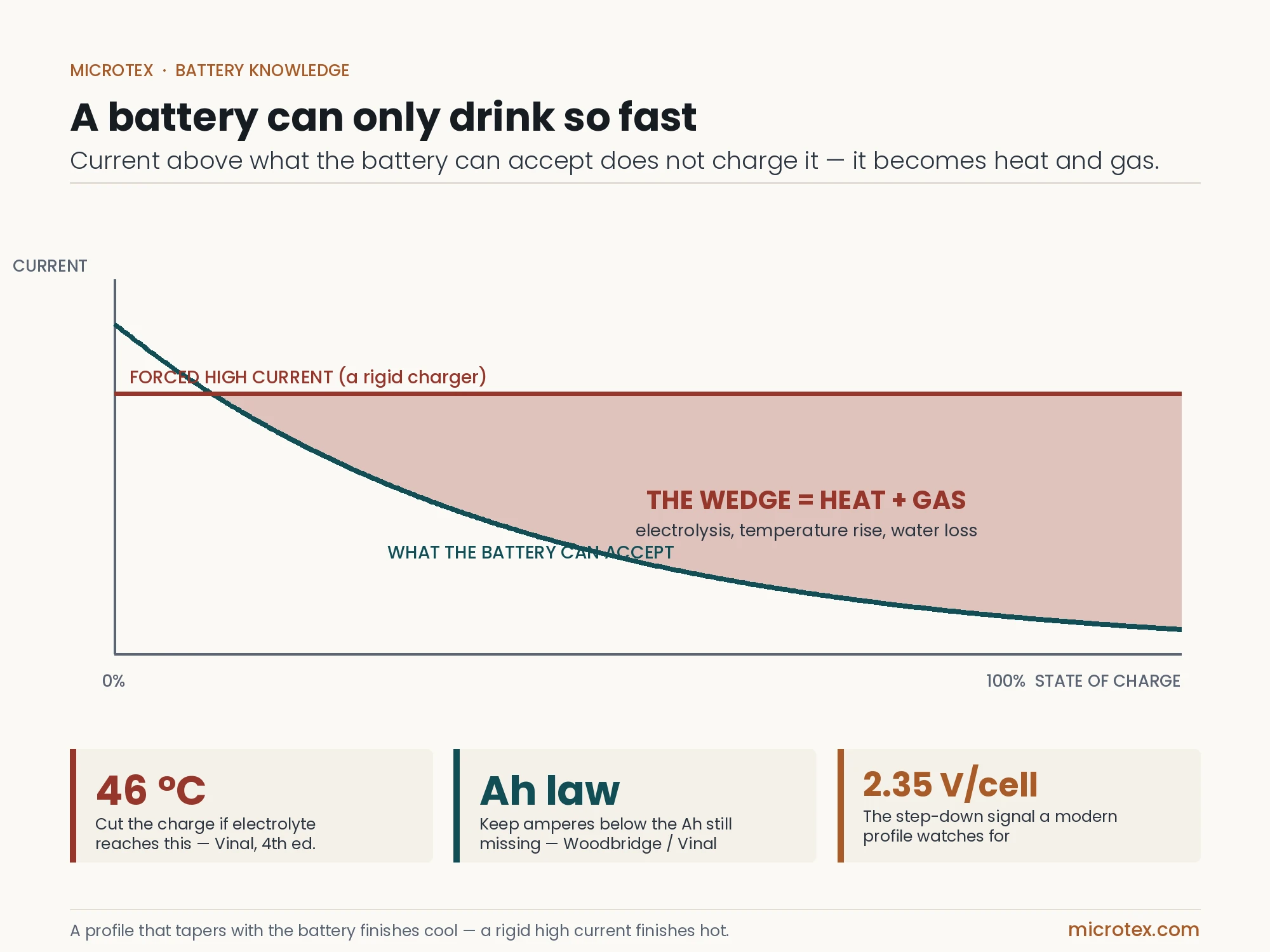
Where the extra amperes really go
Every ampere-hour of overcharge splits about a third of a gram of water into roughly 0.45 litres of hydrogen and 0.22 litres of oxygen — gas that must be ventilated (our guide to why batteries explode covers that discipline), and water that somebody must put back with a topping-up can. The rest of the wasted energy appears as heat, and heat is the quiet enemy: it accelerates positive-grid corrosion, speeds water loss further, and compounds with every degree. A working rule across the industry is that sustained operation around 10 °C above the design temperature can roughly halve service life. Vinal’s edition of 1955 already carried the operational limit that mining and stationary practice still uses: if the electrolyte approaches 46 °C, cut the charge and let the battery cool.
Now look back at that mine’s routine with the right lens. The battery was not “fast-charged” at all. It received its charge plus several kilowatt-hours of unwanted electrolysis and heating, paid for at the meter; it lost water, which someone paid to replace; it aged faster, which the replacement budget will discover in a year or two; and it still could not work the next shift, because the charge that finished “fast” finished hot. Counting the cooling shift, the high-current charger was slower than a correct one.
Cannot the operator simply watch it?
No — and it is unfair to ask. The acceptance line falls continuously; a human with a rheostat cannot track it, and a rigid charger set to one high current crosses it long before the charge ends. The battery itself signals the crossing: the cell voltage climbs, and at about 2.35 volts per cell — a threshold already used for step control in Vinal’s day — gassing is beginning and the current must come down. What tracks that signal reliably is not attention but design.
What a correct charge looks like
A charger built for the battery does four things the rigid high-current charger cannot. It starts strong — there is nothing wrong with high current into an empty battery; the ampere-hour law permits it. It steps the current down as the cell voltage reports rising state of charge, staying under the acceptance line instead of ploughing through it. It corrects the voltage for the battery’s own temperature, measured by sensors on the battery itself — not the room — so a warm battery is never overdriven. And it stops when the battery is full, rather than when a timer expires, logging the ampere-hours it returned so the maintenance team can see the quality of every charge. A battery charged this way finishes its charge cool, works its shift on schedule, uses a fraction of the topping-up water — and lives out the cycle life its plates were built for (how depth of discharge sets that number is covered in our C-rate guide).
This is exactly the philosophy behind the purpose-built Microtex mining battery charger: a stepped, temperature-compensated profile developed and tested on our own mining batteries, with the operator’s role reduced to connecting the battery and pressing START — because the battery, not the operator, should decide how fast it drinks.
Three questions for your own charging room
1. Touch test: is the battery hot when it comes off charge? A correctly charged battery ends only slightly warm. Hot means the charger crossed the acceptance line, every single day.
2. Water test: how often do your batteries need topping up? Frequent watering is electrolysis on the payroll — the charge current is going into gas instead of plates.
3. Time test: add the hours your batteries spend cooling to the hours they spend charging. That total — not the charging time alone — is your real turnaround, and it is the number a matched charger shrinks.
If any of those three answers is uncomfortable, send us your battery types and duty cycle — describe the operation to us and we will review the charging regime with you. It is the cheapest battery-life extension there is. For every term in this article, the battery glossary is open.
Reviewed and updated 19 August 2026.