
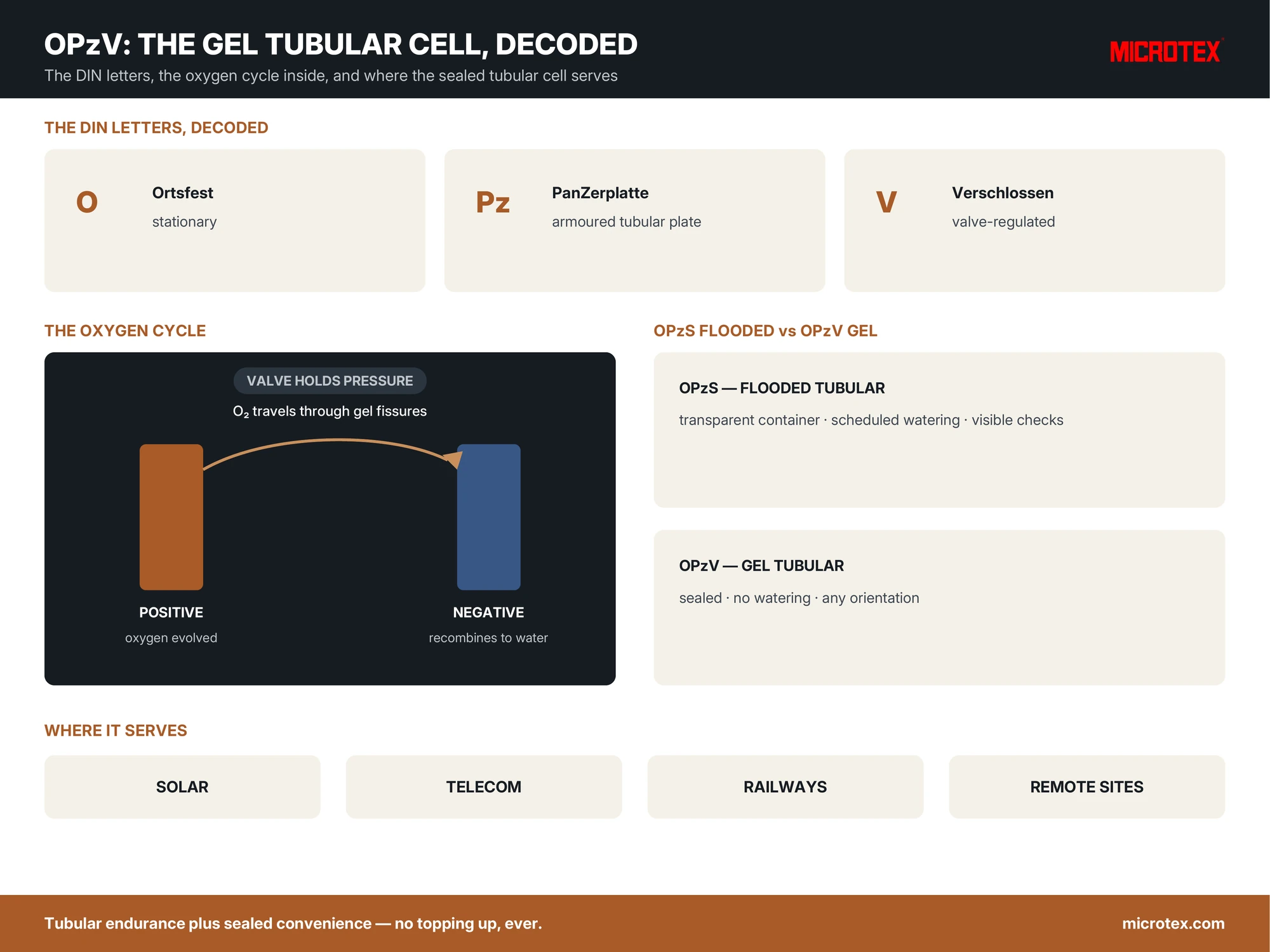
OPzV is German shorthand for a very specific promise. Under the DIN naming of Europe, O stands for Ortsfest (stationary), Pz for PanZerplatte (the armoured tubular plate), and V for Verschlossen (closed) — though no lead-acid cell is ever truly closed, so the V is often read as “valve-regulated” instead: a pressure-relief valve, typically opening at some tens of millibar, replaces the open vent. Put the pieces together and you have the OPzV battery: a 2-volt tubular gel cell built for stationary duty — deep discharges, long life, and almost no maintenance at all.
Gel, not glass mat — and why tubular chose gel
OPzV is a VRLA (valve-regulated) cell, but not the AGM kind. In an AGM battery the acid is held like blotting paper in a fine glass mat, and that mat needs uniform pressure across a FLAT plate face to work — which is why AGM belongs to flat-plate designs. In an OPzV cell the electrolyte is immobilised differently: fumed silica turns the liquid acid into a solid gel that surrounds the plates completely. That is what lets the gel cell keep the tubular positive plate — the construction that holds its active material in woven gauntlets and survives deep daily cycling — and its rounded tube geometry even offers roughly 15% more acid-contact area than an equivalent flat plate. Tubular endurance plus sealed convenience: that pairing is the whole product.
The oxygen cycle inside the gel
Charging past a certain point electrolyses water. At the positive plate: 2H₂O → O₂ + 4H⁺ + 4e⁻. In a flooded cell that oxygen bubbles up and is lost through the vent, taking water with it — hence topping up. In a gel cell, something better happens. As the gel cures and works, it develops fine cracks and fissures; the oxygen produced at the positive migrates through those channels to the negative plate, where it is captured in a chain the literature summarises as: O₂ + 2Pb → 2PbO; 2PbO + 2H₂SO₄ → 2PbSO₄ + 2H₂O; 2PbSO₄ + 4H⁺ + 4e⁻ → 2Pb + 2H₂SO₄. The oxygen ends up back as water, the negative plate is kept busy enough that hydrogen evolution stays suppressed, and the valve holds the small working pressure in. The net result: no topping up, negligible gas in the room, and a battery that can even work on its side without spilling a drop — because there is no liquid to spill.
One honest physical footnote: recombination is slower than gas generation, which is why a gel cell is charged gently, under voltage limits, and takes longer to refill than a flooded cell. The literature is blunt about the stakes — any gas that escapes through the valve is water the sealed cell can NEVER get back, and this slow drying, not sudden death, is how mistreated VRLA cells usually end (the failure the trade calls dry-out). That is the whole case for voltage-limited charging, and it is why the exact voltages and profile belong to the datasheet — the charging guide explains why we never publish universal numbers. The gel construction holds one more quiet advantage over its AGM sibling here: the gel mass in full contact with the plates conducts heat out of the cell better than a part-saturated glass mat, which is why gel cells tolerate warm rooms and deep work with less risk of the thermal spiral — the AGM-versus-gel comparison weighs this properly.
OPzV vs OPzS — sibling cells, different jobs
The OPzS cell is the flooded sibling: same tubular heart, liquid electrolyte, transparent SAN container — chosen for mission-critical rooms where engineers want to SEE plate condition and electrolyte level on a walk-round, and where trained maintenance exists. The OPzV trades that visibility for freedom: an opaque, sturdy container (flame-retardant grades are used), a valve instead of a vent, and no watering, ever. The choice is a staffing question as much as a technical one: where maintenance visits are rare, expensive or unreliable — remote sites, unmanned rooms — the gel cell wins.
What an OPzV cell typically offers
| Cell voltage | 2 V nominal, assembled into any bank voltage in series |
| Capacity range | Typically ~100 to 3000 Ah per cell |
| Design life | Long float life — up to the 20-year class in stationary duty |
| Cycle duty | Deep-cycle class — on the order of 1,200–1,800 cycles at 80% depth of discharge for premium designs |
| Maintenance | No topping up; periodic inspection and connection checks only |
| Orientation | Upright or on its side — immobilised electrolyte cannot spill |
Typical bands, not guarantees — designs differ, and the datasheet governs.
Where OPzV earns its living
The pattern is always the same: frequent deep discharges, time available to recharge, and nobody around to do maintenance. Solar and solar-diesel hybrid installations are the textbook case — daily deep cycling in remote places. Telecom sites, especially off-grid towers, are another: long discharges, no technician for months. Energy-storage and standby-power installations that are cycled deliberately fit the same glove, and in railways the train-lighting and signalling duties reward a deep-cycle battery that never asks for water. What OPzV is NOT for: engine starting and high-rate bursts (the gel’s high-rate performance is modest next to AGM), and forklift-style traction service, where flexible polypropylene trays and different packing rules apply. Deep, patient work is the gel cell’s genius; violence is not.
The Microtex OPzV
Our OPzV range — Eternia gel cells — is built the way this article describes and the way our plant has always worked: tubular plates on our own spines, gauntlets woven in-house, gel filled and formed in Bengaluru, and every claim on the product page tied to test evidence. If your duty sounds like the paragraph above — deep, regular, far from a maintenance crew — tell us the load and the site, and the sizing comes back engineered, not guessed.
Why gel, really — on film
Dr. McDonagh refuses the easy answer: deep discharge demands tubular plates, tubular cannot be built as AGM — so gel is what remains. The desert is a coincidence.