
A cold store is the hardest room a forklift battery ever works in — not because cold destroys batteries, but because cold slows them at exactly the hour the shift needs them most. The long-standing international frozen-food code keeps product at minus eighteen Celsius or colder, so the aisles a freezer truck lives in are colder than almost any outdoor winter its battery was imagined for — and unlike weather, the room never warms up. Add the dock: trucks shuttle all day between a humid loading bay and the frozen aisles, dragging the battery through temperature swings that punish it in ways a steady climate never would. Fleets that understand this get full shifts and long service from lead-acid in the freezer; fleets that treat the cold store as just another warehouse write the tickets our engineers later read. This guide is the missing room in our traction battery guide — what the cold actually does, and the four disciplines that beat it.
What cold does to a working battery
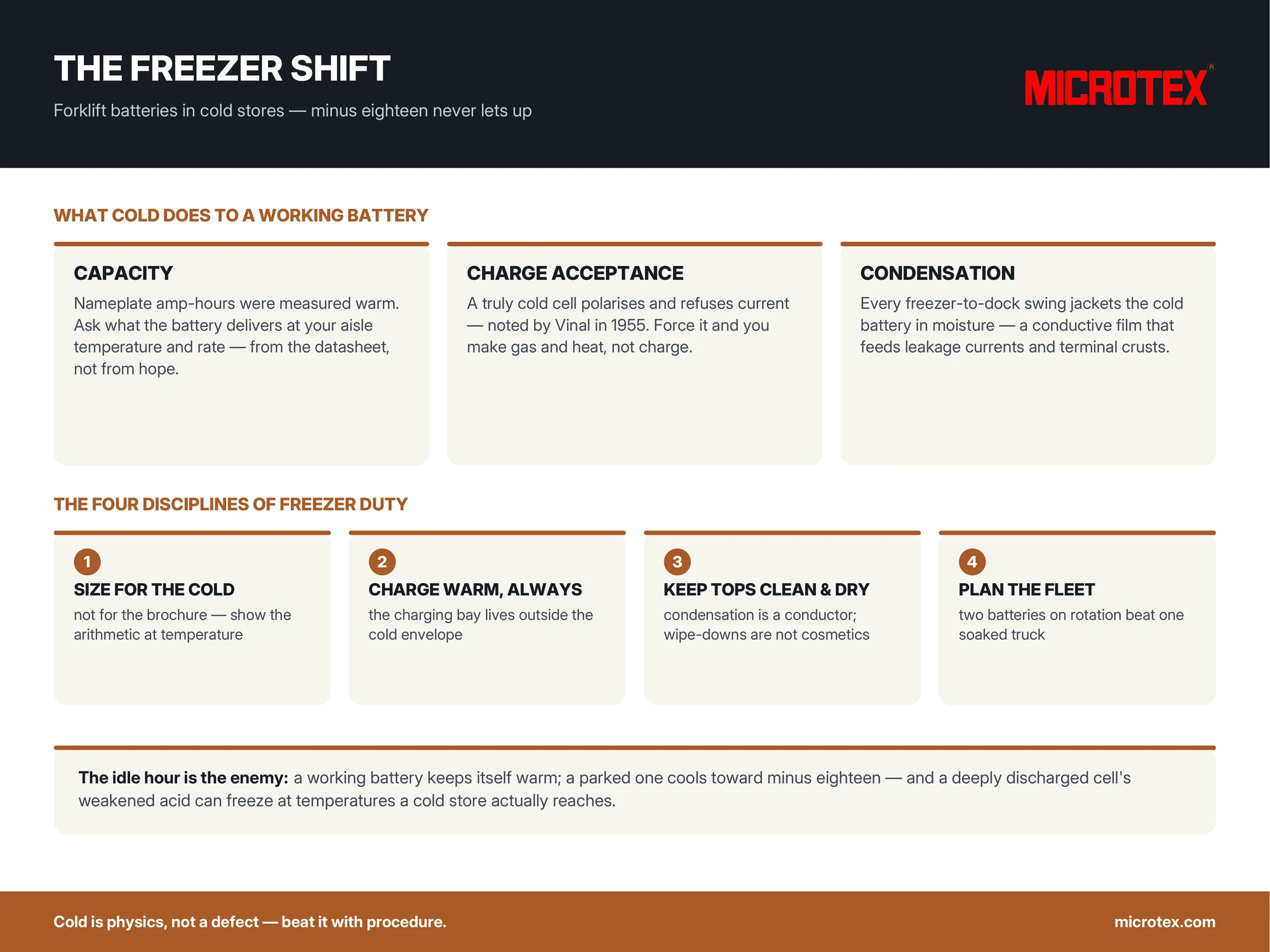
Three effects matter, and they compound. First, capacity: a battery is a chemical machine, and chemistry runs slower cold — the same law that makes heat age a battery faster, run in reverse, as our guide to why heat ages batteries and cold slows them explains. A battery that carries a full shift at room temperature comes up short in a freezer aisle, not because it is faulty but because the amp-hours printed on its nameplate were measured warm — capacity is a number with conditions attached, and the honest question for your supplier is what the battery delivers at your aisle temperature and your discharge rate, from the datasheet, not from hope. Second, charge acceptance: a genuinely cold battery resists charging. Vinal’s classic textbook noted the effect back in 1955 — at very low temperatures the lead sulphate on the plates dissolves so slowly that the cell polarises and simply cannot use the current offered. Push anyway and the energy goes into gassing and heat instead of charge. Third, the swings: every trip from freezer aisle to warm, humid dock jackets the cold battery in condensation — a conductive film across the cell tops that feeds leakage currents and the crusts our terminal corrosion guide teaches you to read. None of these is a defect. All three are physics, and all three yield to procedure.
The one comfort: a working battery keeps itself warm
A battery under load generates heat, and a big traction battery has real thermal mass — it enters the aisle warm from charging and, worked steadily, holds a useful part of that warmth through the shift. This is why the freezer fleet’s enemy is not the eight-hour shift but the idle hour: a truck parked in the aisle over a break is a battery cooling toward room temperature, and the room is minus eighteen. Park warm, park outside the cold room when you can, and keep the battery working rather than soaking. The same logic protects the electrolyte itself: a well-charged cell’s acid is strong and resists freezing far below any freezer aisle, while a deeply discharged cell’s weakened acid can freeze at temperatures a cold store actually reaches — the charge-state-and-freezing story, with its numbers, lives in our cold-weather charging guide. The operating rule it produces is simple: in freezer duty, avoid running deep before recharge, and never leave a discharged battery standing cold.
The four disciplines of freezer duty
Size for the cold, not the brochure. Tell your battery supplier the aisle temperature, the shift pattern and the truck’s real duty cycle, and insist the sizing arithmetic is shown at temperature — the capacity conventions in our C-rate guide are exactly the small print that decides whether the battery finishes the shift. Charge warm, always. The charging bay belongs outside the cold envelope: a battery brought out, allowed to shed its chill, charged in a warm bay with proper ventilation, and returned, will accept its charge fully and gas normally — everything Vinal’s cold-cell problem punishes is avoided by geography. Temperature-compensated charging, where fitted, still matters for the bay’s own swings; that discipline is the cold-weather guide’s subject. Manage the moisture. Wipe-downs and dry cell tops are not cosmetics in freezer duty — condensation is a conductor, and the walk-round’s clean-and-dry law earns its keep here more than anywhere. Plan the fleet, not just the truck. Multi-shift freezer operations are the natural home of battery changing — a warm, charged battery swapped in while the drained one recovers and charges in the warm bay — the model our battery swapping guide shows has quietly worked in warehouses for decades. One battery cannot work a freezer around the clock; two on rotation can.
The lithium question, answered honestly
Cold stores are one of the arenas where lithium trucks are marketed hard, so here is the fair version. Lithium cells must not be charged below freezing — the chemistry is damaged by it — so cold-store lithium packs solve the problem with hardware: built-in heaters and management electronics that lock charging out until the pack is warm. That works, at the price of complexity and cost, and it buys the convenience of opportunity charging in the aisle. Lead-acid solves the same problem with procedure: the warm charging bay and the swap rotation. Both are legitimate engineering answers; which one wins is a duty-and-economics question — count batteries, chargers, bay space, energy and years, the whole-life arithmetic our battery TCO guide lays out — not a technology loyalty question. What does not work, in either chemistry, is ignoring the cold and hoping. If you run trucks below zero — chill, deep-freeze or blast — tell us the aisle temperature, the racking and the shifts, and we will size the battery for the room you actually have, with the cold arithmetic shown.