
An automated guided vehicle is the one machine in the warehouse that never goes home, and that single fact decides its battery before any datasheet is opened. A manned forklift works a shift and stands for a shift; its battery gets the long, complete recharge that lead-acid chemistry is built for. An AGV or an autonomous mobile robot is bought precisely so that it does not stand still, and the way it is kept moving — a few minutes on a charging contact whenever the traffic controller can spare it — is the one charging habit our forklift charger guide tells manned fleets to design out. We make lead-acid traction batteries, so this page is written against our interest in places. Here is where our chemistry still fits a driverless fleet, where it does not, and how to tell which fleet you have.
The market, briefly and honestly
The International Federation of Robotics’ 2025 World Robotics report counts 102,900 professional service robots sold for transport and logistics in 2024, up fourteen per cent and more than any other class, with indoor transport away from public traffic the largest application — a figure the federation itself labels as sample data from 294 suppliers, not an industry census. Whatever the true total, every one of those machines carries a battery and most of them expect to charge without a human present. That expectation is the whole subject.
Two ways to keep a driverless vehicle moving
A 2019 study from Tongji University, working on a real heat-treatment cell that ran twenty-four hours a day, states the choice plainly: automatic charging and battery swapping are the two patterns for keeping AGVs powered. In the first, the vehicle drives itself onto a floor or wall contact whenever its state of charge falls below a trigger and leaves when the traffic controller calls it — the Tongji cell used 200 Ah lithium packs, sent vehicles to charge at eighty per cent depth of discharge, and measured what the work costs: about five amperes an hour while blocked in traffic, ten while travelling empty and sixty-five while carrying a load. In the second, the vehicle drives to a station where a depleted battery is exchanged for a full one, and the charging happens off the vehicle, on the charger’s timetable rather than the vehicle’s. Which pattern a fleet uses matters more to the battery choice than the vehicle’s brand, size or navigation method.
Automatic charging: buy lithium
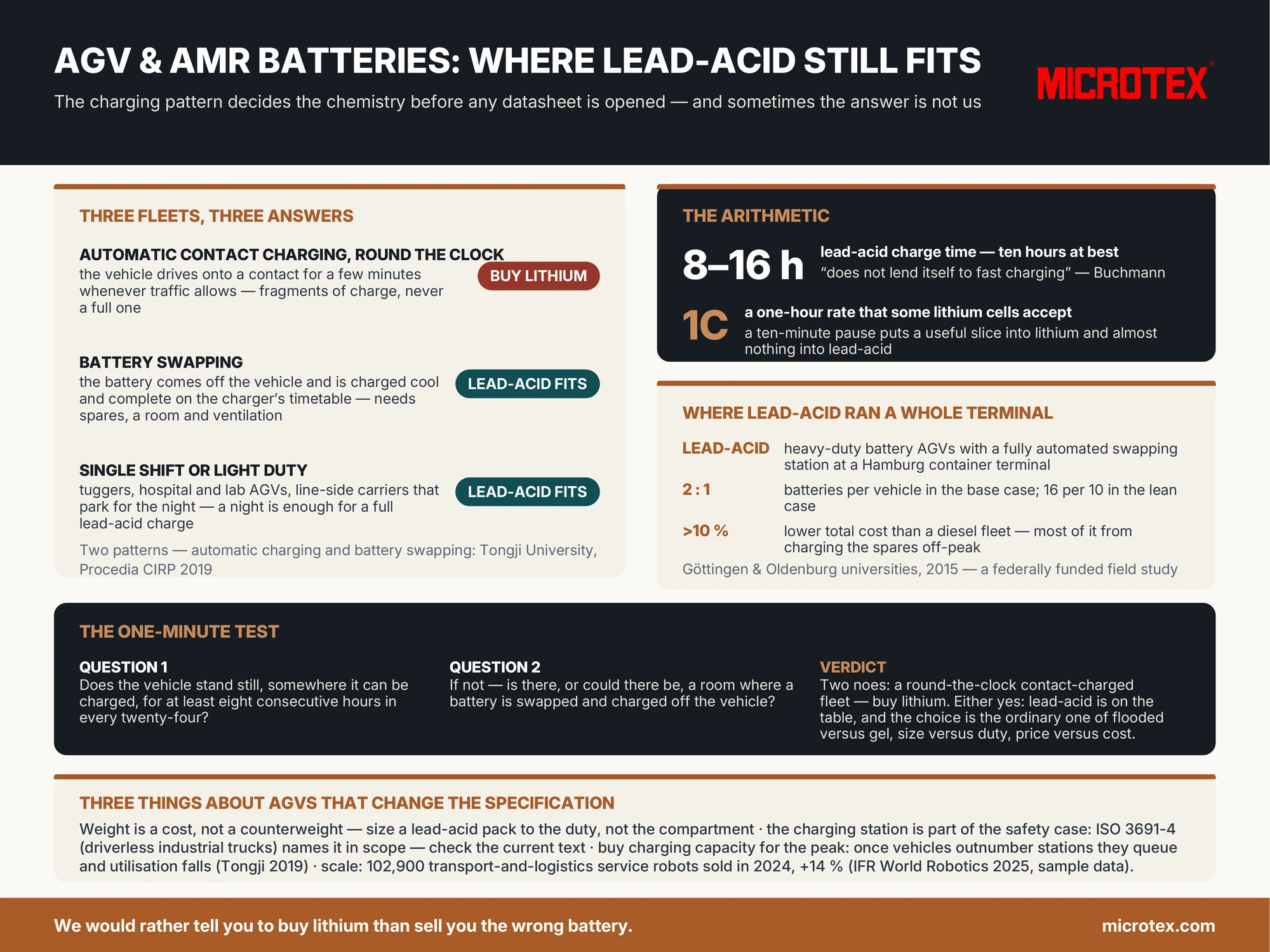
Here is the arithmetic that settles it. Buchmann’s handbook puts a sealed lead-acid battery’s charge time at eight to sixteen hours, ten at best with multi-stage charging, and says without qualification that the chemistry “does not lend itself to fast charging”; the same handbook notes that some lithium-ion cells accept a full one-hour rate across the whole working temperature range. A ten-minute pause on a contact puts a useful slice of energy into a lithium pack and almost nothing into a lead-acid one — and the Tongji study found that stopping the lithium charge at ninety per cent rather than waiting for a full pack raised fleet utilisation further, because lithium’s last ten per cent is its slowest. Lead-acid punishes exactly that behaviour. A cell topped up in fragments and never brought to a full, gassing charge stratifies its acid and sulphates its plates, the two slow deaths our guides to acid stratification and sulfation describe; the weekly full charge that saves a manned forklift’s battery is a charge an automatically-charged AGV has no timetable to receive. So for a fleet that charges on contacts, around the clock, with no swap room, the answer is lithium — usually lithium iron phosphate, sometimes lithium titanate where the pauses are very short — and we would rather say so here than after you have bought from us. Our guide to lithium-ion, honestly covers what that purchase brings with it: the battery management system, the thermal and transport rules, and the price.
Swapping and single shifts: lead-acid still earns its place
The best-documented battery-AGV fleet in the world ran on lead-acid. A 2015 study by researchers at the universities of Göttingen and Oldenburg, funded by Germany’s federal economics ministry, used field data from a Hamburg container terminal running heavy-duty battery AGVs with a fully automated battery-swapping station. The authors treated lead-acid as “technically and economically mature”, modelled a base case of two batteries per vehicle and a lean case of sixteen per ten vehicles, and found that battery AGVs beat a diesel fleet on total cost of ownership by more than ten per cent — most of the gain coming from charging the spare batteries when electricity was cheapest, which a swap room allows and an on-vehicle contact does not. That is the pattern in which our chemistry is at home: the battery comes off the vehicle, gets the full, cool, properly finished charge it needs on the charger’s schedule, and goes back on. A swap fleet needs more batteries than vehicles, a room, a handling system and hydrogen ventilation for that room — our guide to battery-room hydrogen covers the last — and in exchange it buys a cheaper battery, a decades-old recycling loop and no thermal-event procedure. Our guide to battery swapping explains why closed, standardised fleets are where swapping works; a container terminal or a factory is exactly that.
The second home is the single-shift or light-duty vehicle: the tugger that pulls line-side trolleys for eight hours and parks for sixteen, the hospital or laboratory AGV that runs a daytime route, the assembly-line carrier whose duty was sized generously. These fleets return to a bay every night, and a night is enough for a complete lead-acid charge. Where the compartment must be sealed or the vehicle tilts, a gel or AGM block does the job; where the hall runs hot and unconditioned, our guide to AGM versus gel explains why gel is the safer of the two. Where the vehicle is large enough to carry a flooded tubular traction battery and someone waters it, that remains the cheapest kilowatt-hour a driverless vehicle can buy.
Three things about AGVs that change the specification
First, weight is a cost, not a feature. A forklift battery doubles as the counterweight, so a heavy battery is a specification; an AGV carries no forks and every kilogram of battery is energy spent moving it — a real point for lithium, and a reason to size a lead-acid pack to the duty rather than to the compartment. Second, the charging station is part of the machine’s safety case. The international safety standard for driverless industrial trucks, ISO 3691-4, names the battery charging station among the systems within its scope; summaries of the 2023 edition describe automatic charging contacts that are live only while a vehicle is actually charging — check the current text of the standard before relying on any summary, including this one. Third, the number of chargers is a fleet decision, not a battery one: the Tongji study found that once vehicles outnumbered charging stations they queued to charge, and utilisation fell with every vehicle added. Whichever chemistry you choose, buy charging capacity for the peak, not the average.
A one-minute test for which fleet you have
Ask two questions. Does the vehicle stand still, somewhere it can be charged, for at least eight consecutive hours in every twenty-four? And if it does not, is there — or could there be — a room where a battery can be swapped and charged off the vehicle? Two noes mean an automatically-charged round-the-clock fleet, and the honest answer is lithium. A yes to either means lead-acid is still on the table, and the choice becomes the ordinary one of flooded versus gel, size versus duty and price versus cost of ownership.
Send us the duty cycle
We build traction batteries and gel blocks that fit swap-based and single-shift driverless fleets, and we know the difference between those and the fleets that should buy lithium. If you are specifying a fleet, send us the duty cycle — hours of operation, pause pattern, load, hall temperature and whether a swap room is possible — and we will tell you which of the two answers you have, including when the answer is not us.
Sources quoted: I. Buchmann, Batteries in a Portable World, 2nd ed. (Cadex Electronics, 2001).