
Thermal runaway in a VRLA battery is not a fire that starts inside the cell; it is a heat loop that the charger keeps feeding until something gives. Four of our guides mention it in passing — the shorted-cell arithmetic in float charging, the hot-room warning in AGM versus gel, the ripple trapdoor, the honest ledger — and none stops to explain what is actually happening. This one does. It is entirely preventable once you can see the loop.
What the words mean
Linden’s handbook defines thermal runaway as a condition in which a battery on charge overheats and destroys itself through internal heat generation caused by overcharge current or another abusive condition. A German stationary-battery handbook puts the physics in one sentence: a critical condition, arising during constant-voltage charging, in which the rate of heat production exceeds the battery’s ability to shed it, so the temperature rises continuously until the battery is destroyed. Notice what neither definition says. There is no fuel, none of the chemistry that drives the lithium-ion event our guide to lithium fires describes; a lead-acid cell has water, acid, lead and lead oxide, and none of them burns. The energy in a VRLA thermal runaway comes from the charger, through the mains cable, and the loop stops the moment that supply is removed. That is the first and most useful fact about it.
The loop, one turn at a time
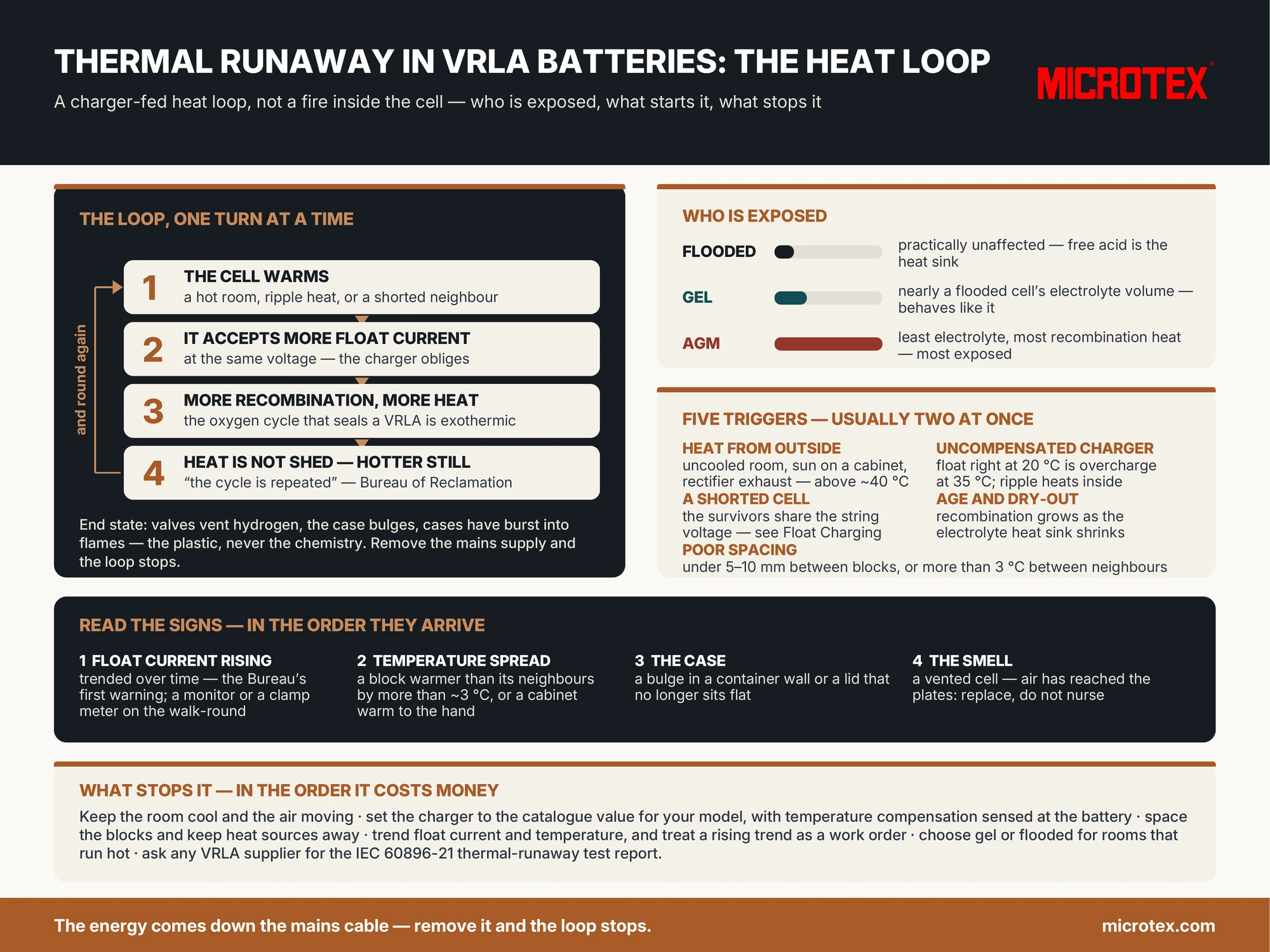
Start with a full VRLA battery on float. The US Bureau of Reclamation’s battery manual states the starting condition precisely: at full charge on float, no net chemical reaction occurs, and almost all the overcharge energy becomes heat. In a flooded cell that energy mostly splits water into hydrogen and oxygen, which leave through the vent and take the energy with them. In a valve-regulated cell the oxygen made at the positive plate crosses the separator and is recombined at the negative plate back into water — the trick that makes the battery “sealed” — and that recombination is exothermic. The German handbook works the numbers for a healthy cell: a vented cell on float dissipates a few hundredths of a watt per hundred ampere-hours; a valve-regulated cell with good recombination, several times that. Both are small, both are carried away by the air of a normal room, and the battery warms by less than a degree. So far, nothing is wrong.
Now warm the cell. A warmer lead-acid cell accepts more current at the same voltage — electrochemistry running faster, the rule our guide to Arrhenius’ theory describes for ageing. The charger is holding voltage, so it obliges: more float current flows. In a valve-regulated cell more current means more oxygen, more recombination, more heat. The Bureau describes the next turn exactly — the temperature rises, more current is required to hold the float voltage, the additional current makes more heat, and “the cycle is repeated”. If the room, the spacing and the cell’s own electrolyte can carry the extra heat away faster than it is made, the loop settles at a slightly warmer equilibrium and nothing happens. If they cannot, each turn is larger than the last. The end state the Bureau records plainly: valves venting hydrogen into the room, cases softening and bulging, and events in which the battery has burst into flames — the plastic case and its surroundings, not the chemistry, being what burns.
Why it is a VRLA problem, and mostly an AGM one
Linden gives the reason in a sentence: the electrolyte is the major internal heat sink in a cell, and VRLA cells have much less of it, so they are prone to thermal runaway under conditions that pose little hazard to flooded cells — particularly above about 40 °C. The German handbook ranks the three constructions. A flooded cell, with its large volume of free acid, is “practically” not affected. A gel cell holds nearly as much electrolyte as a flooded one and behaves much like it. An AGM cell has the least electrolyte, the poorest wetting of the container walls that would otherwise conduct heat out, and — because of the free gas space in its glass mat — the highest recombination rate and so the most heat. Under harsh conditions, meaning high ambient temperature, missing air-conditioning or a charger without temperature compensation, AGM batteries “tend more easily to thermal runaways”. That ranking is our whole AGM versus gel argument for hot countries, and it is why we recommend tubular gel, not AGM, for any room in the Gulf or the tropics that is not air-conditioned — we make both, and we would rather sell you the one that removes the mechanism.
What starts the loop
Every documented case has one of five triggers, and usually two. Heat from outside: a battery room without cooling, a cabinet in the sun, a cell beside a rectifier’s exhaust; the Bureau wants VRLA cells kept as close as possible to 25 °C, the hottest cell within about three degrees of ambient and the hottest-to-coldest spread inside about three degrees. A charger that does not compensate: a float voltage that is right at 20 °C is overcharge at 35 °C, because the cell’s own voltage falls as it warms; the Bureau lists temperature compensation as one of the two capabilities a VRLA charger must have, the other being filtering against the AC ripple that heats a cell from inside. A shorted cell: the charger holds the string voltage, so the survivors share it; our float-charging guide shows how three or four shorted cells drive the rest into the loop within hours, and why the rotten-egg smell of hydrogen sulphide is the alarm. Age and dryness: as a valve-regulated cell dries, its recombination grows more efficient and its heat sink smaller at once, which is why runaway is more often a late-life event. Poor spacing: the handbook asks for at least five millimetres between blocks, ten preferred, and no more than three degrees of temperature difference imposed by the surroundings — a packed cabinet defeats all of that.
How to see it coming
The loop announces itself, if anyone is reading. The first sign is float current: the Bureau’s rule is that a rising float current, trended over time, “could indicate potential thermal runaway”. A permanently installed monitor of the kind our guide to stationary battery monitoring describes measures exactly this; a clamp meter on the walk-round does too, if someone writes the number down. The second sign is temperature — a block warmer than its neighbours by more than the spread above, or a cabinet warm to the hand. The third is the case: a slight bulge in a container wall or a lid that no longer sits flat. By the time the fourth arrives — the smell of a vented cell — the string is already venting hydrogen and the Bureau’s instruction applies: once a valve has opened, air has reached the plates and the battery should be replaced, not nursed.
What stops it
Five things, in the order they cost money. Keep the room cool and the air moving — the handbook’s summary is that heat effects do not become critical when installation and ventilation follow the stationary-battery safety standard. Set the charger to the catalogue value for your model, with temperature compensation sensed at the battery, not at the charger. Space the blocks and keep heat sources away. Trend float current and temperature, and treat a rising trend as a work order. And choose the construction for the climate: where a room will run hot for weeks, a gel or flooded battery removes the mechanism rather than managing it. One question is worth asking any VRLA supplier before an order: the international test-method standard for valve-regulated stationary batteries, IEC 60896-21, contains a thermal-runaway sensitivity test — ask whether the model offered has been through it, and for the report.
Tell us the room temperature
We build tubular gel batteries for exactly the rooms where this loop is a risk, and flooded OPzS cells for the rooms where it is not worth managing at all. If you have a VRLA bank running warm — or a tender that specifies AGM for a 40 °C cabinet — tell us the room temperature, the charger settings and the age of the string, and we will tell you honestly whether the loop is a risk in your installation and what, in order of cost, closes it.
Sources quoted: U.S. Bureau of Reclamation, FIST Volume 3-6: Storage Battery Maintenance and Principles (April 2020); GNB Industrial Power (Exide Technologies), Handbook for Stationary Lead-Acid Batteries, Part 1: Basics, Design, Operation Modes and Applications, 6th ed. (February 2012).