
“Charged and dry” in a purchase specification can describe two different batteries, a dry-charged one and a moist-charged battery, and the difference decides how long it may wait and what the site must do. Both travel without acid, which is why buyers in hot climates and at the end of long sea routes ask for them. This post separates the two using Linden’s Handbook of Batteries, a Gulf national oil company’s published packing specification and two makers’ instructions. The procedure for your cells is your maker’s to give, and we state none of our own.
What the buyer’s document says
A packing specification published by a major Gulf national oil company, covering its lead-acid and nickel-cadmium batteries, says that batteries must be shipped charged and dry, without electrolyte, unless the item’s own description states otherwise. Batteries shipped wet, among which it lists maintenance-free, absorbed and gelled electrolyte types, are packed under different rules and carry corrosive hazard labels to the maritime and air transport regulations. The copy we read is dated May 2005, so verify the current revision, and the wording of your own purchase order, before relying on it. The document gives no reason. Ours is that a filled battery loses charge faster in heat, and a sea voyage followed by months in a site store is the worst case for it.
Dry-charged: formed, washed and dried
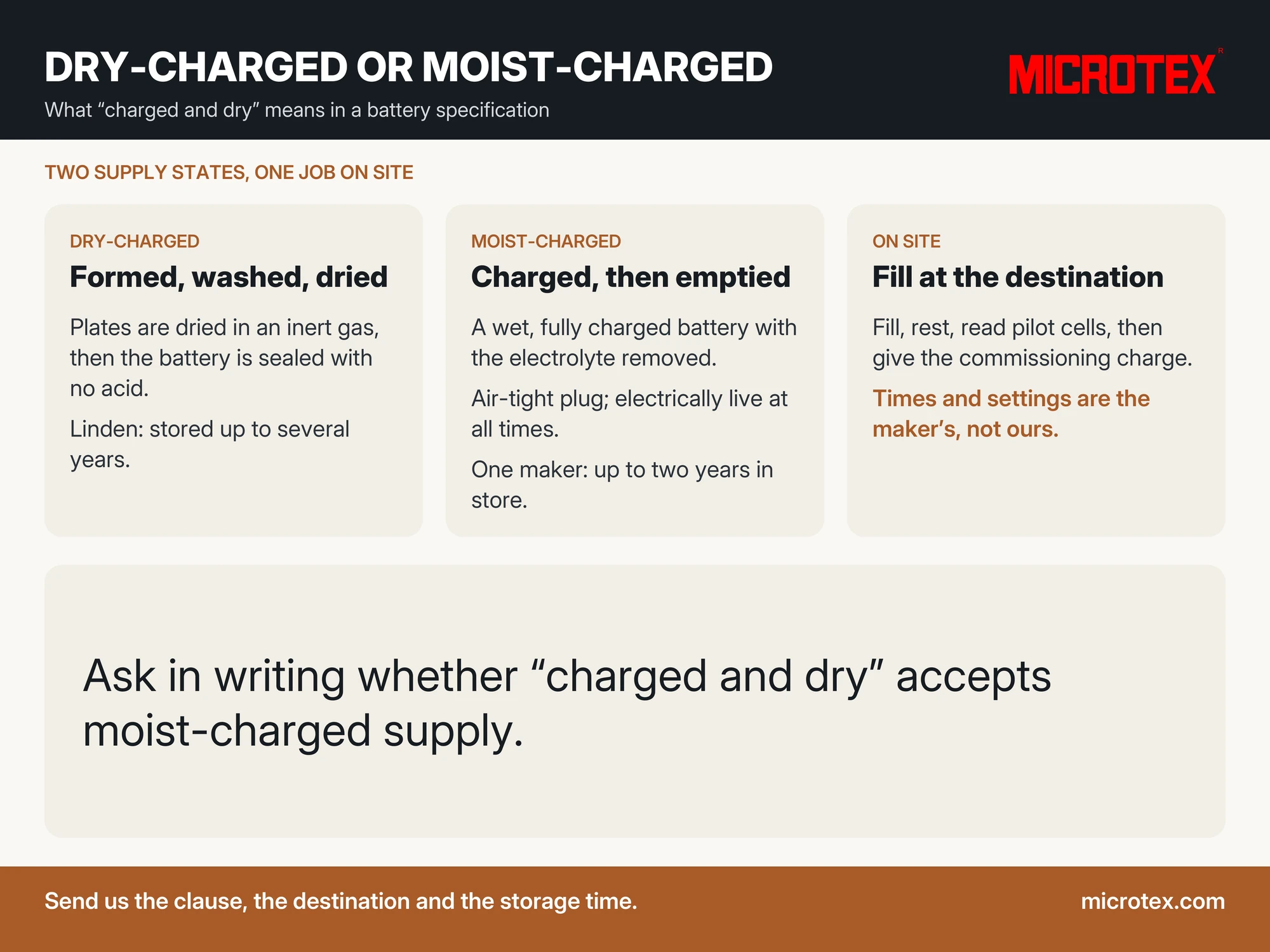
Linden describes the first route. The plates, or the welded element, are tank-formed, washed in water and dried in an inert gas, and the battery is then assembled and sealed with no acid in it. He says a battery in this state can be stored for up to several years before it is reactivated. Our guide to dry-charged batteries covers this route in full.
Moist-charged: filled, charged, then emptied
Linden also names a second state, “charged and moist”, and says several processes convert a wet, charged battery into a moist or semi-dry one, for example by removing most of the electrolyte in a centrifuge. One maker’s filling instruction for flooded stationary cells defines the result plainly: a moist-charged battery is a wet, fully charged battery that has had the electrolyte removed, closed for storage with a special air-tight plug. The same instruction warns that moist-charged batteries are active and electrically live at all times. It asks for a cool, dry and clean store, allows up to two years in those conditions, and adds that long or poor storage will increase the charge time.
How the two differ in practice
The plates of a dry-charged battery are dry. Those of a moist-charged battery are still damp with acid, so the cell is not inert, and that is why the air-tight plug matters. Linden notes that formed negative plates oxidise spontaneously in air; our reasoning from that is that a moist-charged cell with a lost or loosened plug is losing charge while it waits. On shelf life, Linden’s “several years” is a ceiling for the dry process. Two makers’ instructions for unfilled stationary cells give two years and 24 months. Those are their figures for their own cells, so take yours from your maker and count from the date on the label. Our guide to storing lead-acid batteries covers the store itself.
What the site must do
A German maker’s manual for vented stationary batteries says that unfilled batteries should not be filled until they have reached their final destination. After filling, it asks for an idle time, then a reading of electrolyte temperature and density in a few pilot cells, noted in the commissioning report. If the temperature has risen little and the density has fallen little, a simplified commissioning charge is enough; if the change is larger, an extended one is required. It explains why: extended storage, humidity and temperature swings reduce the charge state of the cells. The other maker’s instruction likewise sets a rest after filling, a limit on how soon the charge must start, and a full charge before service. We print none of those times or settings, because each belongs to one maker’s cells. Our guides to filling a lead-acid battery and to battery commissioning cover the practice.
Six things to settle in writing
First, ask whether “charged and dry” in the buyer’s document accepts moist-charged supply or only dry-charged, because the words alone do not say. Second, agree the storage limit, the date it is counted from and the store conditions. Third, agree who supplies the acid, to which purity standard and in what packaging; acid in drums is dangerous goods in its own right, as our guide to dangerous-goods status explains. Fourth, agree who fills and charges, and confirm that the site charger can deliver the commissioning charge. Fifth, agree the record: a commissioning report with pilot-cell readings. Sixth, agree when the warranty starts. The German manual states that service life begins with delivery from the plant and that storage time counts in full, so a battery that waits two years has used two years. Put the answers in the battery specification.
One honest limit: we have read the buyer’s packing specification, not its battery specification, so we make no statement about what that document requires.
Send us the clause, the destination and the storage time you expect and we will say which supply state we would offer and why.
Sources quoted: T. B. Reddy (ed.), Linden’s Handbook of Batteries, 4th ed. (McGraw-Hill, 2011), chapter 16, sections on formation and dry charge; a Gulf national oil company’s packing specification for batteries (May 2005 issue; verify the current revision); a maker’s filling and charging instruction for moist-charged flooded stationary batteries (June 2014); a German maker’s installation, commissioning and operating instructions for vented stationary lead-acid batteries (September 2015).