
More industrial batteries are ruined in their first month than in their first five years. Not dramatically — quietly, by a crate that sat in the sun through a project delay, a string torqued by feel, a first charge cut short because the site needed the power back, and a bank pressed into duty with no record of what “healthy” looked like. When such a battery disappoints in year two, everyone argues about year two; the sin lives in week one. Our published post-mortem method starts at history for exactly this reason. Commissioning is how you give a battery a history worth reading — and it is a checklist, not an art. Here is the whole of it.
Receiving day: the battery’s customs check
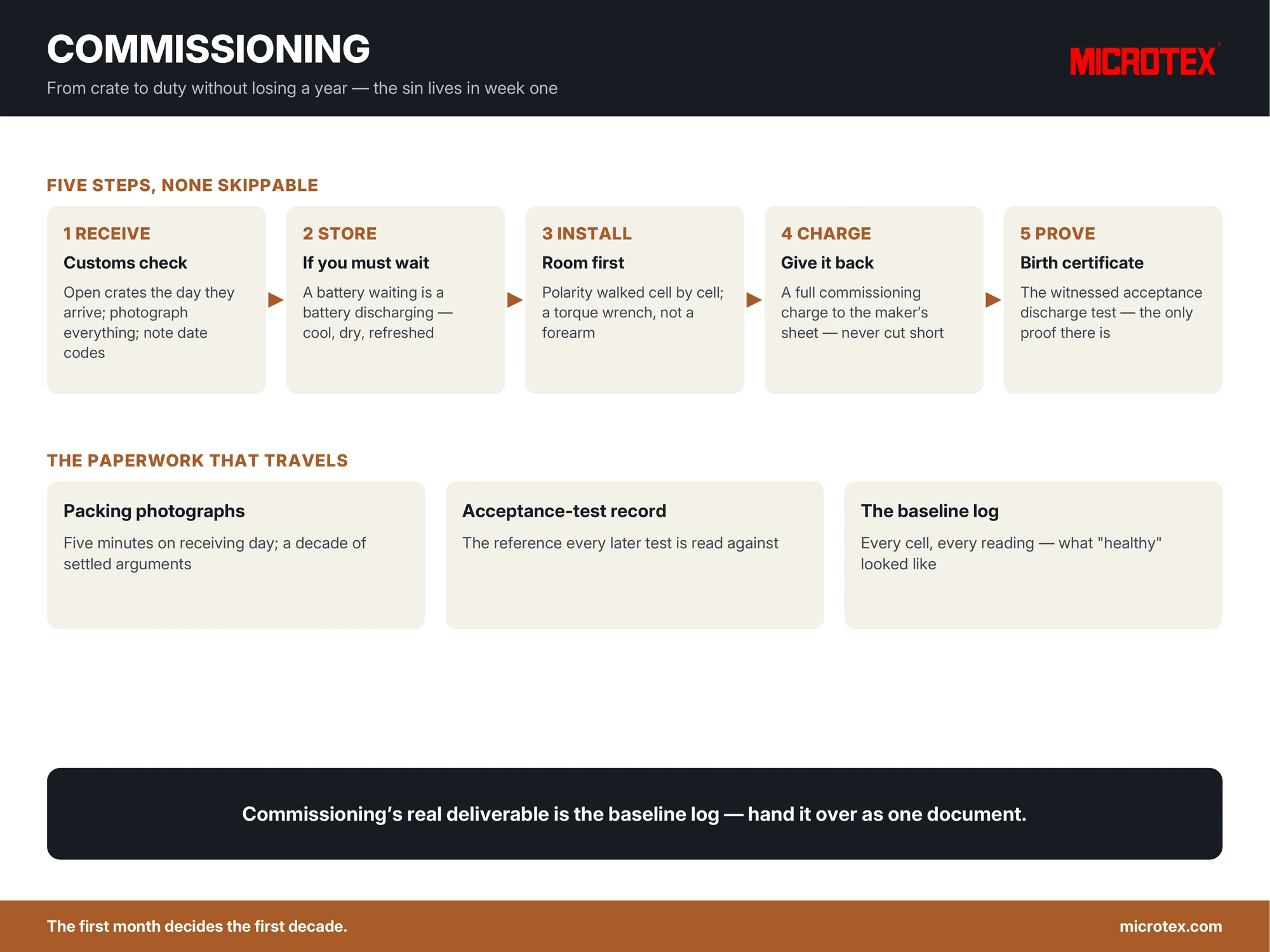
Open the crates the day they arrive, not the day the panel is ready. Check the delivery against the packing list cell by cell — type, count, date codes, accessories — and inspect for transit injury: cracked jars, weeping seals, bent posts, upset vent plugs. Note whether you have received filled-and-charged cells or dry-charged ones, because everything downstream forks on that distinction; our guide to shipping lead-acid batteries explains the classes and the receiving ritual in detail. Then the step everyone skips: if installation is not imminent, storage becomes a duty of its own. A battery waiting is a battery discharging — self-discharge never pauses — so waiting stock needs a cool, dry, ventilated home and, if the wait stretches on, the refreshing charge your maker’s manual prescribes. Photograph everything on arrival, and record the date codes while you are at it: a battery has been ageing since the day it was made, not the day it reached you, and the age you accept at commissioning is part of the bargain you are striking. The record costs five minutes and settles arguments for a decade.
Installation: the room first, then the metal
A bank should move into a finished room, not camp on a building site — ventilation running, temperature sensible, access clear, exactly as our battery room design guide lays out. Then the mechanical liturgy: stands level and earthed where specified; cells spaced per the drawing; polarity walked and verified cell by cell before any connector lands (a reversed cell found by walk-through costs a minute; found by smoke, a bank); and every connection torqued to the maker’s figure with a torque wrench, not a forearm — under-torqued joints become the warm lugs every walk-round hunts, and over-torqued ones crack posts. Strings and parallel groups follow the disciplines in our series and parallel guide. None of this needs genius; all of it needs the drawing, the manual and an unhurried afternoon.
The first charge and the birth certificate
Dry-charged cells are filled and given their first charge by the ritual our filling guide owns — readings-based endpoints, no clock-watching. Filled-and-charged cells still receive a proper commissioning charge to the maker’s sheet before anyone judges them: transit and storage have taken something, and the first duty of commissioning is to give it back fully. Cut this charge short and you build the bank’s whole service life on an underfilled foundation. When the charge is done, let the bank rest and take the string and per-cell voltages once more — a string that will not settle level after its commissioning charge is raising its hand early, while the supplier is still in the room. Then comes the step that separates professional installations from hopeful ones: the acceptance discharge test — a controlled discharge against the specified duty, witnessed, recorded. It is the only proof of capacity there is, as our battery testing guide is blunt about, and it is the bank’s birth certificate: the reference every later test is read against. We welcome acceptance tests on our own batteries; a supplier who discourages one is answering a question you haven’t asked yet.
The baseline log: commissioning’s real deliverable
Before the bank enters service, take one full, unhurried set of readings — every cell voltage, the gravities where the construction allows, connection checks, temperatures, charger settings as left and — where the charger or monitoring system allows — the alarm thresholds confirmed against the values the design actually assumed; and write them into the log book that the maintenance walk-round will keep for the rest of the battery’s life. This baseline is the commissioning’s true deliverable: without it, every future reading floats free of context; with it, “cell seven is three points down” becomes a sentence with a subject. File the acceptance-test record, the packing photographs and the baseline together, and hand them over as one document. If you are commissioning a bank now and want a second pair of eyes on the sequence — or want us present for the acceptance test on our own product — talk to our engineers before the first connector goes on, not after the first argument.