
Curing is the quiet step between pasting a plate and charging it for the first time, and a plate that is under-cured carries the fault into the finished battery: lower early capacity, material that flakes off, and a cell that discharges itself on the way to the customer. This post explains what curing does and how a maker keeps it under control. The methods are the general ones from the two references at the foot of the page. Our own schedule is not printed here, and the principal paper dates from 1990, so treat the details as principles rather than settings.
What curing is for
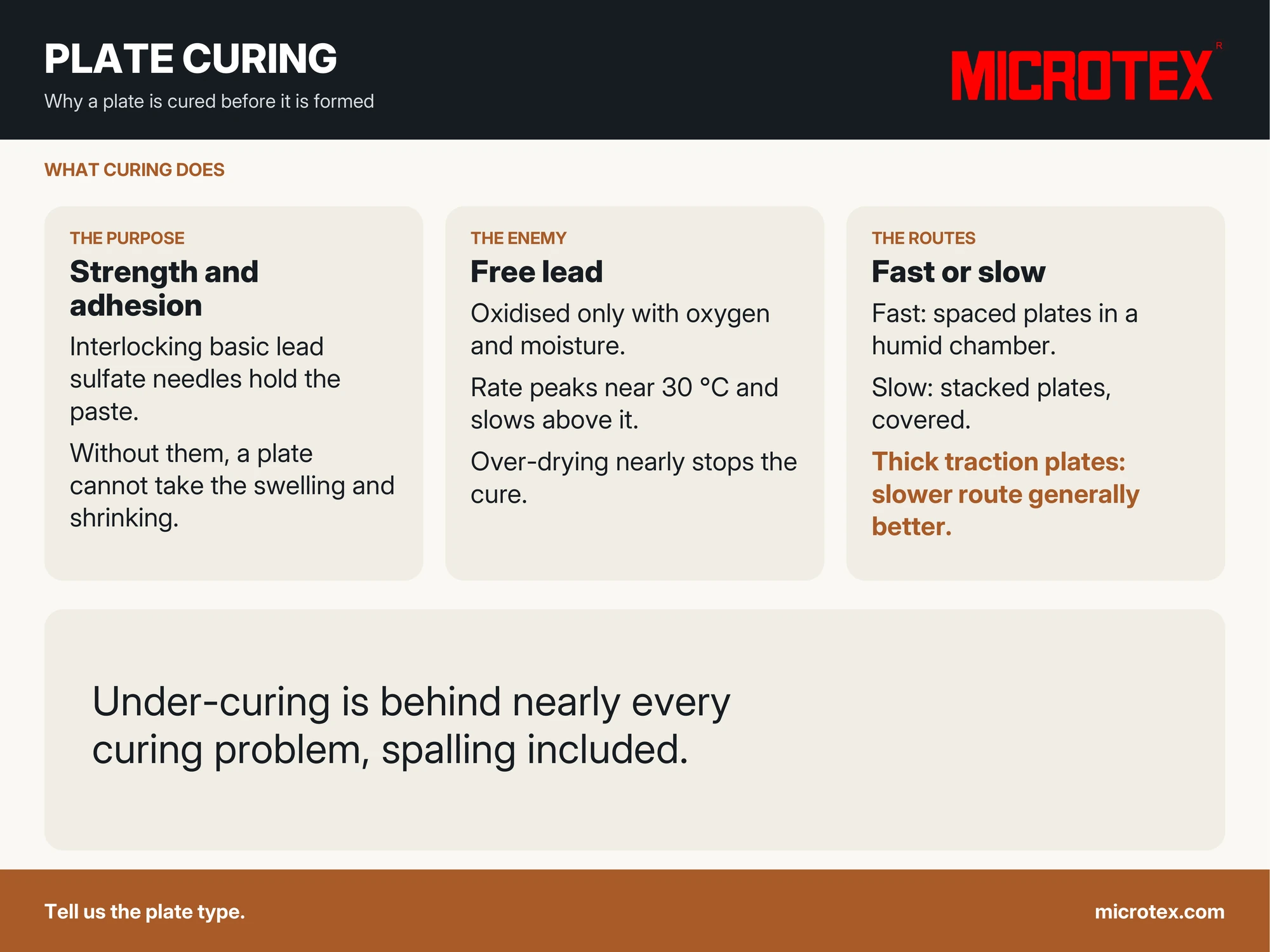
Curing gives the active material its strength and its adhesion to the grid before formation, and the material keeps both afterwards. A cured plate holds lead sulfate and the basic lead sulfates; the tribasic and tetrabasic forms grow as needle-shaped crystals that interlock, and those needles provide the main strength of the positive material. Without that structure the plate cannot take the swelling and shrinking of every discharge and charge. Our guide to lead oxide and battery paste describes the paste; curing comes straight after it.
The enemy is free lead
Fresh paste still holds a good deal of metallic lead left over from the oxide. Unless it is oxidised during curing, that lead stays dense and inactive. In a positive plate, turning metallic lead into lead dioxide takes more ampere-hours than converting oxide, so formation may be incomplete and early capacity lower. For traction cells, which must give their rated capacity early in life, that cannot always be tolerated.
Moisture, air and temperature
Free lead is oxidised only where oxygen and moisture are both present. Air is plentiful, so moisture is the control. The reaction runs fastest over a narrow band of moisture and falls away sharply outside it, and it peaks near 30 °C and slows as the plate gets hotter; these are the findings of L. Prout’s paper on plate curing in the Journal of Power Sources, the fullest treatment of the subject on our shelf. A plate dried too hard in the oven before curing loses the moisture it needs, and the cure nearly stops.
Fast cure and slow cure
Two practical routes are in use. In fast curing, plates leave the drying oven spaced apart and go to a warm, humid chamber. In slow curing, plates are stacked in contact so that the heat of the reaction and the plates’ own moisture do the work, usually under a cover that holds both in. Excellent plates come from either method, and for traction plates thicker than 3.5 mm the slower route generally gives the better cure. Thick plates take longer, so the time is found by testing samples, not by copying a thin-plate schedule.
How under-curing shows up
Nearly every curing problem traces back to under-curing: plates released early because nobody was tracking them, an oven run too hot, plates left to cool before they were covered. Spalling, where the positive material flakes off in formation, is the classic sign, and in container-formed cells it can stay hidden and become the customer’s problem. A plate that leaves the cure with too much free lead also goes on reacting inside the finished cell: it discharges itself while the battery waits for delivery, and a cell that stands partly discharged is on the road to sulfation. For control, most makers accept free lead of not more than 4 per cent by weight in bulk production, found by sampling plates, because chasing a lower figure stretches the cure and upsets production.
Checking a cure
Free-lead analysis is not always to hand, so a rough visual test for positives is worth knowing: scrape away the top layer and compare it with the material beneath. If the colour is substantially the same, the cure is probably complete. If the layer underneath is greenish while the top is yellow or orange, the cure has almost certainly stopped. Negatives cannot be judged by eye, because the carbon and expanders colour the material, and only chemical analysis is reliable there.
Curing in hot climates
Where the air is hot, covers over curing plates need frequent wetting to replace the moisture that evaporates, and shallow tunnels lined with plastic sheeting are another way to hold the water vapour that the reaction itself gives off. The principle is the same everywhere: keep the plate warm and damp for long enough, then dry it in a controlled way. A cure cannot be rushed in any season.
Tubular plates need it too
Curing tubular positives is seldom discussed, but it matters just as much. With red lead filling there is virtually no free lead and no separate cure; with oxide-rich blends some remains, and in a container-formed cell it promotes self-discharge and a rise in temperature. A reasonable target is below 4 per cent free lead. Compare the plate types in our guides to flat and tubular plates and tubular gel and flooded batteries.
What a buyer can ask
Ask how plates are identified through the cure, what the minimum cure time is for your plate thickness and who may release a rack. A maker that tracks cure by label and sample is controlling the step; one that cannot answer is guessing. Our guide to battery formation explains the stage that follows. For a tender, put the question in writing. Tell us the plate type and we will answer for the plates in your cell.
Sources quoted: L. Prout, “Aspects of lead/acid battery technology 3. Plate curing”, Journal of Power Sources 41 (1993) 185–193; T. B. Reddy (ed.), Linden’s Handbook of Batteries, 4th ed. (McGraw-Hill, 2011), chapter 16, section on curing.