
A lead-acid battery loses charge while it does nothing, and how fast depends far more on its grid alloy, its temperature and its age than on its badge. This post explains why, what the general rates look like and what a store should do about it. The rates are the general figures printed in the two references at the foot of the page; for any battery you own, the maker’s datasheet governs.
Why a resting cell discharges
Lead and lead dioxide are not stable in sulfuric acid. Left on open circuit they react slowly with the electrolyte, giving off oxygen at the positive plate and hydrogen at the negative, and the stored charge goes with the gas. Self-discharge is simply the energy a battery loses other than into an external circuit. Every battery has it, the rate depends on the battery type, its state of charge and its temperature, and it rises with temperature and falls as the state of charge falls.
The antimony effect
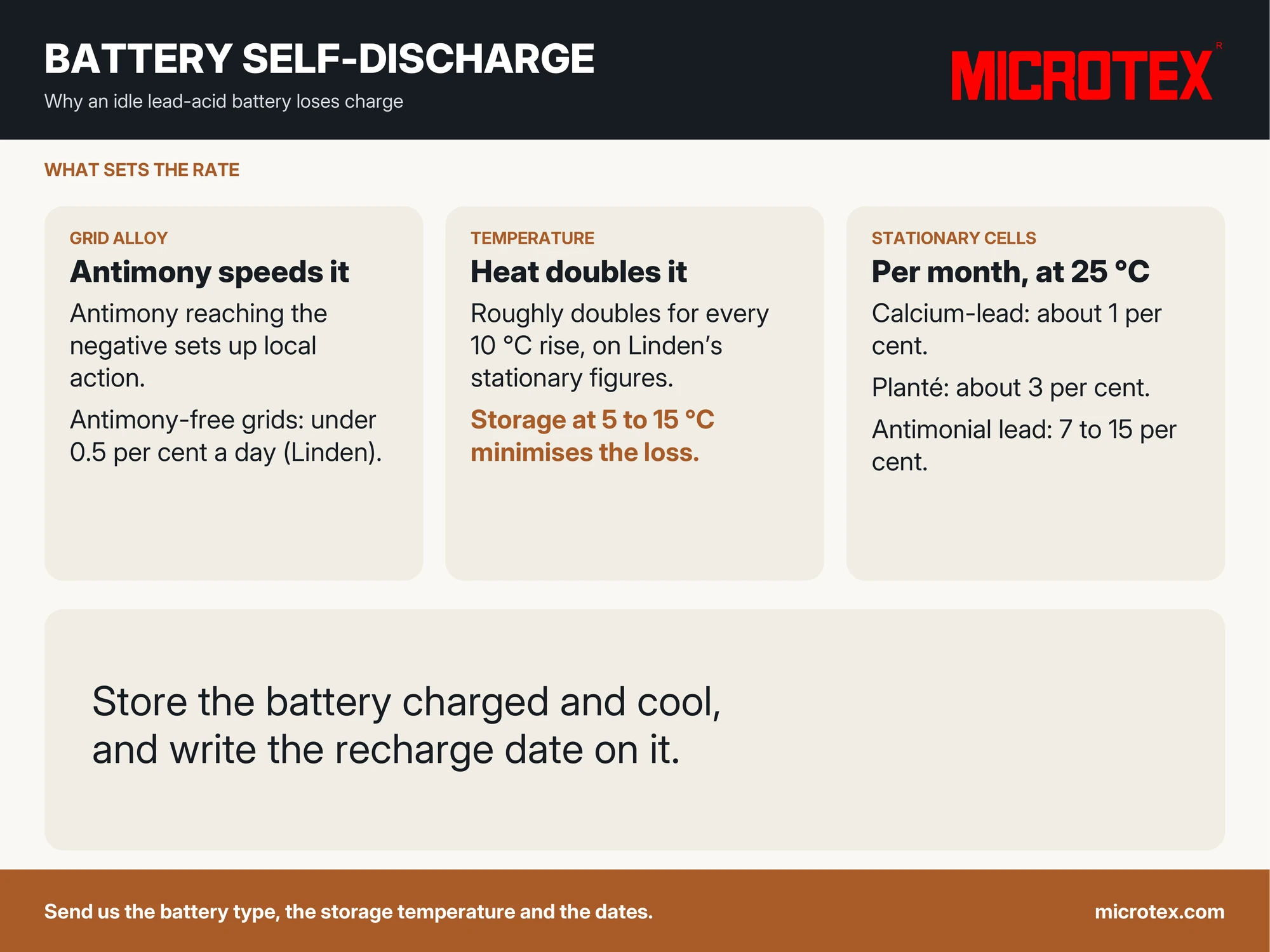
The grid alloy makes the largest difference. The positive plate’s own self-discharge is slow, typically well under 0.5 per cent a day at 25 °C. The negative is faster, especially once metal ions have got in. Antimony lost from the positive grids by corrosion can reach the negative and set up a small local discharge cell there. On the figures in Linden’s handbook, a new lead-antimony battery loses about 1 per cent of its charge a day at 25 °C and the loss grows by a factor of two to five as it ages, while a battery with antimony-free grids loses less than 0.5 per cent a day whatever its age. Antimony brings benefits too, which is why it is still used; our guide to antimony in lead-acid batteries covers the trade-off.
Stationary cells and float current
For stationary batteries the comparison between fully charged cells at 25 °C runs about 1 per cent a month for calcium-lead positives, about 3 per cent for Planté and 7 to 15 per cent for antimonial-lead positives. The practical measure of self-discharge in a battery room is the float current a cell draws: lowest for calcium-lead, higher for antimonial designs, and rising with age. The current that makes good the self-discharge is part of what the charger must supply on float, which is the link to our guide to float charging. If an antimonial cell’s float current is not raised periodically, it becomes progressively self-discharged and sulfated.
Heat doubles it
The stationary self-discharge rate roughly doubles for every 10 °C rise in temperature, and storing batteries at 5 to 15 °C keeps the loss lowest. The consequence for a hot store, or a hot battery room, follows directly: the battery loses its charge faster and then sits partly discharged, which is the condition that favours sulfation. Our guide to sulfation explains what that does to a plate.
Sealed cells
A sealed prismatic lead-acid battery loses relatively little capacity in storage compared with a conventional antimonial-grid battery. For one such product the published rate is about 4 per cent a month, with recharging advised once it has fallen to roughly half charge. The self-discharge of a valve-regulated cell is not linear, because it changes with the state of charge, so treat that 4 per cent as one product’s figure, not a rule for valve-regulated batteries in general.
A fault the maker controls
There is one cause the user cannot influence. If a filled tubular plate keeps too much free lead after curing, a fresh charged cell can self-discharge noticeably while it waits for delivery, and the reaction can warm the cell. A reasonable manufacturing target is a free-lead level below about 4 per cent by weight; the control is set out in our guide to plate curing, and it is not something to fix in the field.
Storage requirements for lead-acid batteries: what to do on the shelf
A stored battery must be recharged at regular intervals, and the interval depends on the battery type and the store temperature. No single interval is printed in the references and we will not invent one; ask the maker for the figure for your type. The loss is most easily seen as a fall in open-circuit voltage or specific gravity, so a log of both turns self-discharge from a guess into a trend. Our guide to storing lead-acid batteries has the routine and our specific gravity chart the readings to compare against.
| Storage requirement | What to do |
|---|---|
| Temperature | Store charged, cool and dry. A store at 5 to 15 °C keeps the loss lowest; every 10 °C warmer roughly doubles it. |
| Recharge interval | Recharge at the interval the maker gives for your type and your store temperature, and sooner if the readings below are falling. |
| What to record | The date in, each reading of open-circuit voltage and specific gravity, and the date of every recharge, written on the battery and in a log. |
When it is a symptom
A cell that sags noticeably faster than its neighbours in the same string, in the same room, is not showing normal self-discharge; look for contamination, a short or a wet top. Send us the battery type, the storage temperature and the dates with the readings and we will say whether they look normal.
Sources quoted: T. B. Reddy (ed.), Linden’s Handbook of Batteries, 4th ed. (McGraw-Hill, 2011), chapter 16, sections on self-discharge and stationary batteries, and chapter 17 on sealed cells; Handbook for Stationary Lead-Acid Batteries, Part 1, 3rd ed. (December 2008), sections on self-discharge and charging; L. Prout, “Aspects of lead/acid battery technology 3. Plate curing”, Journal of Power Sources 41 (1993) 185–193.