
A deep discharge is not just a very flat battery: it is a discharge past the point the maker set for that load, and it can leave damage that recharging does not undo. This post explains the final discharge voltage, why it is not one number, and what happens beyond it. The voltages quoted are as printed in the two references at the foot of the page; your catalogue gives the figure for your cell and your load.
Final voltage, end voltage, cut-off voltage: three names, one setting
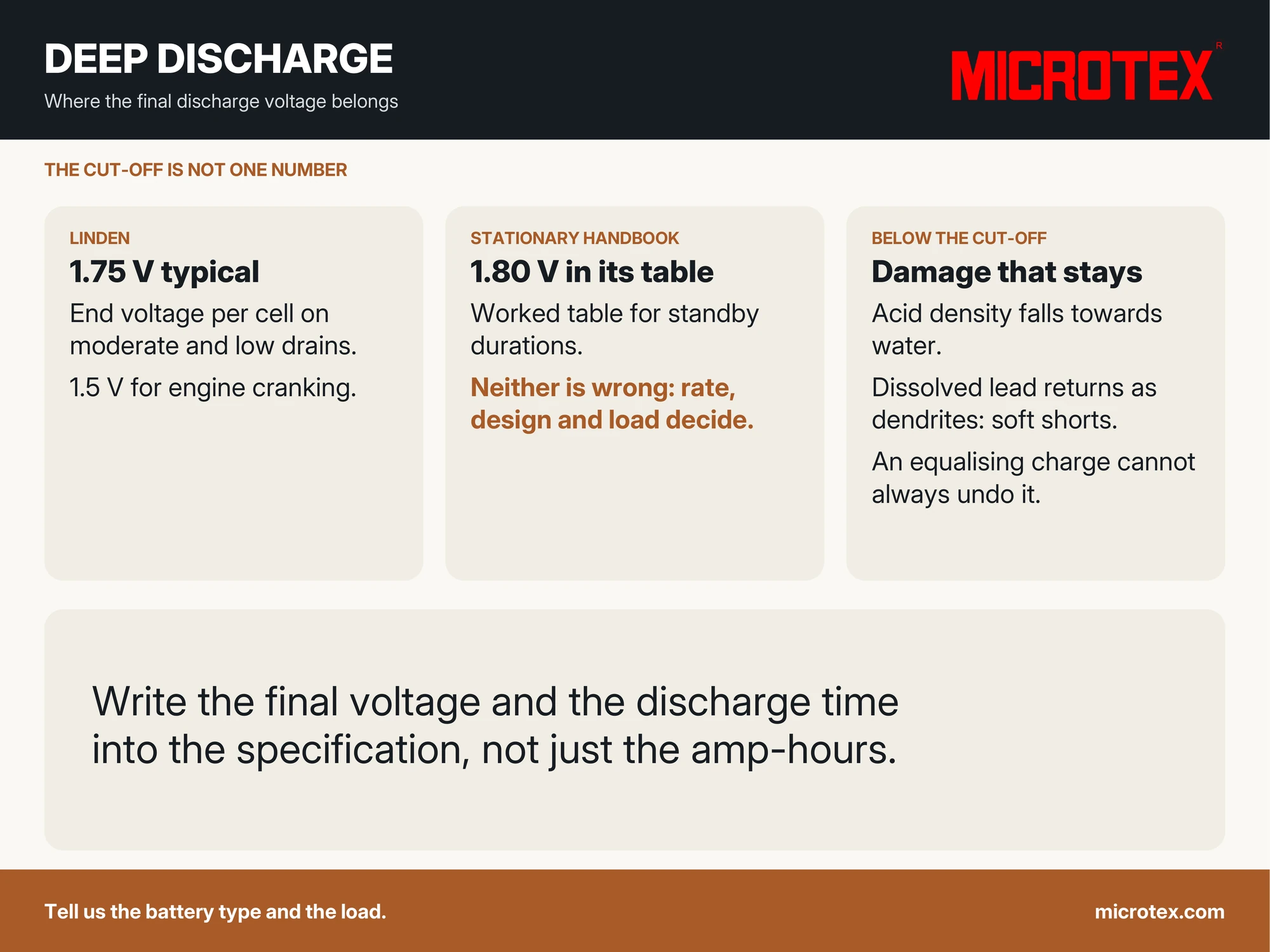
The three terms mean the same thing: the voltage designated as the end of a discharge, usually the point above which most of the capacity has been delivered, and it may depend on the application. For the lead-acid cell Linden’s handbook gives a nominal 2.0 volts, a working range of 1.8 to 2.0, and an end voltage of typically 1.75 on moderate and low-drain discharges and 1.5 for engine cranking. Rated capacity is always the capacity delivered down to a permissible final voltage at a stated rate, for example the one-, three- or five-hour rate. That is why one battery has several capacities, and why our guide to reading a battery datasheet tells you to read the rate and the end voltage together.
Why it is not one number
The two references do not use the same figure, and that is the lesson. The stationary handbook’s worked table for standby durations uses an end-of-discharge criterion of 1.80 volts per cell for the ranges it lists, while the typical value for moderate and low drains quoted above is 1.75. Neither is wrong. The end voltage belongs to the discharge rate, the cell design and the load that has to be supported, and a sizing calculation that borrows another battery’s figure is wrong from the start. See our guide to battery sizing.
What happens below it
A deep discharge is a discharge below the final voltage fixed for the load, and a discharge beyond the nominal capacity is treated as critical. Small currents count too: the reverse current of a switched-off charger, or the drain of monitoring equipment on an installation that is switched off. As lead sulfate forms, the acid concentration falls sharply and the density approaches that of water, which is why the specific gravity reading is the honest witness of a flat cell. In that dilute acid, lead sulfate becomes more soluble, and the dissolved lead returns on recharge as dendrites that can cause soft shorts.
Damage that does not reverse
The consequences of a deep discharge cannot always be reversed by an equalising charge, especially once soft shorts have formed, and the result is mostly a permanent loss of capacity. If a discharged battery is then left for days or weeks, the sulfate recrystallises into a coarse form that behaves as an insulator and makes recharging difficult or impossible. Our guides to sulfation and equalising charge cover the plate and the charge.
The dip at the start
One more caution on setting a cut-off. At the very start of a discharge from a fully charged lead-acid cell there is a dip in voltage, known as the voltage sack or, in the French term, the coup de fouet, caused by the delay in forming the first lead sulfate crystals; it has passed after about a tenth of the discharge time. A cut-off or an alarm that reads the first minutes of a heavy discharge can therefore trip on the dip and not on a flat battery, so ask how your disconnect treats the start.
Gel and absorbed-glass cells differ
In a gel battery the excess of electrolyte keeps the acid density from falling as far in a deep discharge as it does in an absorbed-glass battery, so the tendency to soft shorts is lower, and a microporous separator also resists the formation of shorts. Gel is not immune. Our comparison of AGM and gel batteries sets out the other differences.
How the standards test it
The IEC 60896 series and IEC 61056 contain deep-discharge tests in which the battery is discharged through a resistor for 7 to 30 days, recharged for 48 hours, and must then show at least 75 to 95 per cent of its capacity, depending on the standard. This is the stationary handbook’s 2008 account of those tests; please check the current edition of any standard before relying on it.
What to do about the cut-off
Write the final voltage and the discharge time into the specification, not just the ampere-hours. Set any low-voltage disconnect to the maker’s figure for your load, and set it against the cell’s state of charge, not against a borrowed number. Recharge soon after any deep discharge, and never leave a discharged battery standing. Check that a switched-off charger or a monitor is not slowly draining the bank; our guide to depth of discharge and cycle life shows the depth-of-discharge side of life. Tell us the battery type and the load and we will give you the end voltage for your cell.
Sources quoted: T. B. Reddy (ed.), Linden’s Handbook of Batteries, 4th ed. (McGraw-Hill, 2011), chapter 3 on discharge terms and the lead-acid cell voltages; Handbook for Stationary Lead-Acid Batteries, Part 1, 3rd ed. (December 2008), sections on discharging, deep discharge, sulfation and the end-of-discharge voltage table.