
Forklift battery sizing is a sum you can finish yourself before you ask anyone for a price. The truck has fixed the voltage, the space and the weight already. One question is left: will the biggest battery the truck accepts still be working at the last pallet? This guide works that sum backwards from a nameplate, checks it on a truck at work, and stretches it to a longer day.
What the truck has already settled
System voltage, battery space and battery weight belong to the truck, not to the buyer. Our guide to reach truck, stacker and pallet truck batteries explains how the compartment narrows the choice, and replacing a forklift battery shows where each figure is read on the truck. That leaves one figure open, the ampere-hours.
Turn ampere-hours into the energy of a shift
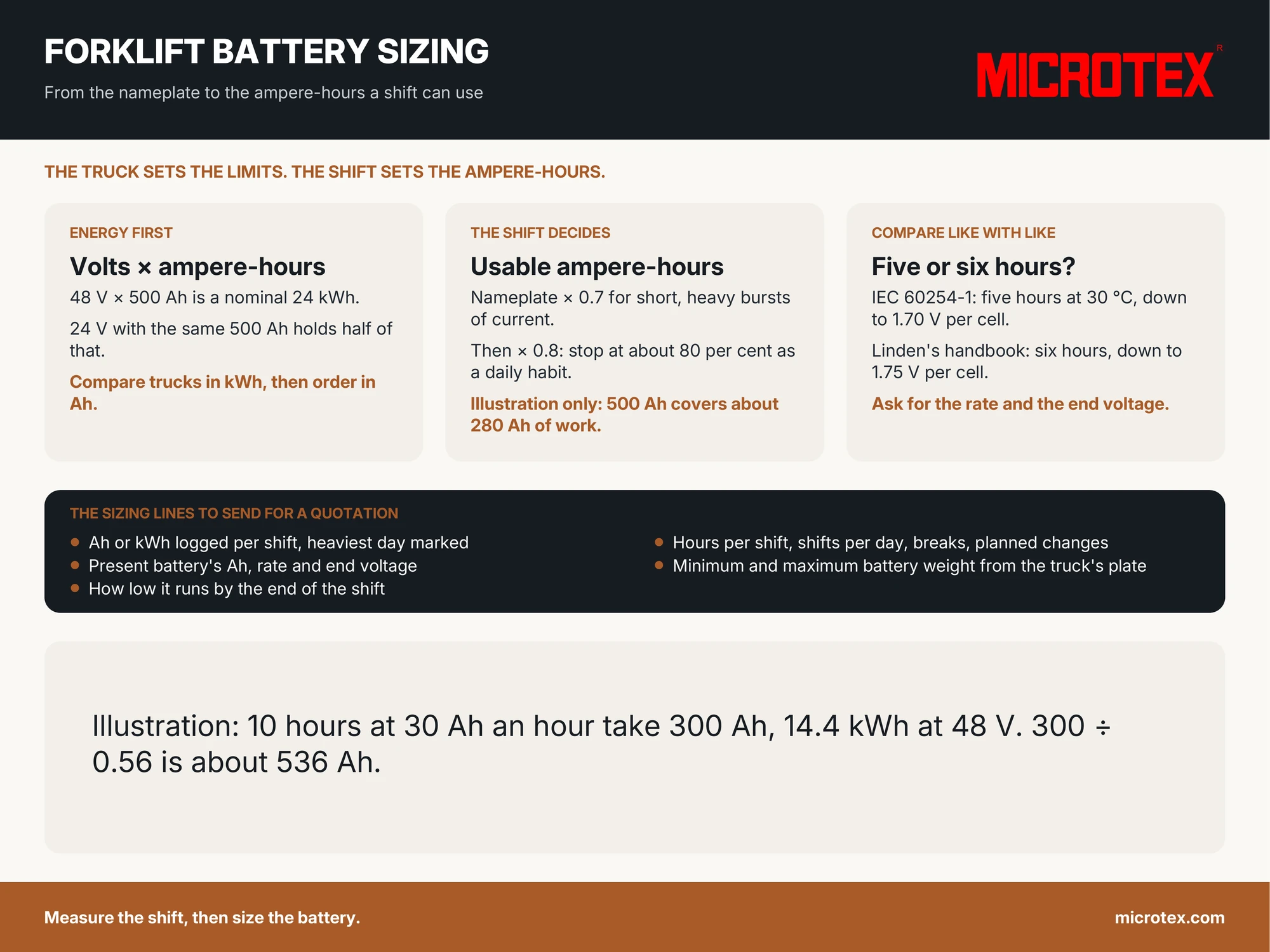
Ampere-hours alone do not tell you how much work a battery holds. Multiply them by the voltage and the answer is in watt-hours, which is energy. A 48 V battery of 500 Ah holds a nominal 24 kWh. A 24 V battery with the same 500 Ah on its plate holds half of that. So compare trucks of different voltages in kilowatt-hours, and divide by the voltage to return to ampere-hours before you open a cell table.
The same step carries a duty from one truck to another. A shift that takes 11.5 kWh is 240 Ah on a 48 V truck and 144 Ah on an 80 V one.
How much of the nameplate a shift can use
Not all of it. Our warehouse truck guide, linked above, gives Crompton’s two divisions, from the ampere-hours the motors draw up to the battery to order. Here the sum runs the other way, because the compartment has usually fixed the largest battery and you want to know what it can do. Multiply the nameplate by 0.7, for current taken in short, heavy bursts, and by 0.8, so that the daily discharge ends at about 80 per cent. Together that is 0.56. As an illustration only, a 500 Ah battery covers a shift in which the motors draw about 280 Ah. At 48 V that is roughly 13.4 kWh of a nominal 24 kWh.
The 80 per cent line is not caution for its own sake. Work has a way of becoming heavier than the first estimate, and a battery some years old gives a little less than it gave when new. A sum that spends every ampere-hour on day one leaves room for neither. Deeper daily discharge also shortens the battery’s life; our guide to cycle life and depth of discharge shows how steep that trade is. Spare capacity buys shallower cycling, longer life and a reserve for the heavy day, and it costs money, weight and space. So when two sizes fit and you are unsure, take the larger, in our view.
Five-hour or six-hour ampere-hours
An ampere-hour figure needs two more facts: how fast the cell was discharged and the voltage at which the test stopped. Our forklift battery price guide explains why the rate belongs beside the figure. For sizing, the end voltage matters too. Under IEC 60254-1 the maker’s nominal capacity is a five-hour figure at 30 °C, with the discharge stopped at 1.70 V per cell. Linden’s Handbook of Batteries, an American reference, describes industrial truck batteries as generally rated over six hours and stopped at 1.75 V per cell. One test runs more slowly and the other stops sooner, so the two numbers for one cell are not interchangeable. The 0.56 sum ends in a five-hour capacity, so run it on a five-hour figure. Ours are five-hour figures at 30 °C. Ask every bidder for both, and confirm which edition of a standard is current before you cite it in an order.
Check your forklift battery sizing on a working truck
A calculation is an estimate. A truck already doing the job is the measurement. Put an ampere-hour meter on it and log a week of ordinary shifts. Note what each shift took and mark the heaviest day, because that is the day to size for. Failing a meter, the fall in the electrolyte’s specific gravity by the end of the shift tells a rougher version of the same story. If the truck cannot finish its work, the battery is too small for the duty or is close to the end of its life.
A longer working day, worked in kilowatt-hours
Here is the method on one case, as an illustration only. The week’s log on a 48 V truck shows 240 Ah on the heaviest eight-hour shift. That is about 11.5 kWh, or 30 Ah for every hour worked. The 500 Ah battery on the truck covers 280 Ah by the sum above, so today there is room to spare.
Now the day is to grow to ten hours at the same pace. Ten hours take 300 Ah, about 14.4 kWh. Divide 300 by 0.56 and the battery wanted is about 536 Ah. The 500 Ah battery falls 20 Ah short, and at 30 Ah an hour that is the last forty minutes of the day.
The wrong answer is to run the battery deeper every day and accept it. There are three sound ones. The first is the next size up, if the compartment and the truck’s maximum battery weight allow it. The second is another battery and a changeover, which our guide to the spare battery ratio works out. The third is a planned charging break. Whichever you choose, the charger has to suit the new ampere-hours; choosing a forklift battery charger explains how. If your trucks work round the clock on short pauses of charge, tell us. We think lithium often fits that duty better, and we will say so.
The sizing lines to send for a quotation
- The ampere-hours or kilowatt-hours logged per shift, with the heaviest day marked, if you have a meter.
- The ampere-hours on the present battery’s plate, with the rate and the end voltage if they are shown.
- How low that battery runs by the end of the shift: the specific gravity or the discharge indicator reading.
- Hours worked per shift, shifts per day, the breaks, and any change you are planning.
- The least and the most the battery may weigh, from the truck’s plate or manual.
The remaining lines of an enquiry, the truck, the compartment, the connector and the charger, are listed in the warehouse truck guide. Send what you have, complete or partial, through our contact page. We answer within the working day. Our forklift battery range runs from 24 V to 80 V and from 42 to 1550 Ah at the five-hour rate, and each quotation gives the filled weight to set against the truck’s plate.
Sources quoted: T. R. Crompton, Battery Reference Book, 3rd ed. (Newnes, 2000), sections 18.1 and 32.2.1 on motive power battery capacity and selection; T. B. Reddy (ed.), Linden’s Handbook of Batteries, 4th ed. (McGraw-Hill, 2011), chapter 16, sections on deep-cycle and traction batteries and on their maintenance; R. M. Dell and D. A. J. Rand, Understanding Batteries (Royal Society of Chemistry, 2001), chapter 3, section 3.6 on battery life; International Electrotechnical Commission, IEC 60254-1 (edition 4.0, 2005), Lead-acid traction batteries, Part 1, adopted in India as IS 5154 (Part 1):2013 (Bureau of Indian Standards), rating basis described in our own words. Check the current edition of each standard.