
Fleet managers size the trucks carefully and then treat the battery as whatever came in the box with it — and for anything busier than a single shift, that is the wrong way round. A battery fleet has its own capacity-planning problem, separate from the truck count: how many packs you need, how big the charging bay has to be, and how much of your working capital is sitting in lead on a shelf rather than moving goods. Get the ratio wrong in one direction and trucks queue for a charged battery while goods wait on the dock. Get it wrong in the other and you have bought batteries you barely use.
The 8-8-8 rule of thumb
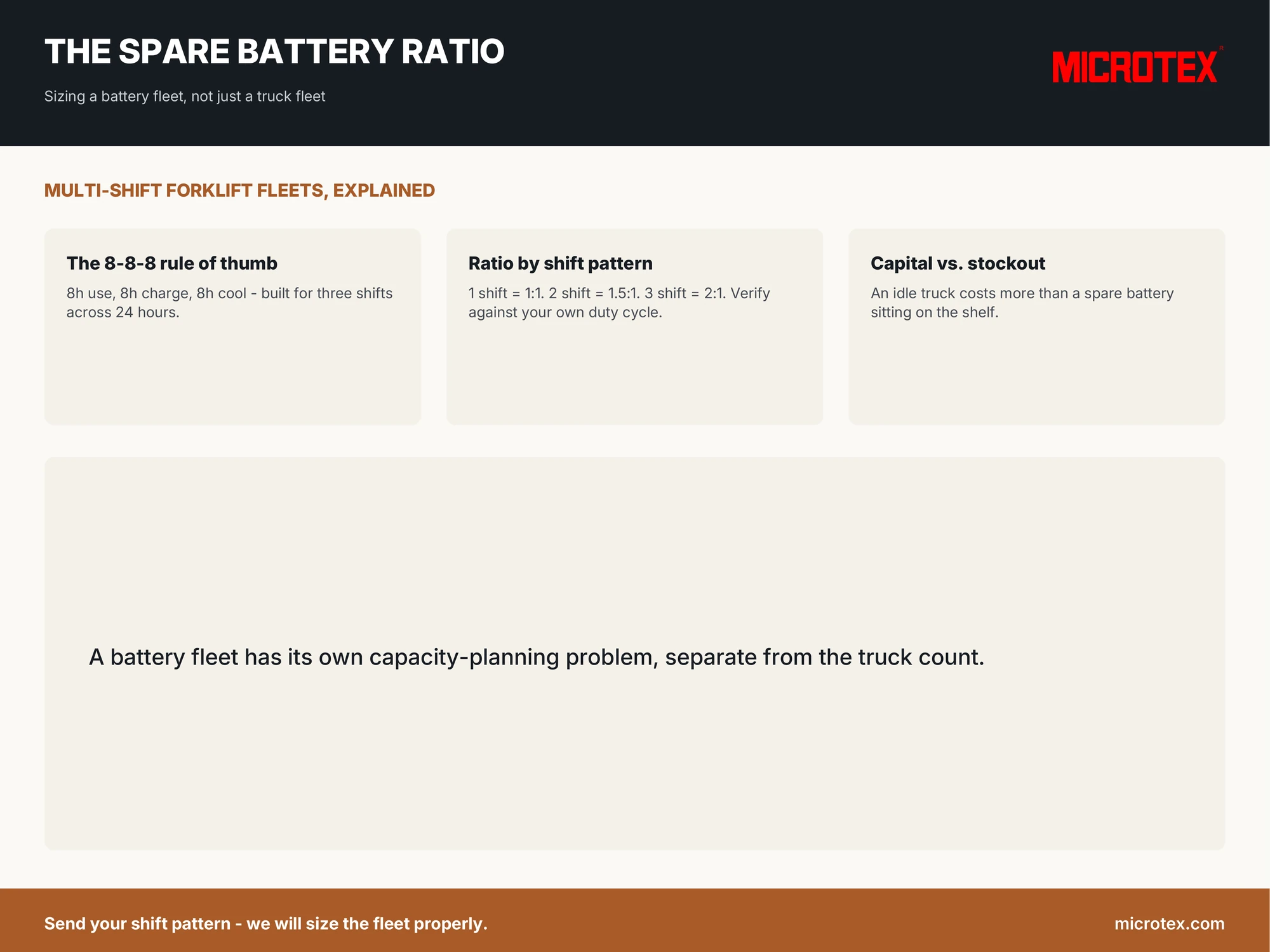
The traction-battery trade has repeated the same rule of thumb for decades, and it is a genuinely useful starting point precisely because it is simple: eight hours of use, eight hours of conventional charging, and eight hours of rest to cool down before the battery goes back to work — a neat fit against three eight-hour shifts in a twenty-four-hour day. The cooling stage is not superstition. A battery straight off charge is warmer than one that has stood, and our guide to positive grid corrosion covers why that matters beyond simple performance: the corrosion reaction that eventually ends every lead-acid grid runs faster at a higher plate potential and, generally, at a higher temperature, so a battery that never gets its rest period is a battery whose grid is ageing on borrowed time, cycle after cycle, whether or not anyone notices for years.
What it means for the spare count
A single-shift operation, running roughly eight hours out of twenty-four, has sixteen spare hours to charge and cool one battery per truck — the 8-8-8 pattern fits with room to spare, and one battery per truck is usually enough. A two-shift operation uses up sixteen of the twenty-four hours and leaves only eight for both charging and cooling combined, which is where the trade’s other commonly quoted figure comes from: roughly one and a half batteries per truck, in practice one spare battery for every two trucks, so that a truck always has a battery that has finished both stages. A genuine three-shift, near-continuous operation is commonly planned closer to two batteries per truck, because there is effectively no unused time left in the day for one pack to do both jobs. Treat all three figures as a starting assumption to check, not a specification to order against — they predate opportunity and fast charging, which our guide to choosing a forklift battery charger covers, and a charging strategy built around genuine opportunity charging changes this arithmetic considerably, usually in the direction of fewer spare batteries and more, shorter charging events through the shift instead.
What actually sets your number
The rule of thumb assumes a conventional charger and a fairly standard duty cycle; your own number depends on things the rule cannot see. The actual charge time your charger delivers at the amp-hour rating you run, the actual room temperature the batteries cool in, how deeply each shift discharges the battery — a fleet doing continuous heavy lifting drains deeper and needs longer to recharge fully than one doing light, intermittent picking — and how much redundancy you want for the day a charger, a battery or a change-out trolley is out of action, all move the real answer away from a textbook ratio. This is a calculation worth doing properly once, with your own duty-cycle data, rather than ordering to a rule of thumb and finding out which direction it was wrong in six months later.
The room has to fit the ratio too
Every spare battery is a battery that has to sit somewhere, be charged by something, and be moved safely between truck and charging bay by someone. Our guides to battery room design and to handling and lifting industrial batteries both assume a known battery count when they size ventilation, floor space and change-out equipment — a spare ratio decided after the room is built is a ratio the room was never designed to hold.
Balance the capital against the stockout
Every extra spare battery is capital sitting on a shelf rather than earning anything, which is exactly the trade-off our guide to battery total cost of ownership sets out to weigh properly. But a truck idled because there is no charged battery waiting for it costs a warehouse far more than the battery itself, in missed throughput and idle labour — the right ratio is the one that balances those two costs against each other, not the smallest number that technically gets you through a shift. Send us your shift pattern and duty cycle and we will size the battery fleet properly, rather than leave it to a rule of thumb built for someone else’s warehouse.