
OPzV solar battery sizing rests on four numbers: the energy the site uses in a day, the days it must run without sun, the depth of discharge you allow, and the discharge rate at which the capacity is stated. Check them against temperature and against what the array can put back, and the cell count and ampere-hours for an off-grid or weak-grid site follow.
Start with the daily load in watt-hours
List every load with its watts and hours per day, and add them up for the worst season. Take the total at the battery terminals: divide the AC load by the inverter efficiency. Our battery sizing guide gives the method. Solar adds a nightly discharge and a weather-dependent recharge, as solar battery storage explains.
Days of autonomy: how long without sun
Autonomy is the number of days the bank must carry the load with little or no charge. The systems chapter of the Handbook of Photovoltaic Science and Engineering, by Whitaker and co-authors, gives 3 to 10 days as a common design range for off-grid sites, and says a shorter figure is enough where a backup generator exists or part of the load can be shed. Choose the figure from the longest dull spell in the site’s weather records and the time a repair visit takes.
Depth of discharge: two limits, not one
A solar bank has two depths of discharge. The daily one is what a normal night takes out, and it decides cycle life. The catalogue design values for our OPzV battery, at 27 °C, are 5200 cycles at 20 per cent depth of discharge, 3000 at 50 per cent and 1800 at 80 per cent, so a shallow daily cycle buys the years. The second limit is the deepest point you allow at the end of the autonomy period, where the controller disconnects the load. Size on the second, then check the first.
The capacity basis: C10 or C100?
The same cell gives different ampere-hours at different discharge rates. Stationary cells are usually rated over ten hours (C10). A solar bank that empties over several days discharges far more slowly, so solar capacities are often stated at the 100-hour or 120-hour rate. Sauer’s battery chapter in the same handbook offers a rule of thumb: a cell of 100 Ah at C10 delivers roughly 130 Ah at C100. An ampere-hour figure without its rate and end voltage cannot be compared with another. Our OPzV catalogue states C10 to 1.80 V per cell; an enquiry in C100 or C120 is welcome.
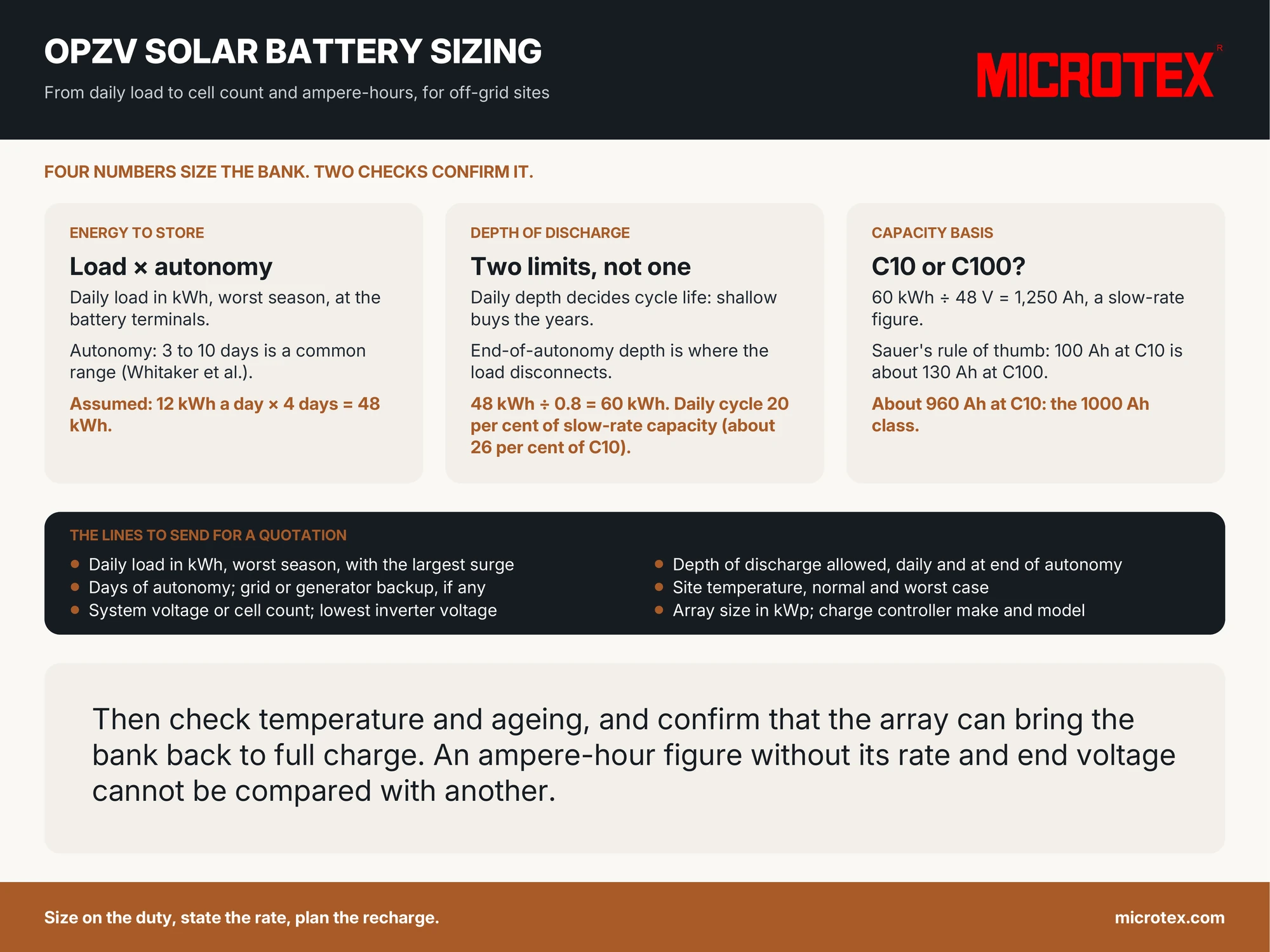
OPzV solar battery sizing: a worked illustration
The numbers are assumed, to show the method only. A site uses 12 kWh a day at the battery terminals on a 48 V system of 24 cells. The owner wants four days of autonomy and allows 80 per cent discharge at the end of them. Four days of load is 48 kWh; divided by 0.8, the bank must hold 60 kWh; divided by 48 V, that is 1,250 Ah. It is a slow-rate figure, since the discharge takes four days, and the 80 per cent limit applies to it. The daily cycle is 12 kWh out of 60, or 20 per cent of the slow-rate capacity. Against the C10 rating the same 250 Ah a night is about 26 per cent, so read the cycle life between the 20 and 50 per cent figures, not at 20. By Sauer’s rule of thumb, 1,250 Ah at the 100-hour rate is roughly 960 Ah at C10, which points to the 1000 Ah class before temperature and ageing are added. The cell’s own rate table, not the rule of thumb, settles the final choice.
Temperature and ageing
Our capacity table is rated at 25 °C. A cold room delivers less, so cold sites need a correction from the maker’s data. Heat shortens life. Our OPzV design life is 20 years on float at 27 °C, and about 15 years in daily solar cycling where the nightly discharge is shallow. A deeper nightly cycle shortens it, as the cycle figures above show. These are design values, not a warranty. Add a stated margin for ageing and for future load, and keep the bank shaded. Our page on lead-acid battery operating temperature gives the reasoning.
Can the array recharge it?
An oversized bank the array cannot refill is not a safer bank. The array has to carry the day’s loads and still bring the cells back to full within a short spell of ordinary weather. Stevens and Corey of Sandia National Laboratories measured a flooded lead-antimony battery and found an average charge efficiency of 91 per cent from empty to 84 per cent state of charge, but only 55 per cent for the step from 79 to 84 per cent. A gel cell will differ, but the shape matters: finishing the charge needs surplus array, and a bank that rarely reaches full charge loses capacity early.
Where OPzV is not the answer
OPzV is the tubular plate sealed in gel, chosen where nobody will top up a cell; see what an OPzV battery is. Where a trained maintainer visits on schedule, a flooded tubular cell can be watered, equalised and inspected, and tubular gel against flooded weighs the two. In our own view, where weight and floor space rule, lithium iron phosphate may be the better buy.
What to send for a quotation
A tender may name IEC 61427-1:2013 or, in India, IS 16270 for solar batteries. Both are test standards, and the editions on our shelf, IEC 61427:2005 and IS 16270:2014, say they do not cover sizing. Check the current edition before citing either: as of 2026 the Bureau of Indian Standards works to IS 16270:2023. Send us these lines:
- Daily load in Wh or kWh, worst season, with the largest surge.
- Days of autonomy, and whether a grid or generator backs the site.
- System voltage or number of cells, and the lowest voltage the inverter accepts.
- Depth of discharge allowed, daily and at the end of autonomy.
- Capacity, if already calculated, with its rate (C10, C100 or C120) and end voltage.
- Site temperature, normal and worst case, and how the room is cooled.
- Array size in kWp, charge controller make and model, and how often the site is visited.
- The standard named, quantity, destination and date needed.
Send them through our contact page. The first reply comes within the working day, the offer carries the sizing with the factors used, and OPzV cells are delivered in 60 days from order confirmation.
Sources quoted: A. Luque and S. Hegedus (eds.), Handbook of Photovoltaic Science and Engineering, 2nd ed. (John Wiley & Sons, 2011), chapter 19, “PV Systems”, by C. M. Whitaker, T. U. Townsend, A. Razon, R. M. Hudson and X. Vallvé, and chapter 20, “Electrochemical Storage for Photovoltaics”, by D. U. Sauer; J. W. Stevens and G. P. Corey, “A Study of Lead-Acid Battery Efficiency Near Top-of-Charge and the Impact on PV System Design” (Sandia National Laboratories, conference paper, 1996); T. B. Reddy (ed.), Linden’s Handbook of Batteries, 4th ed. (McGraw-Hill, 2011), chapter 16, section 16.9.5; R. M. Dell and D. A. J. Rand, Understanding Batteries (Royal Society of Chemistry, 2001), section 12.1; IEC 61427:2005 and IEC 61427-1:2013 (International Electrotechnical Commission); IS 16270:2014 (Bureau of Indian Standards); the Microtex OPzV product page and catalogue.