
The electric vehicle is not new. It is a comeback. A battery maker can say this with some family pride: electric cars outsold gasoline cars in parts of the world a century ago, died for fifty years, and returned. Understanding why — and what the modern EV asks of its battery — is the clearest way to understand where each battery chemistry honestly belongs, including ours.
The first electric age, and what killed it
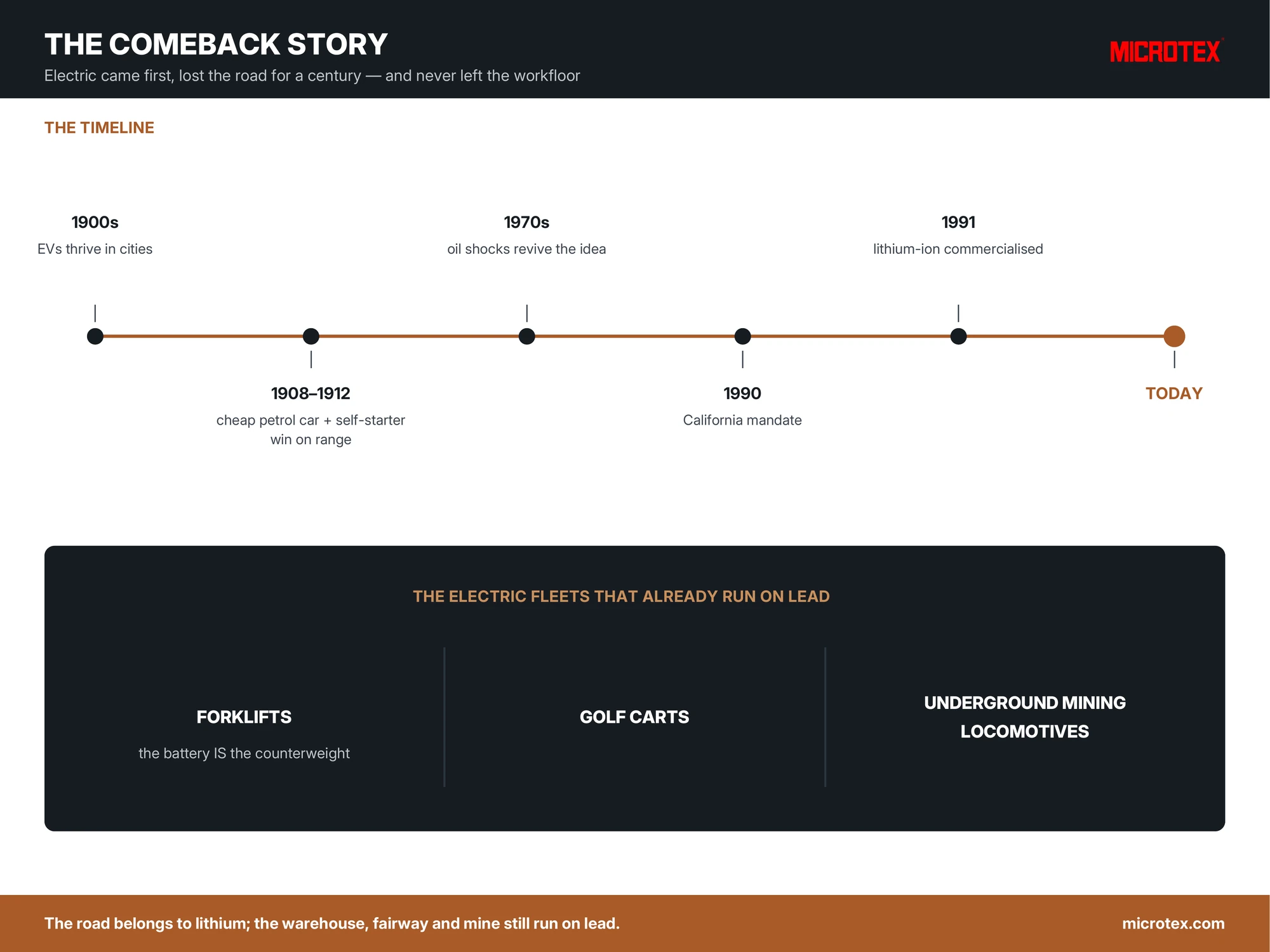
The ingredients assembled through the nineteenth century: Volta’s pile around 1800 gave science a steady current; Planté’s lead-acid cell of 1859 gave it a RECHARGEABLE one; Faure’s pasted plates (1881) and the tubular constructions that followed around 1900 made batteries practical to manufacture — the same lineage that leads to the tubular plate we build today. (Battery lore reaches further back still: a clay-jar find in 1930s Baghdad is often described as a two-thousand-year-old galvanic cell — a story archaeologists still argue about, and too good to leave out.) By the 1900s–1910s, electric cars were a fixture of city life: clean, silent, easy to drive when a petrol car demanded hand-cranking, and untroubled by short urban ranges. Fleet taxis and delivery vans loved them. Then three blows landed in a decade: the low-cost, mass-produced petrol car (1908), the electric self-starter (1912) that erased petrol’s worst inconvenience, and highway networks that made RANGE the deciding virtue. The electric car did not lose on cleanliness or refinement. It lost on energy per kilogram — a number chemistry could not change on demand.
The comeback: smog, oil shocks, and a mandate
What resurrected the idea was not nostalgia but air. Post-war cities discovered that vehicle exhaust dominated their pollution; the oil shocks of the 1970s added a strategic motive; and in 1990 California’s zero-emission mandate forced automakers to build electric vehicles on a schedule. The batteries of that era — advanced lead-acid and then nickel-metal hydride — carried the pioneering fleets and hybrids honourably (industry consortia of lead producers and battery makers funded serious advances; that line of work later produced the CSIRO Ultra Battery, a lead-acid cell with a built-in supercapacitor electrode, which went on to be road-tested across a hundred thousand miles in a hybrid car and matched the nickel-metal hydride pack it challenged — proof the old chemistry never stopped learning). But the decisive arrival was lithium-ion: conceived in the cathode work of Goodenough and the anode work that followed, commercialised in 1991, and offering several times the specific energy of any aqueous chemistry. Road EVs are a weight problem, and lithium-ion won the weight problem. That is the honest sentence, and battery makers who sell against it only embarrass themselves.
What an EV asks of its battery
Strip the marketing and an EV battery has a short, brutal job description: enough energy per kilogram to carry the range; enough power per kilogram to accelerate and climb; deep daily cycling without rapid fade; fast recharge; the ability to swallow sudden regenerative-braking current — braking energy typically returns a mid-teens share of consumption, more in stop-start duty — and all of it safely, for years, at a bearable cost per kilowatt-hour. The pack that answers is a system, not a box of cells: series strings set the voltage, parallel groups set the energy, modules organise them, and a battery-management system supervises every cell’s voltage and temperature, balances the string, and commands cooling — the electronic guardian that immobilised-chemistry packs cannot live without. Deep cycling, strings, supervision: any engineer who has run a fleet of traction batteries will recognise every requirement on the list — the EV pack is the traction battery’s rich cousin, wearing electronics instead of a maintenance crew.
The electric vehicles that already run on lead
Here is the part the road-EV story hides: by fleet size and sheer battery tonnage, the industrial world has been driving electric for a century, and most of it runs on lead-acid. Forklifts and warehouse trucks cycle traction batteries daily in duties where the battery’s weight is not a flaw but a feature — it IS the counterweight. Golf carts and low-speed leisure vehicles run on semi-traction batteries. Underground mining locomotives haul on flameless battery power where a diesel’s fumes would poison the air. In these duties the selection logic is not energy per kilogram but cost per cycle, abuse tolerance, recyclability and a century of proven safety — territory where the honest chemistry comparison still reads differently than it does on the highway. The road EV belongs to lithium. The warehouse, the fairway and the mine gallery, for now, still mostly belong to lead — and we build for all three in Bengaluru. If your electric fleet lives on that side of the story, talk to us.