
A golf cart battery has the hardest job nobody takes seriously. It is discharged deeply, often daily; recharged whenever someone remembers; parked for months at a stretch; and owned, mostly, by people who never open the battery compartment. Car batteries live pampered lives next to this. Technically, a cart battery is a semi-traction battery — a deep-cycle design in the same family as the industrial traction battery, scaled to leisure duty: golf carts and buggies, canal boats, RV campers, cabin and tent power. This guide explains what separates a battery built for that life from one that merely fits the compartment.
Not a car battery — the first and biggest mistake
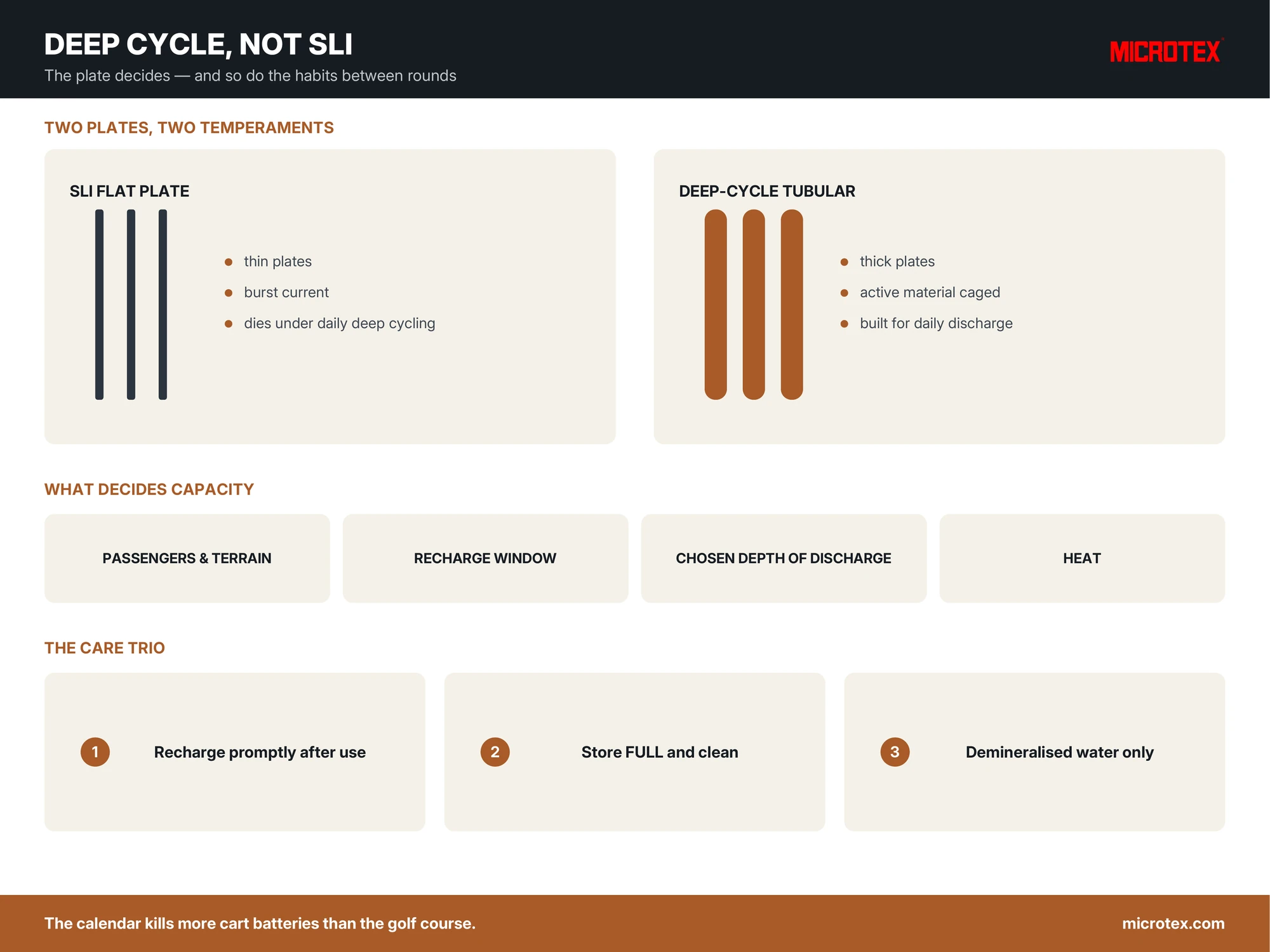
An automotive battery is an SLI design — starting, lighting, ignition. Thin flat plates deliver a violent burst of current for seconds, then the alternator refills it. Ask those thin plates to empty themselves over four hours of fairway driving, every day, and they shed their active material within a season — the flat-versus-tubular guide explains the mechanics. Deep-cycle duty wants the opposite construction: thicker plates, more antimony-hardened structure, and ideally the tubular positive plate, which cages its active material in woven gauntlets so that daily deep discharge cannot shake it loose. That is the single most important line on any cart battery datasheet: not the brand, the plate construction.
The types, honestly compared
| Type | Strengths | Trade-offs |
|---|---|---|
| Tubular plate, flooded | Best deep-cycle life and abuse recovery of the lead-acid family | Needs topping up and basic care |
| Flat plate, flooded | Cheapest to buy | Shortest cycle life in daily deep discharge; struggles to recover from over-discharge |
| AGM (VRLA) | Sealed, no watering, tidy | Cycle life below tubular in deep daily duty |
| Gel — flat plate | Sealed, no watering | Often confused with tubular gel; flat-plate life limits apply |
| Tubular gel | Sealed PLUS tubular endurance | Costs more than flooded tubular; life slightly below it |
| Lithium-ion | Light, fast-charging, high capacity | Highest cost once the mandatory battery-management system is counted; thermal safety rests entirely on that BMS |
Class comparisons — within each class, the datasheet governs.
What actually decides the capacity you need
Four things, none of them the sticker on the old battery. The work: passengers carried, terrain climbed, and driving pattern — a hilly course with four aboard asks roughly twice what a flat ferry-run asks. The recharge window: a battery that finishes its day at 80% depth of discharge needs generous overnight charging; if the hours aren’t there, the honest answer is more capacity, not harder charging. The depth you choose: cycle life stretches disproportionately as daily discharge gets shallower — a battery worked to 60% instead of 80% returns far more total rounds before retirement; the datasheet’s cycles-versus-depth curve prices this exactly. The heat: capacity is rated near 25 °C, and sustained heat shortens life — the operating-temperature guide covers that arithmetic. Voltage, meanwhile, is set by the cart: packs are built from 6, 8 or 12 V blocks in series to reach the common 36, 48 or 72 V systems — and because those blocks work as a string, the string rules apply in full: same type, same make, same age, and never a lone new block among tired ones.
Why leisure duty kills batteries — and the five-minute defence
The cart battery’s real enemy is not the golf course; it is the calendar. Leisure equipment sits — through monsoons, through winters, through work seasons — and a lead-acid battery left discharged quietly converts itself to hardened sulphate that no charger fully recovers. How fast a resting battery loses charge is set deep in its metallurgy: antimony in the grid alloy strengthens the plate for cycling but accelerates self-discharge and watering as the battery ages, which is why a thoughtfully LOW-antimony spine — enough for strength, no more — is one of the quiet design decisions that separates a leisure battery that survives storage from one that doesn’t. The defence is cheap: recharge promptly after use rather than “before next time”; before any long idle spell give a full charge and store the battery clean, cool and disconnected — the storage guide is the checklist — and refresh-charge if the idle stretches months. In service, keep flooded cells topped with approved water only, never acid, keep the lid clean so film and damp can’t leak current between terminals, and when per-cell readings start drifting apart, give the pack an equalising charge. Charging itself follows the maker’s regime — the charging guide explains why universal numbers don’t exist. None of this takes five minutes a week; skipping it is how three-year batteries die in one.
The buyer’s short checklist
When the quotes arrive, compare five lines. Ampere-hours at YOUR discharge rate, not the headline rating. Cycles at a stated depth of discharge, from the datasheet, not the brochure adjective. Plate construction — tubular or flat, the question that predicts year three. Weight — in lead-acid, honest capacity weighs; a suspiciously light battery at the same rating is missing lead. And the maker’s watering and charging requirements, because the best battery is one whose care you’ll actually do. Never buy a used battery — a cart battery’s history is invisible and usually terrible. Our own range is on the golf cart battery page: tubular-plate construction in the standard leisure sizes, built in the same plant as our industrial traction cells. If the duty is unusual — long boats, heavy carts, hot climates — describe it to us and the recommendation comes back sized, not guessed.