
Half the dead batteries we examine were killed by a machine that outlived them. The charger is the single most influential device in a battery’s life — more than the load, more than the weather — and yet it is bought last, cheapest, and blindest. Our charging guide covers the PRACTICE of charging and why universal voltage numbers are a lie; this page covers the MACHINES: what the types actually do, and what separates a charger that partners a battery from one that slowly executes it.
What every good charger does: push, ease, hold
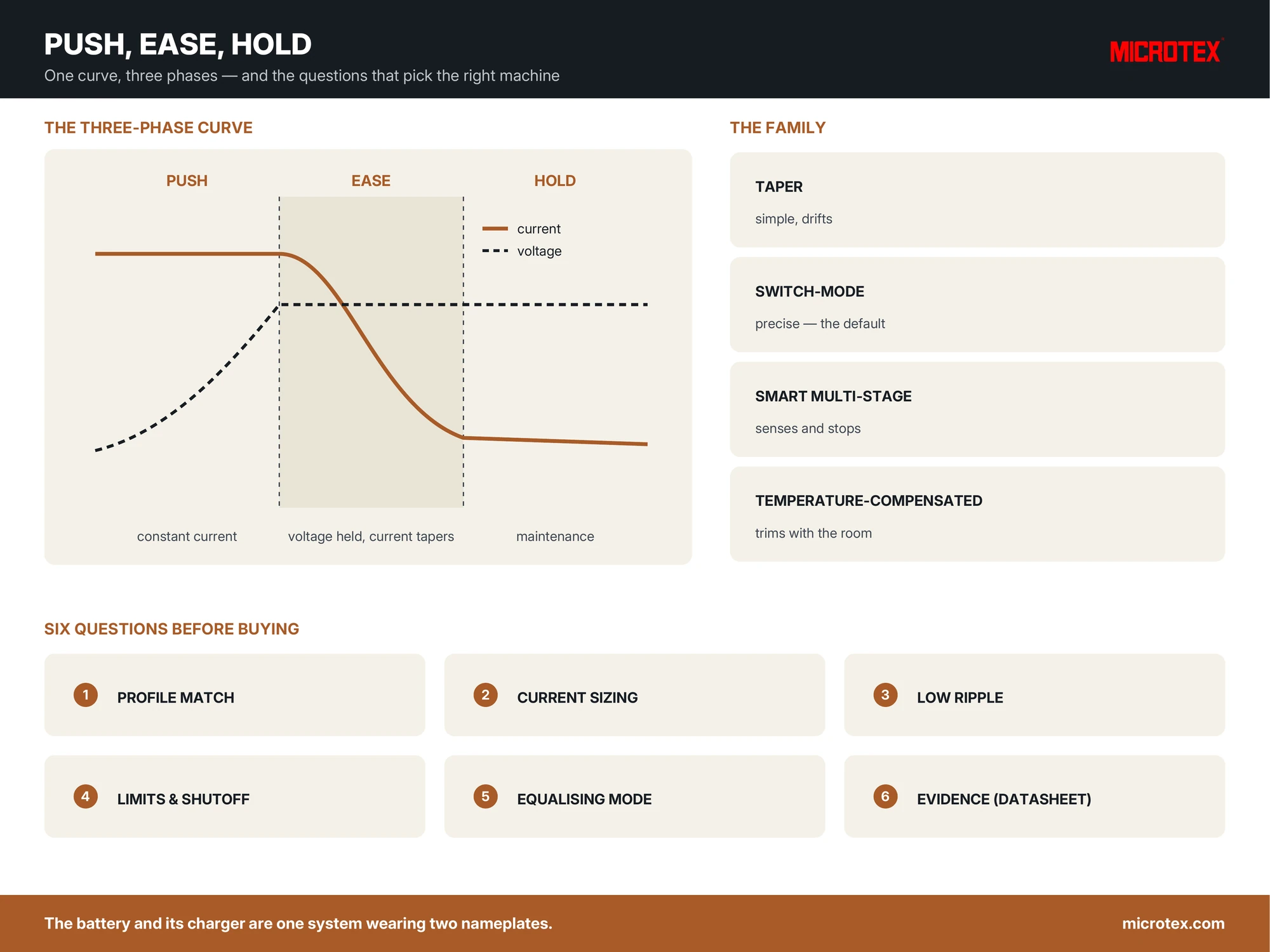
Strip away the brochures and a proper lead-acid charge has three behaviours. PUSH: while the battery is empty it accepts current eagerly, so the charger delivers a controlled constant current and the bulk of the energy goes back in. EASE: as the battery fills, its voltage rises to meet the set limit, and the charger holds that voltage while the current tapers naturally — forcing more would only make gas and heat. HOLD: finally a lower maintenance voltage keeps a full battery full without cooking it. Charger engineers write these phases in compact codes — the IU and IUoU profiles of the trade — but the music is always push, ease, hold, with the actual voltage settings taken from the battery’s datasheet, never from folklore. A charger that cannot perform all three behaviours, or performs them at the wrong settings for YOUR battery type, is the wrong charger regardless of price.
The types you will actually meet
The old taper charger — a transformer, a rectifier, and hope — simply lets current fall as battery voltage rises. Simple, rugged, repairable in any workshop; but unregulated, drifting with mains voltage, and prone to either undercharging or gently boiling a battery, which is why the design survives mainly where nobody is measuring. The modern switch-mode charger regulates electronically at high frequency: precise voltages, programmable profiles, lighter, efficient — the default answer for almost every duty today. The smart or multi-stage charger adds a brain: it senses the battery’s state, runs the push–ease–hold sequence automatically, holds safety limits, and shuts itself off — the feature that forgives human forgetfulness, which is the most common charging fault of all. Temperature-compensated chargers read the battery’s temperature and trim the voltage the way the cold-weather guide describes — hardware doing automatically what good practice demands. And opportunity charging — grabbing partial charges in breaks, beloved of busy warehouses — is a scheduling tactic, not a charger type, and it carries an honest tax: more time spent at gassing thresholds, more heat, more water use, and a shorter life unless the battery, charger and schedule were designed for it TOGETHER. It can be done well. It is rarely done deliberately.
Buying a charger: the six questions that matter
First, chemistry and type match: flooded, AGM and gel want different voltage behaviour — the charger must offer the profile YOUR battery’s datasheet specifies, selectable and verifiable, not assumed. Second, current sizing: the charger must refill your daily discharge within your real recharge window — that is arithmetic from the sizing chain, not a guess; too small never finishes, absurdly large punishes. Third, ripple: cheap rectification leaves an alternating tremor on the DC, and a battery fed trembling current runs warmer and ages faster — a low-ripple specification on the datasheet is the mark of a charger built by people who understood the battery. Fourth, limits and shutoff: voltage limits, current limits, timers, and automatic termination — the safety net for the day nobody comes back. Fifth, an equalising mode under proper control, because the equalising charge is a maintenance tool the charger should offer deliberately, not something improvised with a bigger power supply. Sixth, evidence: a real datasheet, settings you can inspect, and a maker who will state — in writing — that the profile suits your battery. If the seller cannot answer these six, the price is irrelevant.
One system, not two purchases
The deepest truth in this subject is that the battery and its charger are one system wearing two nameplates. Every failure mode in the battery-life guide has a charger fingerprint on it somewhere — undercharge feeding sulfation, overcharge feeding corrosion, water loss and heat. That conviction is why we build chargers for our hardest application ourselves: our mining battery charger was designed WITH the battery it serves, finishing the charge with minimal gassing because underground, gas is not a maintenance line-item but a safety one. Whether the duty is a mine, a warehouse or a substation, the buying rule is the same: choose the charger with the same seriousness as the battery — or tell us the battery and the duty, and we will specify the charger it deserves.