
A battery order is easy to sign and heavy to move. A single industrial cell can weigh what a person does; a container of traction batteries is tens of tonnes of lead, acid and stored energy crossing oceans and borders. Buyers rarely think about the journey until the first export order — then the questions arrive at once: is this dangerous goods? Can it fly? What paperwork travels with it? Having shipped batteries by the container for decades, here is the working map.
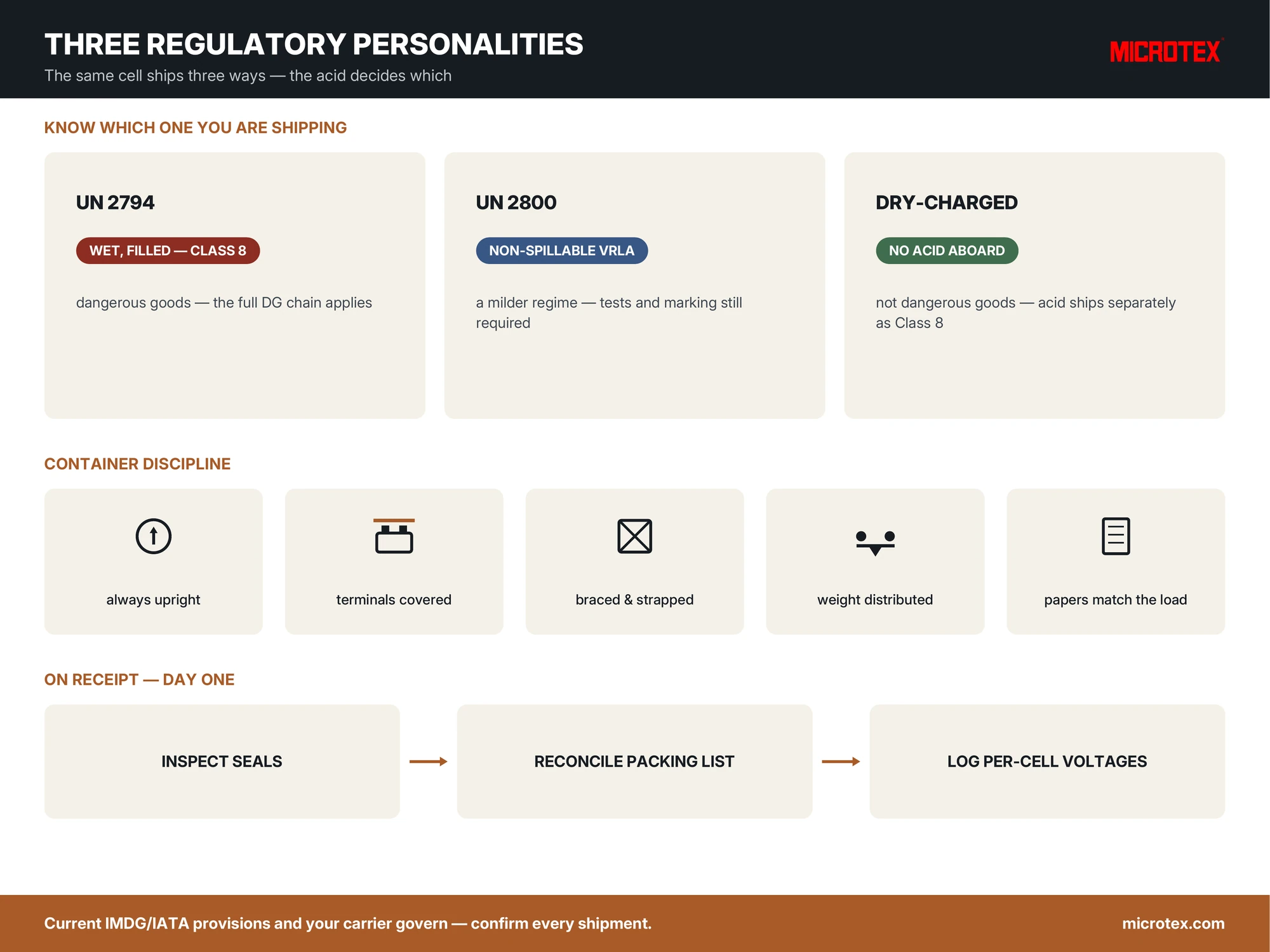
What the regulations see: three kinds of battery
Transport law does not see brands or capacities; it sees SPILLABILITY. A flooded battery shipped filled travels as dangerous goods — the classification UN 2794, “batteries, wet, filled with acid,” Class 8 corrosive — with everything that implies: certified packaging and marking, a dangerous-goods declaration, trained handling. A sealed VRLA battery — AGM or gel — can qualify as UN 2800, “batteries, wet, non-spillable,” a milder regime reflecting what its immobilised electrolyte cannot do, provided it passes the prescribed tests and is marked accordingly. And a DRY-CHARGED battery — plates formed and dried at the factory, no electrolyte aboard — is, without its acid, not dangerous goods at all: the acid ships separately as its own Class 8 consignment, and the battery is commissioned at destination by filling and first charge. One product, three regulatory personalities — and the CHOICE among them is a commercial decision as much as a technical one. A caveat in writing, because this is law, not physics: classifications and test requirements are amended periodically; the current IMDG (sea) and IATA (air) provisions and your carrier’s requirements govern every real shipment, and confirming them is part of professional export practice — ours and yours.
Why battery exports go by sea
Lead-acid batteries and air freight rarely make sense together: the economics of flying lead speak for themselves, and wet Class 8 cargo meets aviation’s strictest mood. The trade’s road is the sea container, and a properly stuffed container is a small engineering exercise we treat with respect. Batteries travel UPRIGHT, always — filled cells are never laid down — palletised and strapped, with dunnage and bracing so nothing shifts in a swell; a battery that cannot move cannot short, spill or crush. Terminals are the sacred detail: protected with covers or insulating board so no metal object, strap or neighbouring battery can bridge them, because a charged battery needs no mains connection to start a fire — it brings its own energy to any short circuit. Weight is distributed within axle and container limits, documents match the load cell for cell, and the doors close on a consignment that can cross two monsoons unbothered. This is also why our mining batteries arrive pre-assembled, charged and ready — packing discipline at origin is what delivery-day simplicity is made of.
Wet-charged or dry-charged: the exporter’s real decision
The classification table above hides the decision that matters. Shipping WET-CHARGED means the battery arrives ready — but it travels as Class 8, ages slightly in transit like any stored battery (long voyages plus port delays deserve a freshening charge on arrival), and demands the full dangerous-goods chain. Shipping DRY-CHARGED trades convenience for freedom: simpler transport, indefinite shelf life in sealed storage, no in-transit ageing — paid for at destination, where competent commissioning must exist: correct-gravity acid, proper filling, a disciplined first charge. For distributor markets with technical capability, dry-charged is often the professional’s choice; for end-user deliveries, wet-and-ready wins. There is no universal answer — there is a right answer per route, per buyer, per battery type, and quoting it is part of our export conversation, not an afterthought on the invoice.
What arrives with the battery — and what to do on day one
A professional consignment is paperwork wearing a pallet: commercial documents, packing lists that match cell serial numbers, safety data sheets for the acid, the dangerous-goods declaration where applicable, and the test and warranty documents our claims culture requires. And for the buyer, day one has its own short ritual: inspect before signing — container seals, pallet condition, any smell of acid; check received cells against the packing list; measure and LOG per-cell open-circuit voltages as the receiving baseline (the testing guide’s hierarchy starts at delivery); and schedule the freshening or commissioning charge the shipment type calls for. Sixty seconds of receiving discipline converts “the battery arrived” into “the battery arrived, and we can prove in what condition.” If you are planning a first import — or a hundredth — ask us how your route’s consignment should travel; the answer comes from people who load the containers themselves.