
Batteries are not harmed by being stored too charged — only too discharged. Golf carts parked for the season, campers and boats laid up, inverter banks in an empty house, spare fleet batteries on a shelf: storage is where good batteries quietly die, and almost every storage death has the same certificate — stored part-empty, self-discharged to flat, sulphated, and in cold climates sometimes frozen. The prevention is a one-hour routine.
Why storage kills — the physics in one paragraph
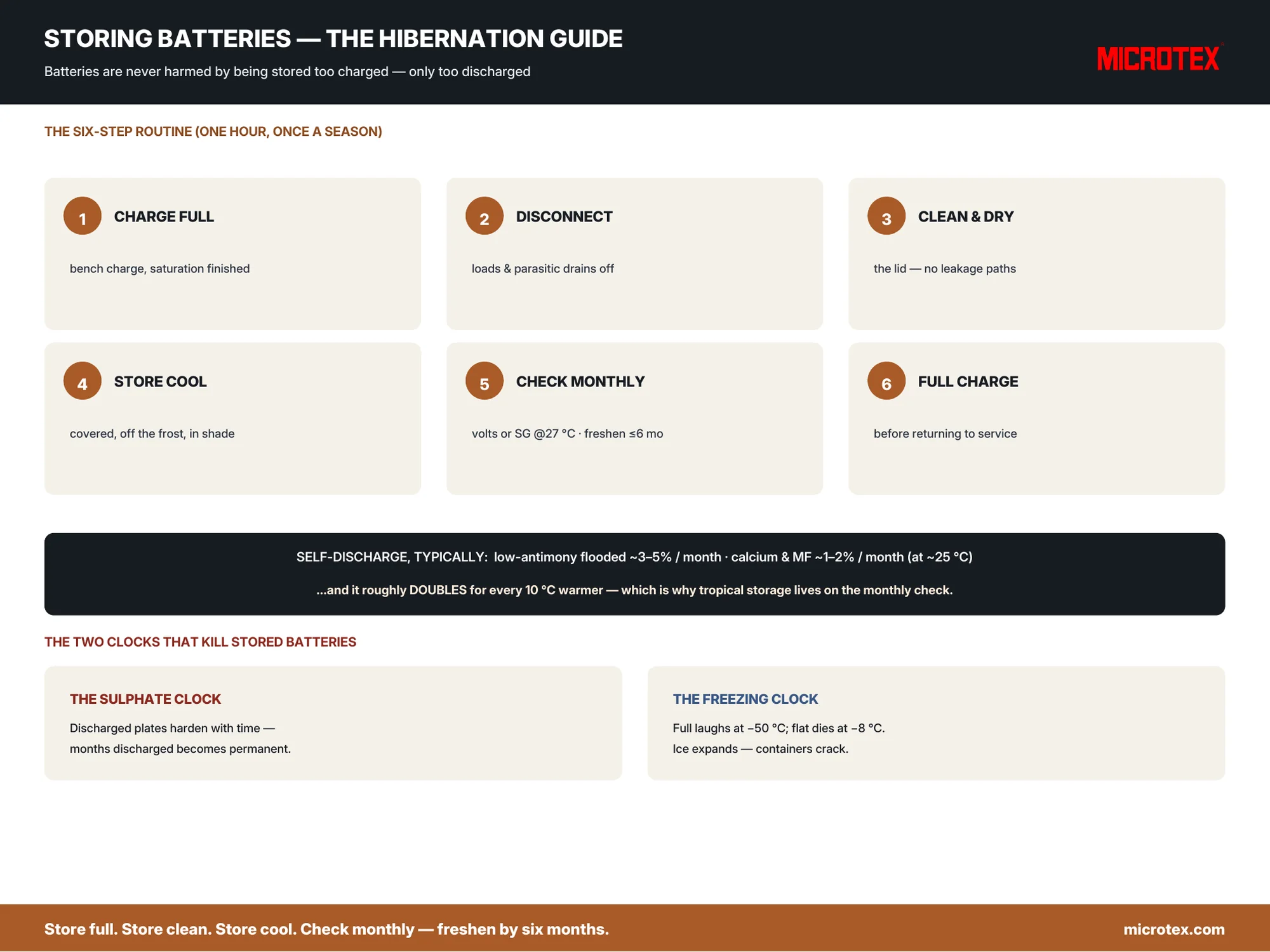
An idle battery discharges itself — typically around 3–5% of capacity per month for ordinary low-antimony flooded types and 1–2% for calcium and maintenance-free designs at room temperature, roughly doubling for every 10 °C warmer (typical class values; the datasheet states yours). As charge leaks away, two clocks start. The sulphate clock: discharged plates carry soft lead sulphate that hardens with time — the disease of the sulfation guide, fully preventable, and left for months, permanent. And in cold climates the freezing clock: discharge turns acid toward water, and a deeply discharged battery can freeze on an ordinary frosty night — the expanding ice (water’s famous anomalous expansion, the reason a beer bottle bursts in a freezer) cracks containers and buckles plates. The freezing table lives in the cold-weather charging guide; the summary is that a FULL battery laughs at −50 °C while a flat one dies at −8 °C.
The hibernation routine — six steps
One — charge it FULL first, properly, to the end of the saturation phase, per the charging guide; a bench charge from an external charger beats the vehicle’s own system. Two — disconnect everything: terminals off the load; parasitic drains (clocks, alarms, inverter standby) flatten stored batteries with astonishing speed. Three — clean and dry the top: an acid-misted lid is a leakage path that discharges the battery all season; wipe, dry, and lightly protect the terminals. Four — store cool, covered, off the frost: cool storage slows self-discharge (the 10 °C doubling in reverse); avoid open exposure and freezing corners. Five — check monthly: a rest-voltage reading, or gravity corrected to 27 °C per the battery acid guide; recharge when the rest voltage has fallen about 0.05 V per cell below its usual full-charge value, or at the latest by six months — the freshening charge. (A maintained shelf can instead run the trickle regime from the float charging guide — typically 40–100 mA per 100 Ah, then disconnect.) Six — full charge before service: never return a stored battery to work on yesterday’s charge.
The tropical variant — India, Africa, and every hot garage
Most of our readers store batteries against heat, not frost, and the routine barely changes — only the enemy does. Heat is a self-discharge accelerator: the same battery that loses 3% a month at 20 °C can lose 6% at 30 °C and more again at 40 °C, so the monthly check becomes the discipline that matters. Charge full, disconnect, clean the top, and store in SHADE — a covered, ventilated spot, never a tin-roofed corner that becomes an oven by noon. Maintenance-free and VRLA types hold their charge longest and suit long hot storage best, but they obey the same law: store full, check, freshen. And after any storage, hot or cold, the return-to-service ritual is identical — a proper full charge, a corrected gravity or rest-voltage reading that matches the datasheet’s full-charge value, and only then back to work.
Terms live in the glossary. A seasonal fleet worth protecting — golf carts, boats, campers, standby banks — deserves its storage plan written down once and followed every year; if yours keeps waking up weak each season, describe the routine to us and we will find the leak in it.