
Customers have started asking us whether the lead-acid starter batteries on their diesel locomotives can be swapped for lithium-ion — and the honest engineering answer is: not for the cranking duty, not as a drop-in, and not yet. This is not chemistry tribalism. We have published an honest guide to lithium-ion and a fire-safety review written without scare tactics, and both stand. Lithium wins real duties on the modern railway, and we will name them below. But the starting second of a large diesel engine is a very particular duty — and every documented attempt to move that class of duty to lithium, from motorcycles to certified aircraft, has run into the same four walls: current limits, cold, charging systems, and the electronics that fail when a protection circuit steps out of the way. Here is the evidence, so your workshop can decide on facts.
What the cranking second actually asks
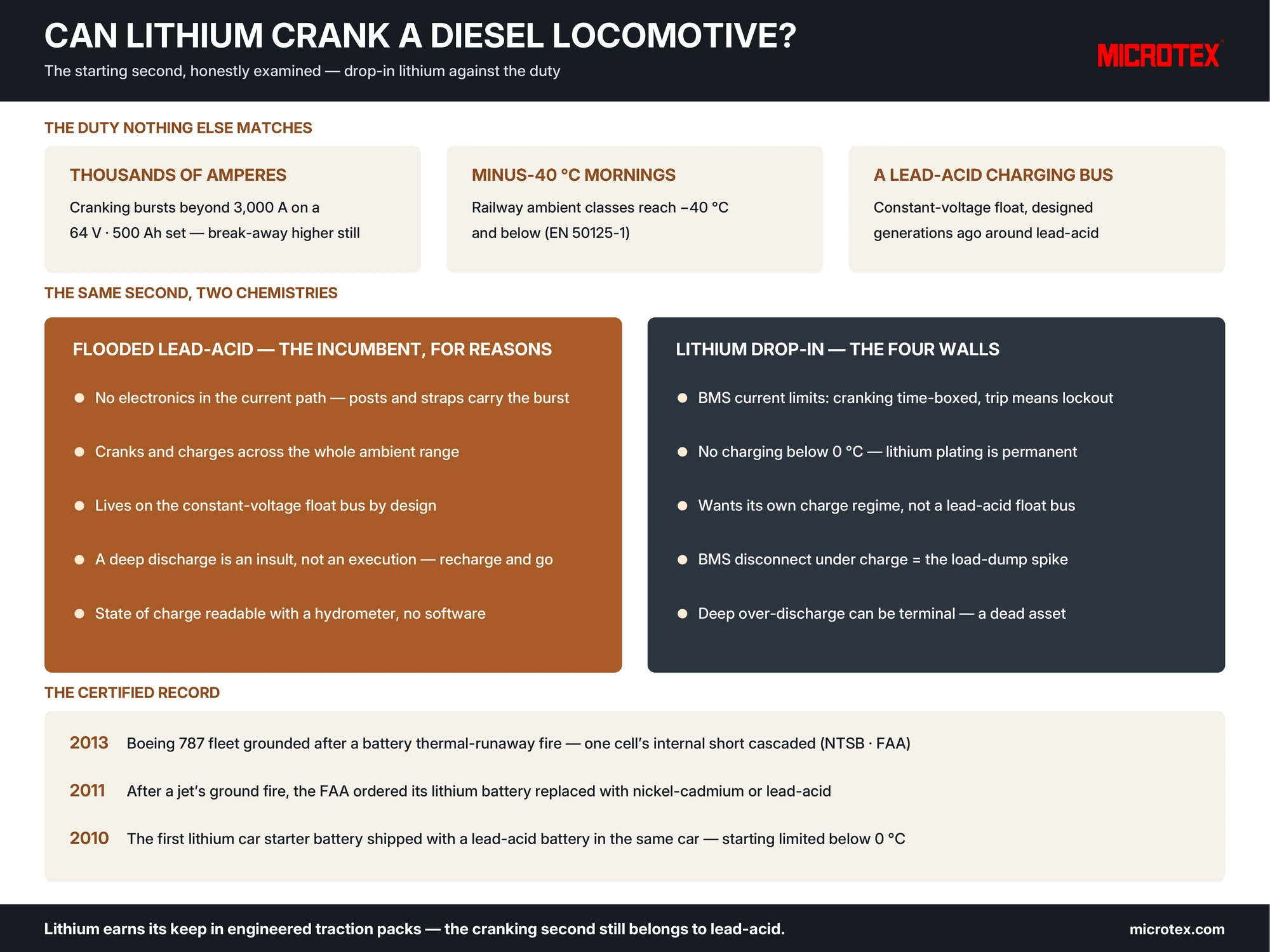
Starting a locomotive diesel is the most violent thing a battery is ever asked to do. A typical Indian arrangement — eight 8-volt monoblocs forming a 64 V, 500 Ah set — must swing a cold engine of many litres with cranking bursts beyond 3,000 amperes; published locomotive-battery literature independently documents peak demands beyond 1,300 amperes, with break-away current at the first instant of rotation higher still. Then comes the second life: the battery sits on the locomotive’s constant-voltage auxiliary charging bus — a system designed generations ago around lead-acid behaviour — vibrating, in engine-room heat, holding itself ready for months between overhauls. And it must do all this across the whole railway ambient range: the European rolling-stock environment standard EN 50125-1 defines classes reaching minus 40 degrees and below, and North American railroading routinely operates there. In a flooded lead-acid starter battery, that colossal burst flows through solid lead posts and heavy copper-cored connections. There is no electronic gatekeeper in the current path — nothing to trip, time out, or ask the engine to wait.
What changes when lithium enters the circuit
A lithium battery cannot be sold without its guardian: the battery management system, a protection circuit standing in series with everything the battery feeds. That guardian is not optional and not passive. The makers of lithium starter batteries publish its rules in their own manuals: cranking limited to ten to thirty seconds in any minute, and if the limit trips, the battery disconnects itself and locks out for one to three minutes of cooldown. Deep-cycle lithium iron phosphate batteries of the size a locomotive would need carry BMS continuous ratings in the range of a few hundred amperes, with peak currents time-boxed to seconds. Set those numbers beside a break-away demand in the thousands of amperes and the mismatch is not a detail — it is the whole problem. The battery that protects itself mid-crank has, from the driver’s seat, simply failed to start the locomotive.
Cold makes every number worse. Lithium cells must not be charged below zero degrees Celsius — charging a cold cell plates metallic lithium onto the anode, and the damage is permanent, a limitation documented across the industry’s own datasheets and reference literature. Cranking performance collapses in the cold too: one leading powersports maker’s manual prescribes four to five minutes of headlight load at minus seventeen degrees to “wake” the battery before the engine may be cranked. Nobody holds a headlight ritual on a minus-thirty morning in a locomotive yard. The most telling precedent is the first production lithium starter battery ever sold: when Porsche introduced it as a lightweight option in 2010, the company stated plainly that starting capacity is limited below zero degrees — and delivered a conventional lead-acid battery with every car so the owner could get through winter. The maker that pioneered the product told you its boundary. Our own guide to battery charging in cold weather covers what low temperature does to both chemistries — the difference is that lead-acid loses performance gracefully and recovers, while a lithium pack charged below zero is being damaged.
Then there is the charger that already hangs on the locomotive. The auxiliary charging system is a constant-voltage, float-forever regime built around lead-acid electrochemistry. Lithium makers themselves prescribe a different regime — their own datasheets direct a distinct charge profile and advise against the continuous trickle that a locomotive bus delivers by design. A drop-in lithium battery therefore inherits, for its whole service life, a charging system it was never designed to meet — with only its BMS standing between the two. And if the locomotive is ever left to flatten its battery completely — a stranded machine, a forgotten isolating switch — the two chemistries part ways for good: a deeply discharged lead-acid battery is an insult that prompt recharging usually forgives; a lithium cell driven far into over-discharge suffers internal copper dissolution, documented in the research literature as largely irreversible. One is a maintenance incident. The other is a dead asset.
“It fried the electronics” — what actually happens
Motorcycle and automotive communities are full of conversion stories that end with damaged regulators and control units and a quiet return to lead-acid. The experience is real; the folk explanation — “lithium’s high current burned the electronics” — is not quite right, and the truth is more damning for cranking duty. Automotive electronics standards have a name for what happens when a battery abruptly leaves the circuit while the alternator is delivering charge: the load dump, the harshest transient in the ISO 7637-2 family, documented in semiconductor application literature at spikes approaching two hundred volts in ordinary 12-volt systems. A lead-acid battery essentially never leaves the circuit — it is the system’s voltage anchor, and clamping such transients is one of its quiet jobs. A lithium battery’s BMS, by contrast, is designed to leave the circuit: that is what protection means. Every over-current trip, every cold-charge refusal, every fault disconnect is the battery stepping out from under a live charging system — and machines whose electronics were designed on the assumption that a battery is always present take the spike. The riders’ stories are correct; the mechanism is the protective disconnect, not the current. Scale that thought up to a locomotive — a 74-volt bus, control electronics, protection relays — and the “instant satisfaction” of a lighter, faster-cranking battery on a warm afternoon looks very different across a fleet and a winter.
What the certified record shows
Aviation is the one industry that has run the full experiment — certified lithium batteries in starting and auxiliary-power roles, under the world’s most rigorous engineering oversight — and its record is instructive. In January 2013, a lithium-ion auxiliary-power battery aboard a Boeing 787 caught fire on the ground in Boston; the US National Transportation Safety Board’s final report traced it to an internal short circuit in a single cell that cascaded into thermal runaway of the battery. The Federal Aviation Administration grounded the entire 787 fleet by emergency directive within days. Two years earlier, after a business-jet ground fire, the FAA had issued an emergency airworthiness directive ordering that aircraft’s lithium-ion main battery replaced with a nickel-cadmium or lead-acid battery — a regulator, in plain print, directing the industry’s newest battery back out of the aeroplane. The FAA’s standing advisory guidance states the reason without drama: lithium batteries are significantly more susceptible to internal cell failures that can result in thermal runaway than the nickel-cadmium and lead-acid types they replace. Grid-scale energy storage learned a parallel lesson — South Korea’s government investigation of twenty-three storage-plant fires in under two years found system-integration and protection failures, in installations far more engineered than any battery box under a locomotive frame. And the world’s shipping rules quietly agree on the risk ranking: lithium batteries travel as Class 9 dangerous goods under the UN’s mandatory abuse-test regime, with the densest formats restricted from passenger-aircraft cargo — while lead-acid batteries ship worldwide under long-settled, far simpler provisions. None of this says lithium is bad. It says lithium is unforgiving of casual integration — and a drop-in starter swap is casual integration by definition.
Where lithium honestly belongs on a railway
Here is the other side, stated without hedging. Battery-electric locomotives now in freight service carry multi-megawatt-hour lithium traction packs — thousands of cells with engineered cooling, monitoring, fire barriers and dedicated charging infrastructure. That is lithium doing what it is genuinely good at, inside a system designed around its needs from the first drawing. Rolling-stock standards bodies have published a lithium-ion standard for auxiliary battery duties (IEC 62973-5), and railway institutions in India and elsewhere have deployed lithium iron phosphate in trainset auxiliary and depot storage roles. Modern electric cars carry small lithium auxiliary batteries with no complaint — because an electric car has no engine and no cranking second. The pattern across all of it is consistent: lithium succeeds as an engineered system and disappoints as a drop-in replacement, and diesel-engine starting is the duty furthest from lithium’s strengths — short, brutal current far beyond BMS comfort, delivered cold, from a battery married to a lead-acid charging bus. To our knowledge no major railway has approved lithium for diesel-locomotive cranking duty; whatever you read here or anywhere else, verify the current position against the governing railway authority’s own specifications before committing a fleet. The wider chemistry landscape is mapped honestly in our comparison of battery chemistries and across the railway’s battery duties.
The workshop verdict
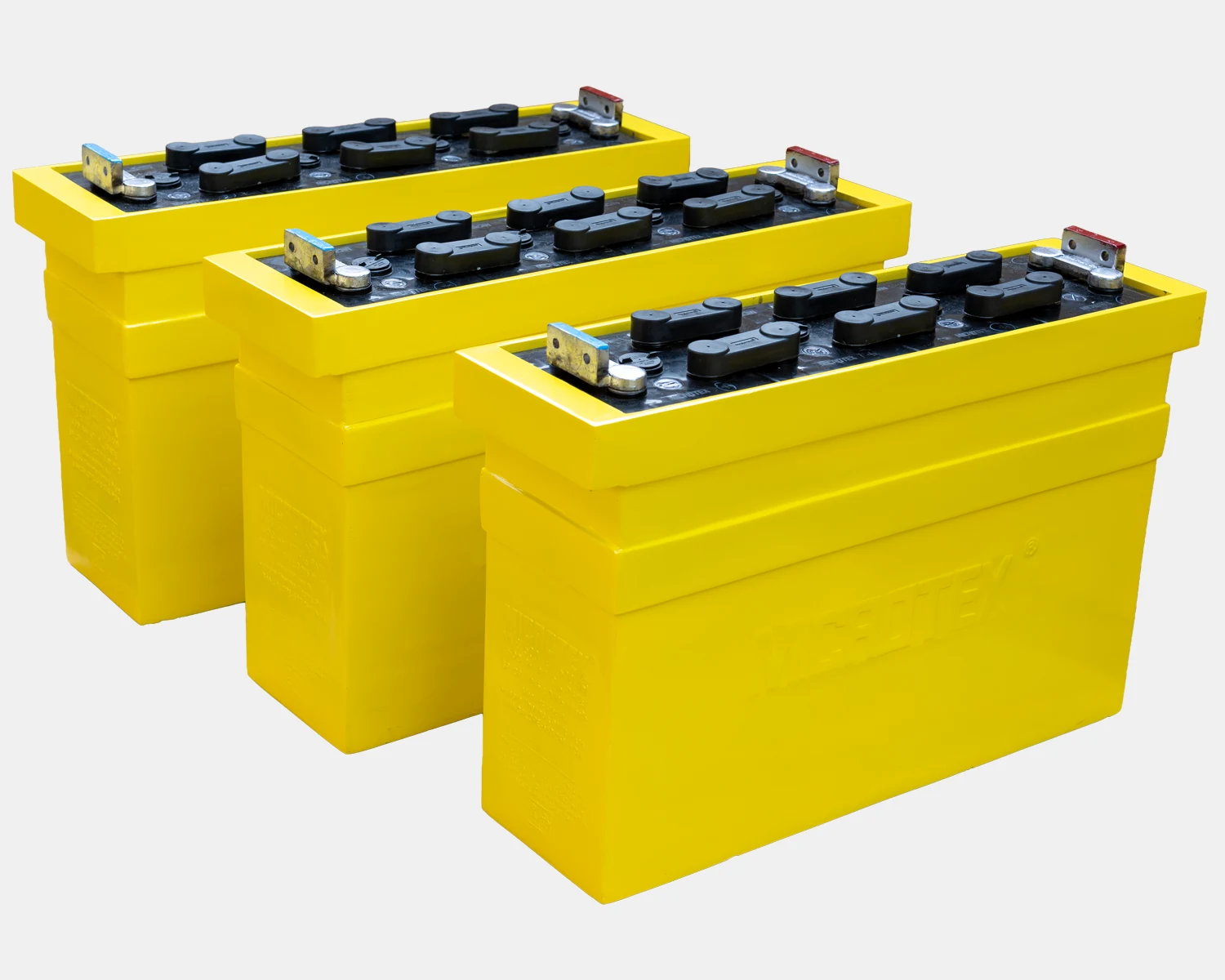
For lithium to crank a locomotive diesel honestly, four things would all have to be true at once: a BMS rated for break-away current with no trip-and-lockout behaviour; cell heating and management that makes sub-zero charging safe in a battery box on a vibrating frame; a re-engineered charging system replacing the constant-voltage bus the fleet already owns; and a railway-grade approval trail for starting duty. Today, that package does not exist as a product you can bolt into a battery box — and the price of pretending otherwise is a locomotive that cranks beautifully in the demonstration and fails on the coldest morning of the year, which is the only morning that matters. When the engineering changes, this page will change; we argue from evidence, not loyalty. Until then, the cranking second belongs to the battery with no electronics in its way — the diesel locomotive starter batteries we have built for railway duty for decades. If your fleet’s battery question is live — replacement, re-engineering, or an honest second opinion on a lithium proposal — put it to our engineers, and the answer will come back in specifications, not slogans.