
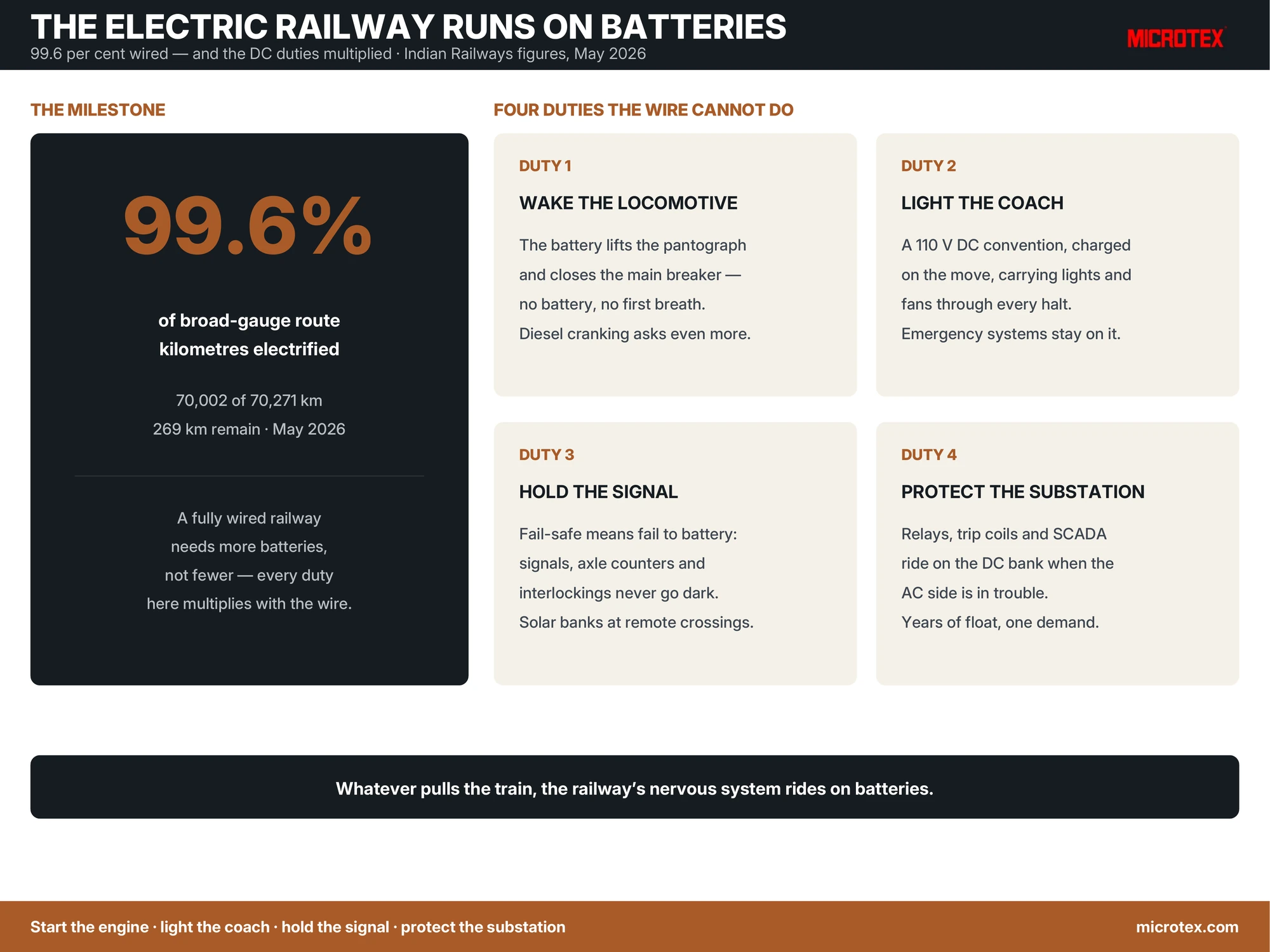
India has all but finished wiring its railway — and the humble battery has never mattered more to it. By Indian Railways’ own figures published this year, 99.6 per cent of the broad-gauge network is electrified as of May 2026: 70,002 of 70,271 route kilometres under the wire, with just 269 kilometres to go. You might expect a fully electric railway to need fewer batteries. The opposite is true. Every locomotive that wakes, every coach that lights, every signal that fails safely and every substation that protects itself does so on direct current from a battery — and electrification multiplies those duties rather than retiring them. A railway is, among other things, one of the world’s largest distributed fleets of industrial batteries. Here is where they hide, duty by duty.
The locomotive’s first breath
An electric locomotive under a live wire is, at the moment of waking, still a dead machine. The overhead line can give it nothing until the pantograph rises and the main circuit breaker closes — and the power to lift that pantograph, close that breaker and light the control electronics comes from the locomotive’s own battery. No battery, no first breath: twenty-five thousand volts overhead and the machine cannot reach it. Diesel locomotives ask even more brutally — cranking a large diesel engine is a deep, violent burst of current — and both duties are served in a vehicle that vibrates for a living, in machine rooms that run hot. This is the duty our locomotive starter batteries are built for: heavy plates, mechanical honesty, and tolerance for a life of being shaken.
The coach beneath your feet
Ride any long-distance train at night and you are riding on batteries. Indian coaching practice has long standardised on a 110-volt DC convention for the systems a coach carries (stock and specifications vary — the governing specification, not this article, is the authority). In the classic self-generating arrangement, an alternator driven off the coach axle charges under-slung batteries while the train moves, and the batteries alone carry the lights and fans through every halt — a cycling duty, repeated at every station, all night. Modern end-on-generation trains carry their hotel load from power cars instead, but the battery does not retire: it holds the emergency lighting, the controls and the communication systems for the moments when everything else has failed — which is precisely when a railway needs them. Either way the coach battery lives a hard life: cycled daily, shaken always, and hot for much of the year — and heat is the silent third party in every battery contract.
Signalling: where “fail” means “fail to battery”
Railway signalling is built on a beautiful, severe philosophy: any failure must leave the railway safer than before. A signal that loses its supply must show its most restrictive aspect; a system that loses mains power must fall onto a battery, never into darkness. So behind the signals, the point machines, the axle counters and the interlockings sit battery-backed power supplies, holding the signalling alive through every outage — installations governed in India by the railway’s own standards body, RDSO, whose specifications and approved-vendor lists rule what may be installed (verify current requirements against the governing documents before relying on any summary, ours included). At remote level crossings beyond dependable mains, the pattern completes itself: a solar panel, a battery bank, and a duty cycle that is solar’s hardest test — partial charge by day, discharge by night, year after year.
The substations behind the wire
Those seventy thousand electrified kilometres are fed by a chain of traction substations, and every one of them keeps a DC heart: the battery bank that powers protection relays, breaker trip coils, control systems and SCADA when the AC side is in trouble — the exact moment the protection must act. It is the same unglamorous standby duty we described in the nuclear plant battery post: years of quiet float charging, then one unnegotiable demand for everything at once. A railway that electrifies its last kilometre has not finished buying batteries; it has finished building the network that depends on them.
Beyond the wire — and the honest verdict
Even at 99.6 per cent, a railway keeps unwired places: yards and sidings, branch and heritage routes, and the depot corners where diesel shunters still work. Indian Railways is currently trialling its first hydrogen train service — our honest physics review of hydrogen storage covers that experiment and the battery-electric alternative the arithmetic keeps favouring. But the verdict of this article does not hang on any one technology: whatever pulls the train — electric, diesel, hydrogen or battery — the railway’s nervous system rides on lead-acid banks doing the oldest jobs in our trade: start the engine, light the coach, hold the signal, protect the substation. These are duties we understand from the plate outward. If a railway battery duty is on your drawing board — rolling stock, signalling or substation — talk to us, and we will answer in specifications, not slogans.