
A mobile network is only as awake as its batteries. Every call, every payment, every one-time password rides through a tower site that must never sleep — fed, in much of the world, by a grid that sometimes does. The industry has stopped treating this as a diesel problem: in May 2026, one of India’s largest mobile operators used its quarterly results commentary to declare a push to eliminate diesel from network operations altogether, working with its tower-infrastructure partner — and that partner reports more than 260,000 towers under management, one slice of one of the world’s largest tower fleets. Read those company statements closely and they say one thing: work that generators used to do is being handed to batteries. Here is what a tower actually asks of them, duty by duty.
The site, anatomised
Strip the shelter open and a tower site is a direct-current machine. The radios and baseband units run on DC, arranged around the telecom trade’s long-standing convention of a nominal minus-48-volt bus (site designs vary — the governing specification, not this article, is the authority). Rectifiers convert whatever the grid supplies, carry the load, and hold the battery bank across the bus in the quiet discipline of float charging. Where the grid is weak, a generator waits behind them. The battery is not an accessory in this arrangement — it is the anchor of the bus. When the mains blink, nothing transfers and nothing decides: the battery is already in the circuit, and the site simply keeps transmitting while the rectifiers fall silent.
Three sites, three different battery lives
The same battery cabinet lives three very different lives depending on its postcode. In a metro site on a solid feeder, the duty is standby: years of float, rare shallow discharges, and a long quiet contract of readiness. On a rural feeder with scheduled and unscheduled outages, the battery cycles every day of its life — discharged each outage, seldom given a full recharge before the next one, the same partial-state-of-charge grind we described in our solar battery storage guide, and often alongside a solar array doing exactly that. And at the diesel-hybrid site, the battery is cycled deliberately: run the site on stored energy for hours at a stretch so the generator runs fewer, fuller, more efficient hours — trading battery wear for fuel, maintenance and carbon. Whether that trade pays is not a slogan but a sum, and it belongs in a proper total-cost-of-ownership ledger — fuel saved on one line, battery life consumed on the next.
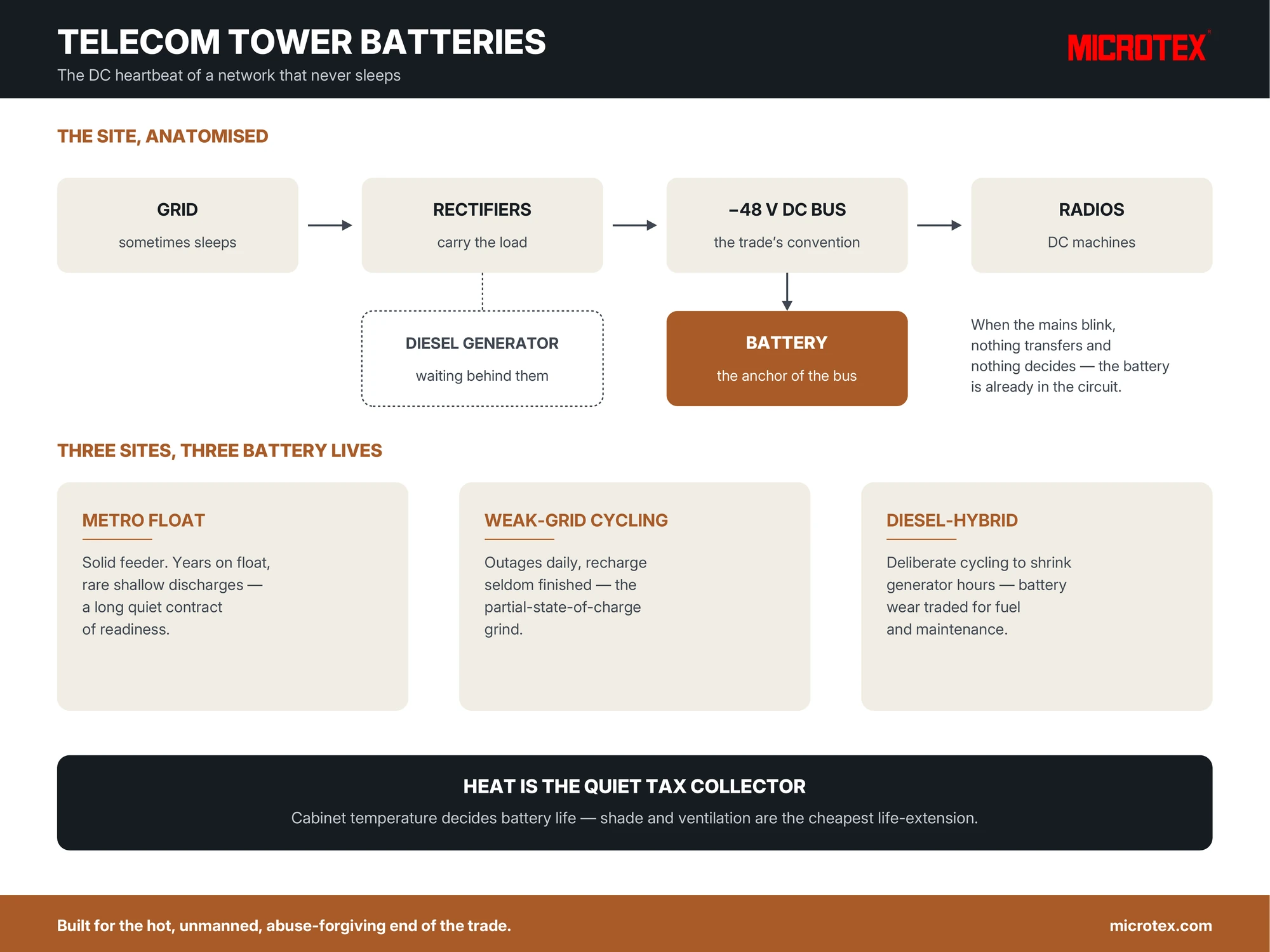
Heat is the quiet tax collector
Most tower batteries in this part of the world live in outdoor cabinets, and an outdoor cabinet in an Indian summer is a punishment cell. Battery chemistry runs faster when hot — the useful reactions and the destructive ones alike, grid corrosion included — and the pattern is unforgiving: sustained heat shortens battery life on the steep curve we set out in our guide to battery operating temperature. Two practical consequences follow. First, the cheapest life-extension equipment at a tower site is often shade, ventilation and cabinet placement, not a different battery. Second, construction matters: a gelled electrolyte in full contact with the cell walls conducts its internal heat outward better than a glass-mat separator holding the acid in suspension — one of the quiet reasons tubular gel suits hot, unmanned sites.
The honest chemistry fork
New tower installations increasingly specify lithium iron phosphate, and the reasons are real: less weight and floor space where rooftop leases charge by the kilogram, faster recharge in the short windows between outages, and high cycle counts for the hardest daily-cycling sites. We say that plainly, as we did in our lithium fire-safety review — which also explains why a lithium cabinet brings its own integration and protection homework. The tubular gel side of the fork earns its seat differently. An OPzV battery is sealed and never watered — decisive at a site nobody visits; it forgives the deep discharge that a long outage inflicts, and recovers with a proper recharge; it will sit on float for years without complaint; and at end of life it enters the settled, near-total lead-acid recycling chain, where its scrap value returns as a credit line in the ledger rather than a disposal fee. Trade reporting adds one unglamorous line to the comparison: battery theft remains a persistent operational drain at tower sites worldwide, and site security belongs in the battery budget whichever chemistry you buy.
What to ask before you buy
The right battery for a tower falls out of five questions, none of them about chemistry. What duty will this site actually run — float standby, daily outage cycling, or deliberate hybrid cycling? What do the outage statistics for this feeder really look like, measured rather than remembered? What temperature does the cabinet reach in May, measured rather than assumed? How long is the recharge window between discharges? And who takes the battery at end of life, at what value? Answer those, and the chemistry chooses itself site by site — which is why serious fleets run both. We build tubular gel for exactly the hot, unmanned, abuse-forgiving end of this trade, and we would rather lose a metro rooftop honestly than size your rural site wrongly. If you have outage data and a cabinet temperature log, put them to our engineers — the answer will come back in duty cycles and ampere-hours, not slogans.