
The grid has started buying storage by the day, not by the hour — and that changes which technologies get the cheque. This March, a storage project announced for Ireland paired a modest ten megawatts of power with a thousand megawatt-hours of energy: one hundred hours of discharge at full output, aimed at service by 2029. A year of announcements like it — the first utility-scale iron-air battery already operating in the United States, a gigawatt-hour-class follow-on ordered by the same utility group — has put a clumsy phrase into the trade’s vocabulary: long-duration energy storage, LDES. Here is what the phrase actually means, who the contenders are, and — because you would expect nothing else from us — where our own chemistry honestly sits. As throughout this article: the field is moving, the figures carry their dates, and this page will be refreshed as it moves.
Power is not energy
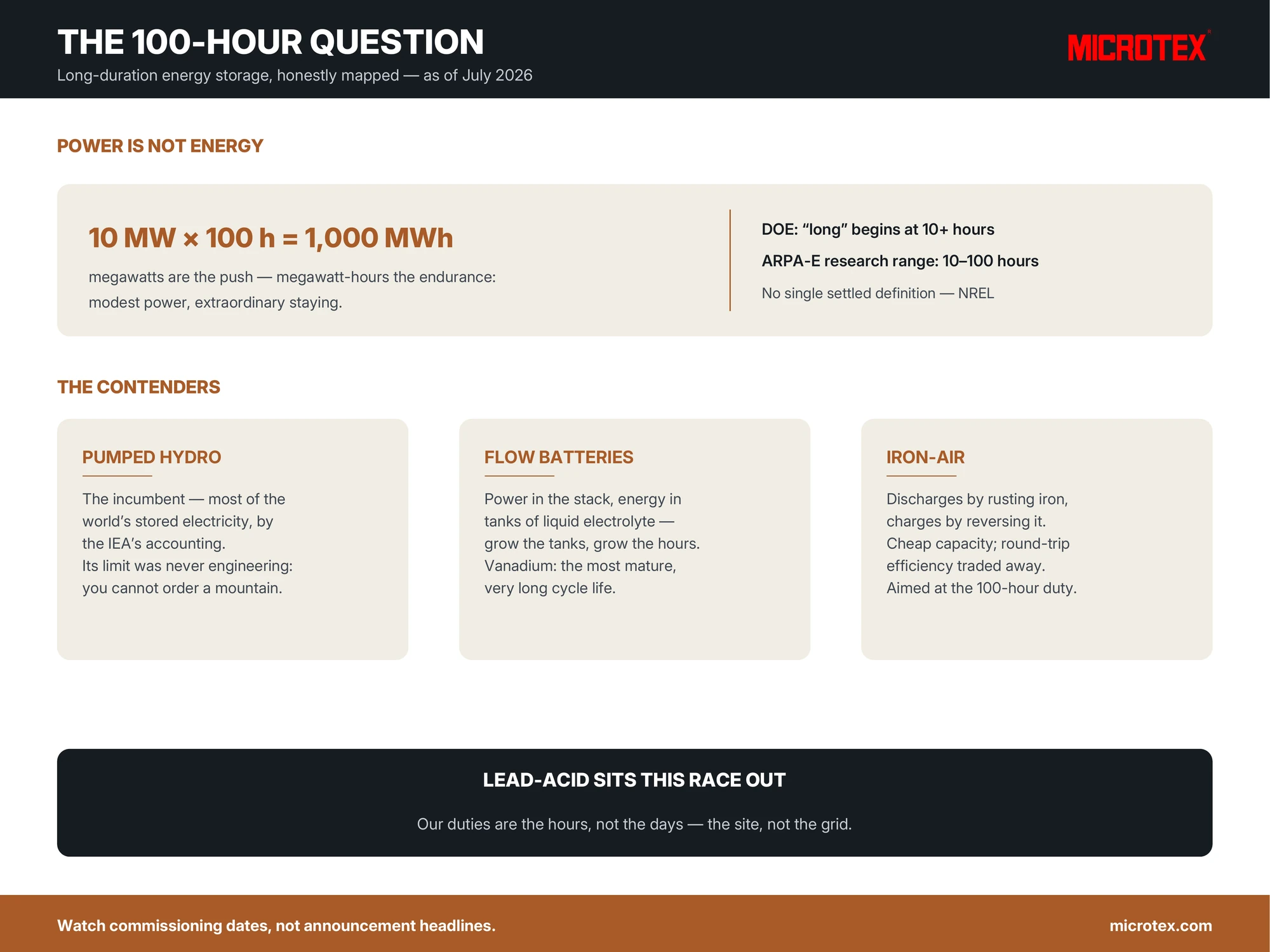
The whole subject turns on a distinction this library teaches everywhere: power is how hard a battery can push; energy is how long it can keep pushing. Megawatts are the push, megawatt-hours the endurance — and ten megawatts stretched across a thousand megawatt-hours is a sprinter’s opposite: modest power, extraordinary staying. How long must storage last to count as “long”? The United States Department of Energy draws its line at ten hours or more; its advanced-research agency ARPA-E has framed the research problem as ten to one hundred hours; and the National Renewable Energy Laboratory notes, honestly, that the trade has no single settled definition. Within the band, two different jobs hide: diurnal storage that shifts solar noon into evening peak, and multi-day storage that carries a grid across the windless, sunless stretches German grid engineers named dunkelflaute. It is the multi-day job that the new technologies are chasing.
The incumbent nobody counts
Long-duration storage is not new — most of the world’s stored electricity already sits behind dams. Pumped hydro — two reservoirs, a hill, and a century of operating practice — still accounts for the large majority of installed storage capacity worldwide, by the International Energy Agency’s accounting. Its limitation was never the engineering but the geography: you cannot order a mountain. Much of the new LDES field is best understood as an attempt to build pumped hydro’s endurance without its terrain.
Why lithium thins out past eight hours
Lithium iron phosphate has decisively won the short-duration grid book — the one-to-eight-hour systems our BESS guide describes. But a lithium plant’s cost scales with its energy: every additional hour of duration means buying that many more cells, and the tenth hour costs roughly what the second did. The LDES contenders all share one design idea — decouple the power from the energy. A flow battery keeps its energy as liquid electrolyte in tanks and makes its power in a separate cell stack: to double the hours you grow the tanks, not the stack. Vanadium flow is the most commercially mature of these, with very long cycle life and a settled industrial record. An iron-air battery goes further down the cheapness road: it discharges by letting iron plates rust in controlled fashion and charges by reversing the rust, storing energy in one of the cheapest materials on earth. The price of that cheapness is paid elsewhere — round-trip efficiency well below lithium’s, a deliberate design trade — and its makers aim it squarely at the hundred-hour, multi-day duty. As of 2026 the scorecard reads: one utility-scale iron-air plant operating in the United States, gigawatt-hour-class projects announced on both sides of the Atlantic, and compressed-air, thermal and gravity schemes filling out the field behind them.
Why now — the demand side
Two forces pulled LDES from conference papers into purchase orders. The first is the renewable-heavy grid itself: as solar and wind displace fuel, the gap between a bad week and a blackout must be bridged by something, and hours-class batteries cannot bridge days. The second is newer: the extraordinary growth of computing load. Utilities planning for data-centre demand are procuring reliability in bulk, and trade reporting through 2025 and 2026 ties several of the largest LDES commitments directly to that load growth. When a technology’s buyers change from pilot programmes to utility procurement, it has stopped being a science project — though it is worth saying that at the hundred-hour end, commissioned plants remain few and small; watch commissioning dates, not announcement headlines.
Where lead-acid honestly sits: out of this race, busy elsewhere
Now the question you came to a lead-acid maker’s website to ask. Is lead-acid a long-duration contender? No. We said in our honest outlook on lead-acid’s future that grid-scale battery storage has gone to lithium and is not coming back to us; multi-day storage now belongs to these newer classes, and pretending otherwise would cost us the credibility this library runs on. Our trade’s seat is different and unglamorous: the hours class, where the duty is a site rather than a grid. The substation bank that carries protection systems through an outage; the telecom tower that must transmit through the evening’s load-shedding; the solar installation cycling its bank every single day — a duty where lead-carbon designs have genuinely raised the chemistry’s game. Duration, it turns out, is a procurement class: buy the duration your duty needs, not the duration in the headlines. A factory’s backup problem is an hours problem; no factory needs a hundred-hour battery, and no hundred-hour battery will crank your generator or hold your DC bus.
The honest verdict
Long-duration storage is real, needed, and — as of 2026 — arriving: definitions from the DOE and ARPA-E, an incumbent in pumped hydro, flow batteries commercially mature at moderate durations, iron-air moving from first plant to first fleet, and demand pulled by grids that must survive their worst week rather than their average day. None of it changes what you should buy for a site-class duty this year, and none of it needed a single exaggerated number to be worth your attention. If your storage question is an hours question — backup, cycling, DC systems, or an honest second opinion on a storage proposal — put it to our engineers, and the answer will come back in duty cycles and ampere-hours, not headlines.