
Solar looks like the gentlest duty a battery could have — and it is quietly the hardest. No violent starting currents, no vibration, just sunshine in and lamplight out. Yet solar installations kill more batteries per year of service than almost any duty we supply, and they do it with three polite-looking demands: a deep discharge EVERY night, a recharge that depends on tomorrow’s weather, and years of service in places nobody visits. Understanding those three is the difference between a bank that lasts the design life and a bank that dies in eighteen months with the installer blaming the panels.
The real enemy has a name: partial state of charge
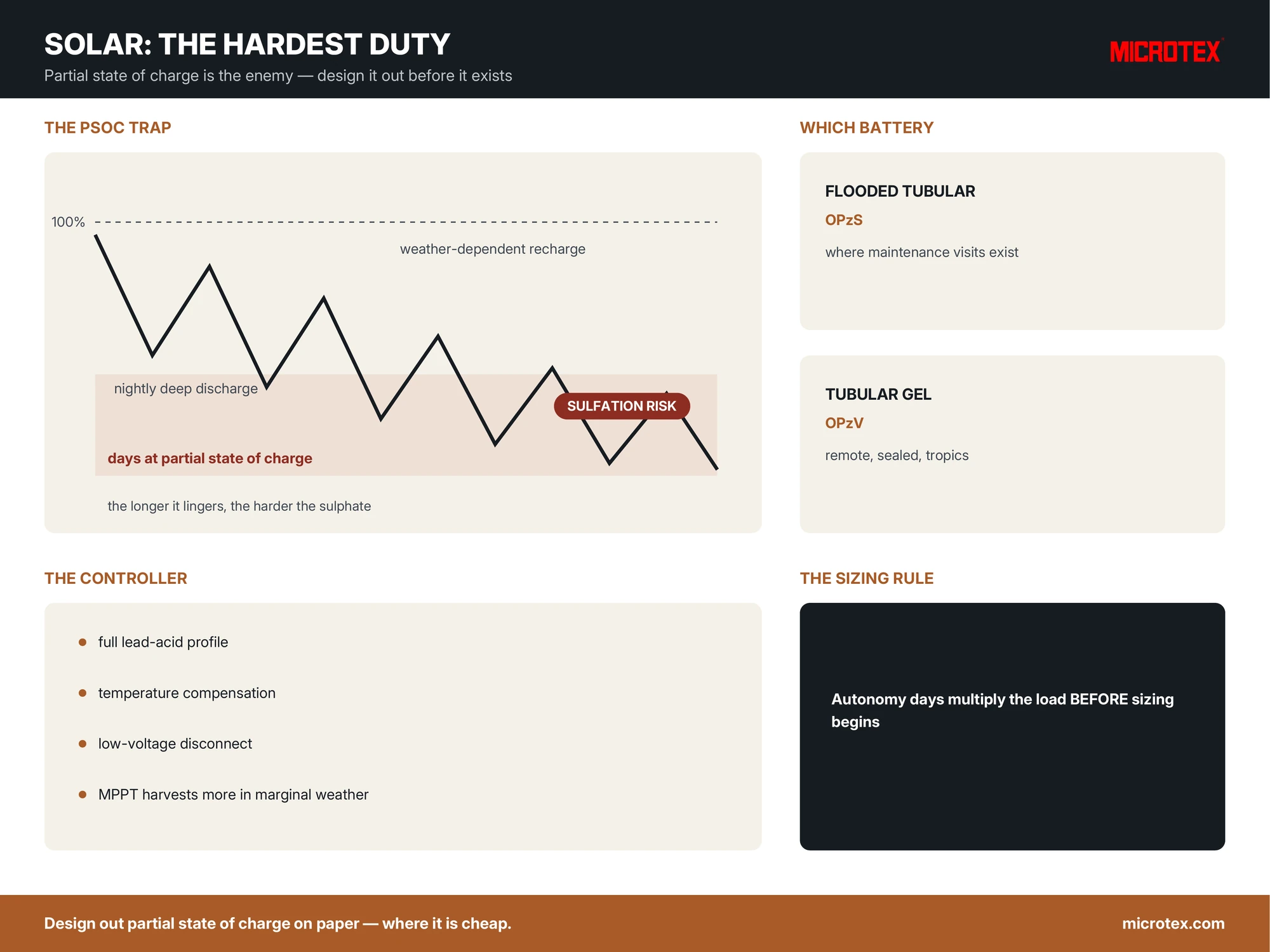
A grid-charged battery finishes every day full. A solar battery finishes every day with whatever the sky provided — and in monsoon weeks, winter stretches or undersized arrays, that means living for days at PARTIAL state of charge, the condition the trade calls PSOC. For lead-acid chemistry this is the cruellest regime there is: the battery spends long hours holding exactly the discharge products that harden into permanent sulfation, never getting the full, finishing charge that would convert them back. The research literature on photovoltaic duty cycles documents the mechanism thoroughly; the field documents it as banks that fade years early with no single day of visible abuse. Every design rule that follows exists to fight PSOC — that is the lens that makes solar battery selection make sense.
Which lead-acid survives solar — and which doesn’t
Start with the exclusion: automotive and flat-plate SLI batteries do not belong in solar service, whatever the shopkeeper says — thin starting plates fed daily deep cycles shed themselves to death in a season, as the plate-construction guide explains. Solar wants the deep-cycle family: the tubular plate for its caged active material and deep-cycle endurance, in one of two clothings. Flooded tubular (OPzS class) where maintenance visits are real — it accepts the corrective, stirring charges that undo PSOC’s accumulation and lets a technician read the acid directly. Or the tubular gel cell — the OPzV — where they are not: sealed against watering neglect, spill-proof on rough sites, tolerant of the tropics, the textbook remote-solar battery. The tubular-gel-versus-flooded comparison weighs the pair honestly. And because this site does honesty even when it costs us: lithium iron phosphate genuinely shines in solar duty — PSOC barely troubles it and its cycle life is superb — at a higher upfront price, with electronics that must be trusted unattended for a decade, and without lead’s closed recycling circle. Cost, simplicity, recyclability and heat-proven service records keep tubular lead-acid the working choice across most of the off-grid world; the chemistry comparison holds the full scorecard.
The system around the battery
Three design decisions guard the battery. Sizing with autonomy: a solar bank is sized not for one day but for the sunless RUN of days the site must survive — autonomy days multiply the load before the sizing chain even begins, and an undersized bank is condemned to permanent PSOC on day one; the arithmetic is the honest installer’s first duty. The charge controller: between panels and battery sits either a simple PWM controller (rugged, cheap, fine for modest systems matched to battery voltage) or an MPPT controller, which harvests meaningfully more from the same panels — energy that, in marginal weather, is precisely the finishing charge that fights sulfation. Whichever type: it must carry a proper multi-stage lead-acid profile with settings from the battery’s datasheet, temperature compensation for hot climates, and low-voltage disconnect so appliance-hungry evenings cannot over-discharge the bank into an early grave. The maintenance calendar: even sealed banks deserve an annual visit — connections, readings, a controller check — and flooded banks their equalising discipline, because in solar service the equalising charge is not optional polish; it is the periodic undoing of everything PSOC accumulated.
The one-paragraph buying guide
Size for the true load with real autonomy days; buy deep-cycle tubular, flooded where maintenance exists, gel where it doesn’t; insist on a controller with a full lead-acid profile and temperature compensation; never let an SLI battery near the job; and plan the recharge, not just the discharge. We have supplied solar and solar-hybrid banks across India and export markets for decades — from village systems to telecom and institutional installations — and the pattern in every long-lived bank is the same: the chemistry was chosen for the DUTY, and somebody did the arithmetic. Send us your loads, site and sun profile, and the bank comes back engineered — with the PSOC problem designed out on paper, where it is cheap to fix.