
A battery is not a bucket, and this is the single most expensive misunderstanding in fleet charging. Take a hundred ampere-hours out of a cell and you cannot put a hundred back and call the job done — you must put more back, every time, for the whole life of the battery, and you pay your electricity tariff for the excess. The multiplier has a name, the charge factor, and it appears on almost no purchase order and in almost no budget. Then there is a second, larger loss hiding behind the first: the energy efficiency, which is worse than the ampere-hour efficiency for a reason most people have never had explained. This guide sets out both, what they cost, and what makes them worse.
Two efficiencies, not one
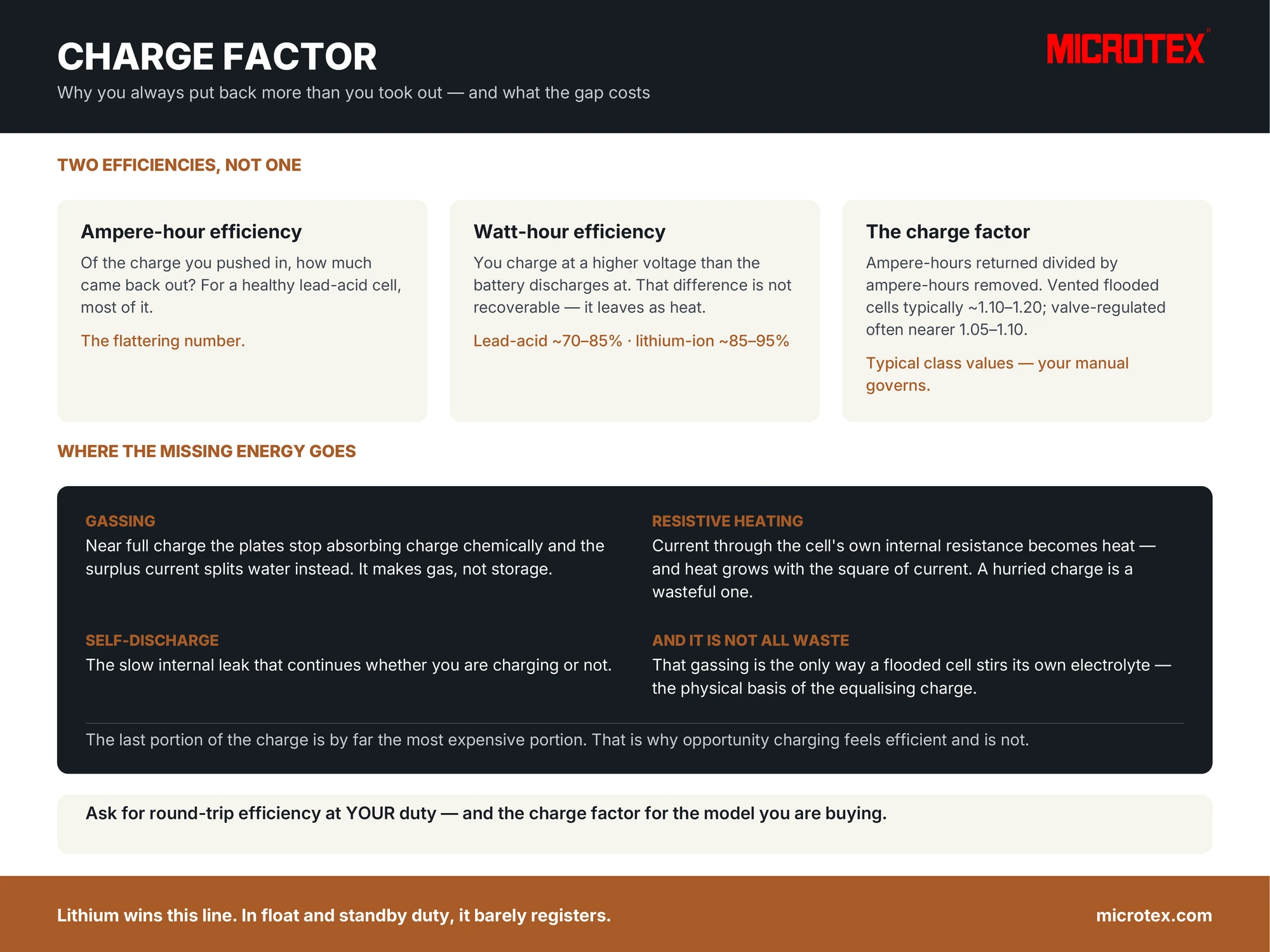
Ampere-hour efficiency asks a simple question: of the charge you pushed in, how much came back out? For a healthy lead-acid cell the answer is high — most of the charge that goes in is available again. Energy efficiency, measured in watt-hours, asks a harsher question, because energy is volts multiplied by amperes multiplied by time, and you charge a battery at a higher voltage than the voltage at which it discharges. That difference is not recoverable. It is the price of pushing the reaction backwards, and it leaves the battery as heat before you ever see it again. This is why the watt-hour figure is always poorer than the ampere-hour figure, and why quoting the flattering one is a small, popular deception. National-laboratory-class storage documentation puts lead-acid round-trip efficiency broadly in the seventy to eighty-five per cent region and lithium-ion in the eighty-five to ninety-five region — figures we publish here, as elsewhere on this site, including where they are unflattering to us.
Where the missing energy goes
Three destinations, in order of size. First, gassing: as a cell approaches full charge, the plates become less able to absorb charge chemically, and the surplus current starts splitting water into hydrogen and oxygen instead. That current does no storage work at all — it makes gas, which is why flooded batteries need topping up and why the room needs ventilation, as our guide to why batteries explode sets out. Second, resistive heating: current flowing through the cell’s own internal resistance produces heat, and heat grows with the square of current — so a hurried charge is a more wasteful charge as well as a harder one. Third, self-discharge, the slow internal leak that continues whether you are charging or not. Notice where the first loss sits on the timeline: the last portion of the charge is by far the most expensive portion, which is exactly why opportunity charging feels efficient and is not, and why a battery that never quite finishes never quite works.
The charge factor — and its second job
The charge factor is the ratio of ampere-hours returned to ampere-hours removed. For vented flooded cells it typically sits somewhere around 1.10 to 1.20 — that is, ten to twenty per cent more charge back in than came out. Valve-regulated designs, which recombine most of the gas internally rather than losing it, typically need less, often nearer 1.05 to 1.10. Those are class-level typical values and nothing more: your battery’s manual governs, and a maker who cannot tell you the charge factor for the model you are buying has told you something useful about themselves. The important part is that this excess is not pure waste. It has a second job. The gassing it produces is the only mechanism a flooded cell has for stirring its own electrolyte, which is what prevents acid stratification from consolidating, and it is the physical basis of the equalising charge. Charging to exactly one hundred per cent of what you removed would be cheaper on the meter and ruinous in the battery room.
What it costs — illustrative arithmetic
These numbers are invented to show the method, exactly as in our total cost of ownership guide. Suppose a fleet takes 100 kilowatt-hours out of its batteries each working day at a round-trip efficiency of 80 per cent. Then 125 kilowatt-hours must be bought to return 100 — the extra 25 leaves as heat and gas, and the ventilation then spends a little more energy removing it. Over roughly 300 working days that is 7,500 kilowatt-hours a year of electricity that never reached a wheel. Now change one assumption: at 70 per cent the same fleet buys about 143 kilowatt-hours a day rather than 125 — a fifteen per cent larger electricity bill for identical work, arising entirely from a number nobody asked for at the quotation stage. The arithmetic is trivial; the point is that almost nobody does it, and the gap between two batteries on this single line can be wider than the gap in their prices.
What makes it worse
Efficiency is not a fixed property of a battery; it is a property of how you treat one. Heat makes it worse — a hot cell gasses earlier and more freely, one more reason our guide to operating temperature keeps insisting on ventilation and spacing. Age makes it worse, as internal resistance rises and charge acceptance falls. The wrong charger profile makes it worse by dwelling in the region where current makes gas rather than storing charge — the machine’s role is set out in our guide to battery chargers. Undersized or corroded cabling makes it worse in a way people rarely trace: volt drop between charger and battery means the charger works harder and longer for the same result. And chronic partial charging makes it worse twice over, wasting the expensive top-of-charge portion repeatedly while letting stratification and sulfation set in. Note too that the charger has its own efficiency, from the mains to its output terminals — a separate number from the battery’s. Ask for both.
Where this line goes against us
Honestly stated: lithium iron phosphate wins the efficiency line cleanly. It needs little or no overcharge, wastes less at the top of charge, and returns a higher share of the energy fed into it. For a fleet cycling hard every day at a high electricity tariff, that difference is real money and should be priced, not argued with. The counter-case is narrower than our industry usually pretends but it is genuine: in float and standby duty — a substation bank, a plant’s DC system, a UPS that discharges a few times a year — the battery spends its life waiting rather than cycling, and the efficiency line barely registers against purchase price, service life and end-of-life value. So the rule is simple. If your batteries cycle daily, ask for round-trip efficiency at your duty and the charge factor for the model, put both into the ledger, and let the arithmetic choose. Send us your duty cycle and daily energy and we will do that arithmetic with you — including, where it points that way, the answer that does not favour our chemistry.