
A lead-acid battery’s container is a structural part, a viewing window and a fire-behaviour decision, and most buyers never ask what it is made of. This post collects what four reference works say about container and lid materials, with the honest limits. We draw on Linden’s Handbook of Batteries, Crompton’s Battery Reference Book, Dell and Rand’s Understanding Batteries and a genericised German stationary-battery handbook; the material for your battery is your maker’s to state.
From glass and hard rubber to plastic
Dell and Rand trace the history for automotive batteries: early glass containers gave way to a bituminous composition, then to moulded rubber, then to polypropylene. Polypropylene cut the weight and allowed the case and cover to be heat-sealed together. Crompton says cell boxes were traditionally hard rubber, with increasing use of plastics, and that polypropylene is more robust and allows a heat-sealed joint between box and lid, a significant improvement on the older seals. Linden makes the same point for industrial batteries: lighter plastic containers replaced hard rubber, with better seals.
What the stationary tables list
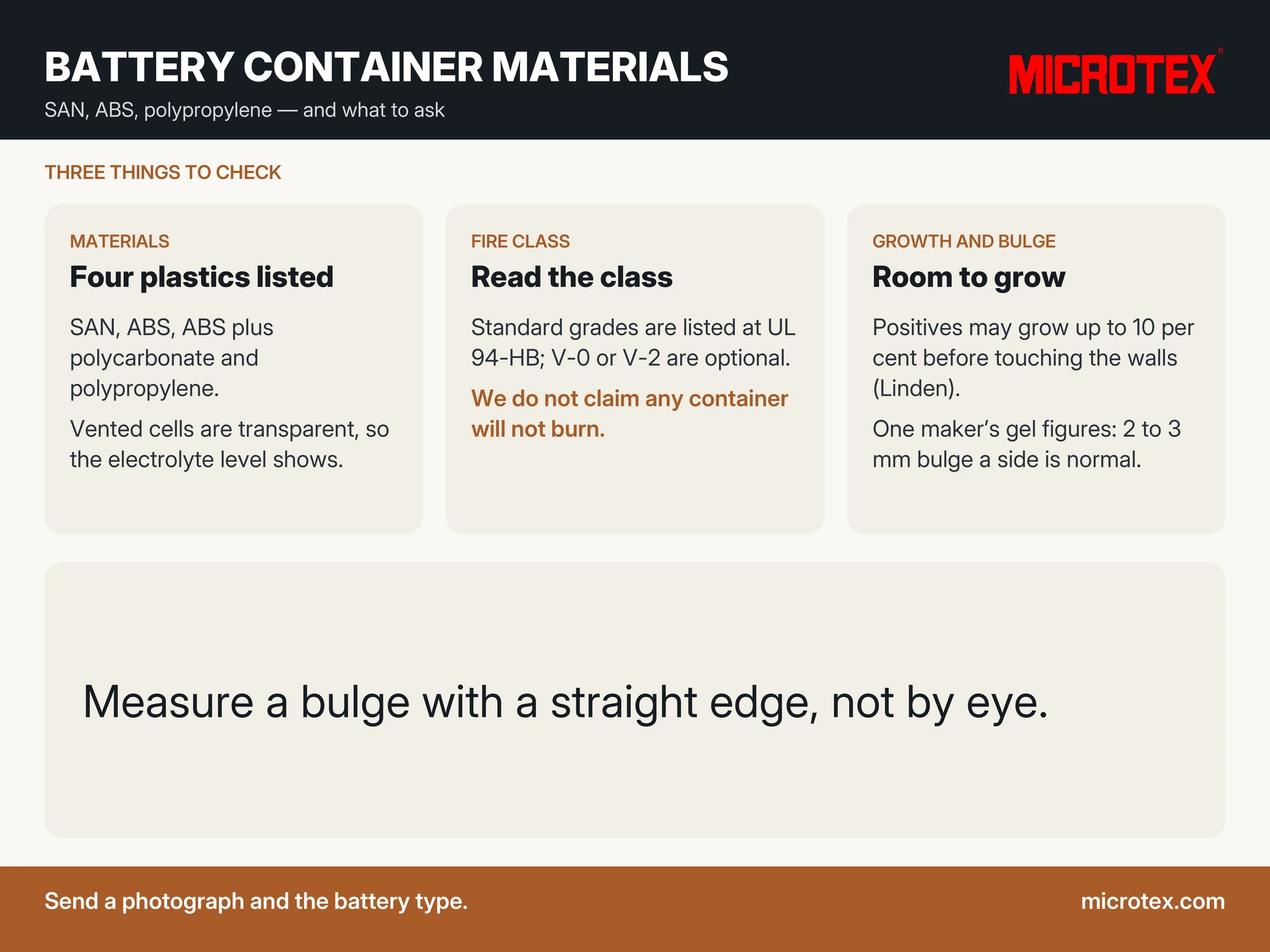
The handbook lists four materials for containers and lids: SAN, ABS, a blend of ABS and polycarbonate, and polypropylene. For its vented cells the housings are transparent, which lets you see the electrolyte level. In its table, SAN is used for vented cells up to 3,000 Ah, ABS for the block types, and polypropylene for the largest cells. Linden agrees that stationary containers are usually transparent thermoplastics, and adds that some small stationary batteries use translucent polyolefin. That table is one maker’s, and other makers choose differently, so ask for yours. One small detail from the handbook is worth knowing: a container is slightly conical so that it comes out of the injection mould, and on racks with a bend of more than 2 mm the cells can look crooked when they are not.
Fire behaviour: read the class, not the colour
For every range it lists, the handbook gives the plastic’s UL 94 flammability classification. The standard material is listed at UL 94-HB, and for several ranges a V-0 or V-2 grade is shown as an optional extra, and the tables list the lid and the container together, so ask about both. Our reading is that ordinary container plastics burn, that the standard class is the basic one, and that a stricter class is something to ask for and to pay for. UL 94 is a plastics standard with its own definitions, so check them before you write a class into a specification. We do not claim that any battery container will not burn. Our guide to battery room design covers what a site should plan around that fact.
Room to grow
Linden explains that the distance from the positive plate to the container wall is set so that the positives can grow by up to 10 per cent before they touch the walls. Growth beyond that loosens the active material and leaves the battery severely positive-limited, and it must be replaced. The handbook adds that Planté plates hang on shoulders in the container so that they can grow downwards. The lesson is practical: a container is sized to its plate pack, so a cell is not a place to fit a different one. Our guide to positive grid corrosion explains why the plates grow.
Bulging and contraction in sealed batteries
For its gel batteries the handbook says the internal pressure is about 0.06 to 0.18 bar, which is the opening pressure of the valves, so the container walls and lid may bulge slightly. It treats 2 to 3 mm per side as normal, says 5 mm should not be exceeded, and says anything beyond that needs examination. Temperatures above 55 °C can add to the bulging. A visible contraction, it adds, can signal a deep-discharged condition. These are one maker’s gel-product figures, so do not apply them to another design. Our guides to the VRLA battery and to thermal runaway cover the sealed types.
What to check on site
Look for cracks, weeping seams, a bulge that is larger than last time and discolouration near a hot spot, and record each with a dated photograph. Measure bulging with a straight edge and not by eye. The lid-to-container joint is a manufactured seam, so a seam that weeps on a new battery is a defect to report on arrival and not a fault to live with. On a rack, a bulged cell also pushes on its neighbours, which is another reason to measure it and not to ignore it. A container fault is a symptom as often as a cause, so pair it with the readings in your failure analysis routine. Send us a photograph and the battery type and we will say what we see.
Sources quoted: T. B. Reddy (ed.), Linden’s Handbook of Batteries, 4th ed. (McGraw-Hill, 2011), chapter 15 and chapter 16, section on stationary batteries; T. R. Crompton, Battery Reference Book, 3rd ed. (Newnes, 2000), chapter 18; R. M. Dell and D. A. J. Rand, Understanding Batteries (Royal Society of Chemistry, 2001), chapter 8; Handbook for Stationary Lead-Acid Batteries, Part 1, 3rd ed. (December 2008), section on cell and block housings; UL 94 (verify current edition).