
A battery behind a UPS does not discharge at a steady current; it discharges at a roughly steady power, and that changes how it should be sized and tested. The difference is easy to miss on a datasheet that lists only ampere-hours. We draw on Linden’s chapter on factors affecting battery performance and on a genericised German stationary-battery handbook for UPS practice; the figures for your cells come from your maker’s tables, and we print none.
Three ways to empty a battery
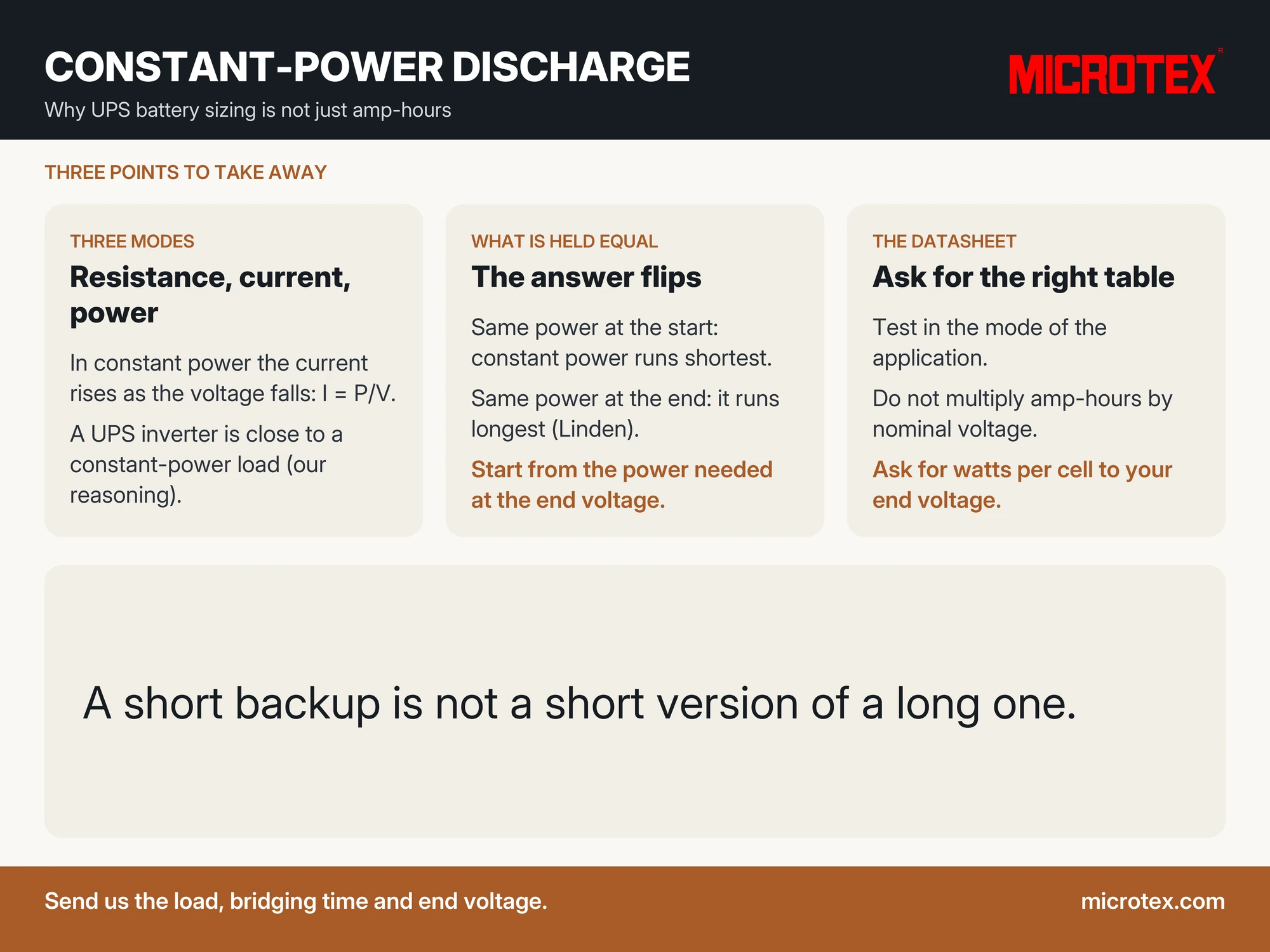
Linden names three basic discharge modes. In constant resistance the current falls as the voltage falls, following I = V/R. In constant current the current stays the same. In constant power the current rises as the voltage falls, following I = P/V, so the battery delivers the same power throughout. The mode changes the service time you get from the same battery, which is why the mode matters when you compare figures. Linden also gives a power equivalent of the C rate, called the E rate, written P = M × En, where En is the rated energy in watt-hours at the n-hour rating; our guide to the C rate covers the current version.
Why a UPS is close to a constant-power load
This is our reasoning, not a quotation. An inverter must deliver the power its load demands, and as the battery voltage sags during discharge the inverter draws more current to hold that power. The handbook says UPS bridging times are mostly in the range of 1 to 30 minutes, long enough to start an alternative power source or to shut the load down in a controlled way, and that valve-regulated batteries are mostly used (as of its 2008 edition). It refers to the IEC 62040 series for UPS requirements; verify the current editions before relying on them. This is also why a UPS cell is sold with its own table, because the table already carries the rising current. At the end of the discharge the current is at its highest while the voltage is at its lowest, so a loose joint or an undersized cable costs the most at exactly the moment you need the battery; our guide to bank cables and connectors covers that part. Our guide to data-centre batteries covers the wider picture.
It depends on what you hold equal
Linden compares the three modes under three conditions, and the answer changes with the condition. If the loads are set so that current and power are the same at the start, constant current runs shorter than constant resistance, and constant power runs shorter still, because its average current is higher. If the loads are set so that the power is the same at the end of discharge, which Linden calls the most realistic case for equipment that needs a minimum input power, the order reverses: constant power has the lowest average current and the longest service. He adds that the advantage depends on the battery, and is larger for systems that give a wide voltage range. So constant power is not harsher or kinder by nature. The comparison rule decides, and a fair rule starts from the power the equipment needs at the end voltage.
What this means for a datasheet
Linden’s practical rule is that the mode of discharge used in a test should match the application, or the results will be wrong. Our advice follows from it. Do not multiply ampere-hours by the nominal voltage to estimate run time, because that ignores the falling voltage and the rising current. Ask the maker for a constant-power table for your exact cell type, in watts per cell to a stated end voltage for your bridging time, and say which end voltage your UPS allows. Ask also whether the figures in the table already include any allowance for ageing and for temperature, because a table that is silent on them is only a starting point. Our guides to reading a battery datasheet, to Peukert’s law and to battery sizing explain the neighbouring ideas.
A short backup is not a short version of a long one
Again our reasoning: a ten-minute discharge pulls much larger currents than a long rate does, so voltage drop across the cells’ internal resistance matters more, and the end voltage is reached sooner. A substation battery, by contrast, is usually described as a sequence of current steps over hours; our guide to the substation duty cycle shows the method. The two jobs need different questions.
When you ask for a quotation, give the load in watts or kilovolt-amperes with its power factor, the inverter’s DC voltage window, the bridging time, the end voltage, the room temperature and the ageing margin your specification names. Send us those figures and we will say which of our cells we would size, and where we would want the maker’s own table.
Sources quoted: T. B. Reddy (ed.), Linden’s Handbook of Batteries, 4th ed. (McGraw-Hill, 2011), chapter 3, section on mode of discharge; Handbook for Stationary Lead-Acid Batteries, Part 1, 3rd ed. (December 2008), section on uninterruptible power supply; IEC 62040 series (verify current editions).