
The power stations being built fastest today arrive on trucks. Drive past a new solar park or a substation expansion almost anywhere in the world and you will see them: rows of white shipping containers on concrete plinths, humming quietly behind a fence. Each one is a battery energy storage system — a BESS — and together they are the grid’s newest tool for a very old problem: electricity is made when it is made, and wanted when it is wanted. This guide opens the container, explains the jobs grid batteries actually do, tells the truth about which chemistry has won the current round — and is equally honest about where our own chemistry still earns its keep.
Inside the container
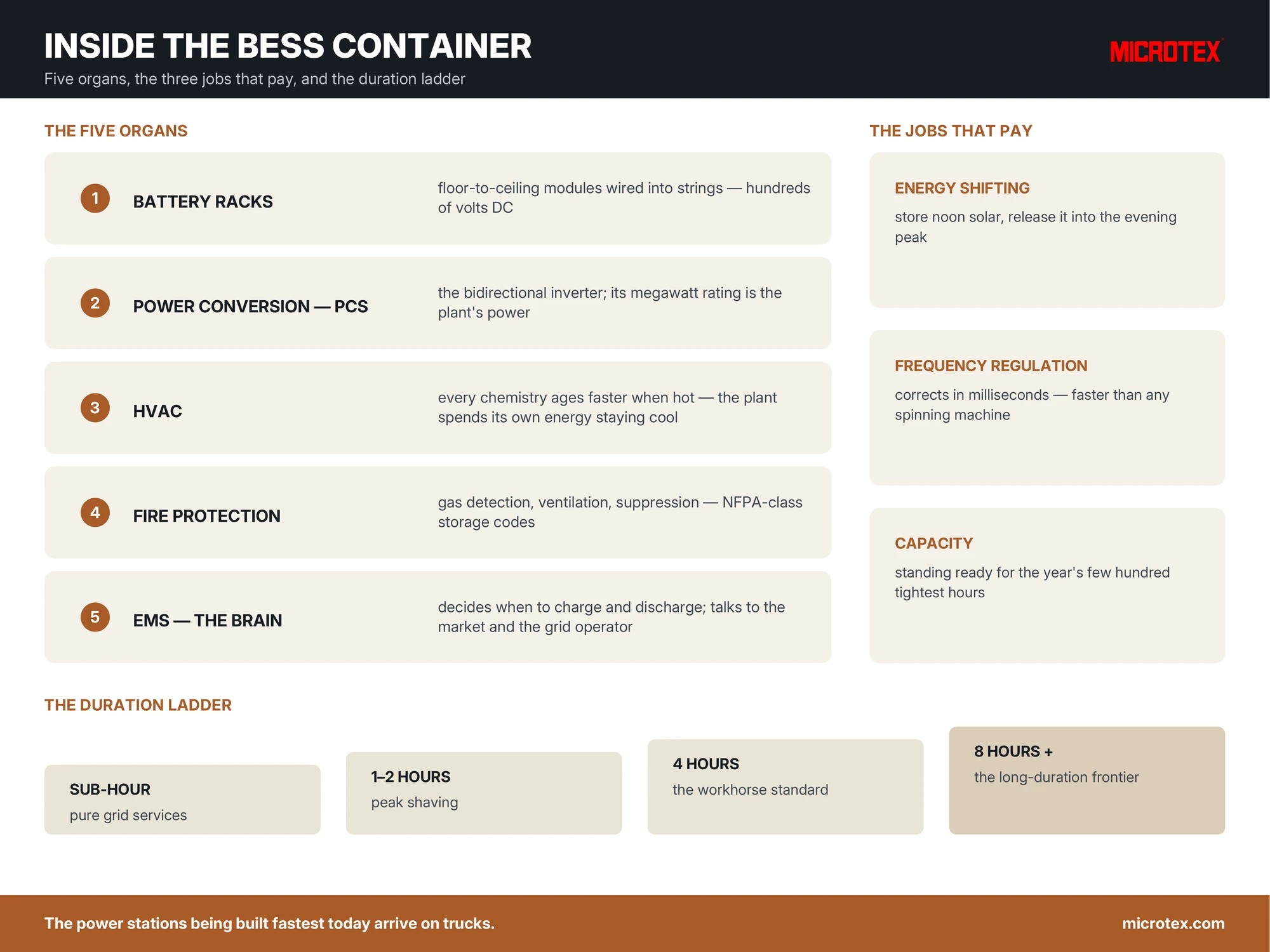
A BESS container is a small power station with five organs. First, the BATTERY RACKS — floor-to-ceiling steel shelving holding battery modules, each module a brick of cells with its own monitoring electronics, wired into strings that add up to hundreds of volts DC. Second, the PCS or power conversion system — a bidirectional inverter that turns the batteries’ DC into grid-frequency AC when discharging and back again when charging; it is the container’s mouth, and its rating in megawatts is the plant’s power. Third, the HVAC — because every battery chemistry ages faster when hot (the same temperature arithmetic that rules a lead-acid room rules a lithium rack), a BESS spends part of its own stored energy keeping itself cool. Fourth, FIRE PROTECTION — gas detection, ventilation and suppression engineered to standards written specifically for storage plants, such as the NFPA’s energy-storage installation code in the US. Fifth, the EMS — the energy management system, the site’s brain, which decides when to charge and discharge, talks to the market or the grid operator, and sits above the battery-level electronics the way a plant manager sits above shift supervisors. Transformer and switchgear connect the whole assembly to the network.
What grid batteries actually do
Three jobs pay for most of the world’s grid batteries. ENERGY SHIFTING: store cheap solar at noon, release it into the evening peak — the job that dominates as solar grows, and the reason storage and solar are now planned together. FREQUENCY REGULATION: grid frequency must hold steady second by second, and a battery can correct its output in milliseconds — faster than any spinning machine — which makes even a modest battery a superb stabiliser. CAPACITY: standing ready to serve the year’s few hundred tightest hours, so that a peaking plant need not be built. Around these sit quieter earnings — deferring an overloaded transformer’s upgrade, black-start duty, smoothing a wind farm’s output. Duration sorts the fleet into classes: sub-hour plants for pure grid services, one-to-two-hour plants for peak shaving, four-hour plants as the workhorse capacity standard, and beyond that the long-duration frontier — eight hours and more — where batteries begin competing with pumped hydro, and where much of the technology race is now aimed.
Why lithium iron phosphate rules the fleet
Here the honesty is easy, because the numbers are public. Per BloombergNEF, and echoed by the IEA’s storage reviews, lithium iron phosphate — LFP — accounts for roughly 90% of new grid-storage deployments, a share it built in barely five years. The reasons are sound engineering, not fashion: LFP offers long cycle life, falling cost, and more benign fire behaviour than the nickel-rich lithium-ion chemistries it displaced, and a battery that sits on concrete never needs the energy density that nickel buys. The scale is historic: BloombergNEF counts 2025 as the first year global storage additions entered the hundred-gigawatt era, with still more forecast for 2026 — a forecast, but one backed by contracted pipelines. When a market speaks that clearly, a rival chemistry’s website should simply report it.
Where lead still plays — honestly
Lead-acid will not win today’s utility-scale auctions, and we will not pretend otherwise. But the grid is bigger than its auctions, and in the smaller rooms lead keeps earning its place: the substation DC systems that must trip breakers on the grid’s worst day, telecom and UPS standby, island and village systems, and off-grid solar across the hot, remote geographies where a battery must forgive neglect. The lead industry’s research arm has larger ambitions too: the Consortium for Battery Innovation documents advanced lead-carbon storage plants from a 25 MWh installation in Germany to user-side plants in China at the hundred-megawatt-hour scale, and its technical roadmap sets cycle-life and charge-acceptance targets aimed squarely at storage duty. Add the argument the auctions ignore — lead is the only battery chemistry with a closed recycling loop already running at scale — and the honest summary reads: LFP owns the gigawatt front; lead earns the guardposts, and is training for more. If your project is a bank measured in kilowatt-hours rather than megawatt-hours — backup, solar, substation, telecom — size it properly and talk to us; that is the end of the market where we will give you the straightest answer in the industry.