
India builds industrial batteries at every quality level that exists — and every factory’s brochure is printed on the same glossy paper. If you searched “battery manufacturers in India”, you probably wanted a list. We will be straight with you about why you should not want one: we are a manufacturer ourselves, so any list we published would be advertising wearing a lab coat. What we can give you honestly is worth more — the checklist an insider would use to evaluate any battery factory, ours included. Six questions, each with a reason, each answerable before you sign anything. We will show our own working as we go; hold every factory you shortlist, including us, to the same standard.
One: ask who makes the plates
The plate is the battery — the lead-acid battery’s entire working life happens in its plates, and everything else is packaging and plumbing. So the first sorting question is vertical integration: does the factory cast, paste, cure and form its own plates, or buy them in and assemble? Neither answer is automatically damning, but they are different businesses — an assembler’s quality ceiling is set by someone else’s process discipline, and when a batch goes wrong, an assembler can only inspect what a plate-maker could have prevented. Ask the question plainly, and ask the follow-up that exposes bluffing: “May we see the pasting line and the curing chambers on a visit?” For our part: we have made our own plates in Bengaluru since well before most of our competitors existed — the company was established in 1969 — on plate-making and formation lines of American and European origin.
Two: ask how the plates are formed — and for the records
Formation — the factory first-charge that turns cured paste into working electrodes — is the process a buyer never sees and lives with forever, as our battery formation guide explains. You cannot inspect it at delivery; you can inspect its paperwork. A factory that controls formation keeps charge logs and per-batch records, and will not be offended when you ask what travels with your batch. Pair this with the documentation question our battery standards guide arms you for: which standard does the datasheet claim, type-test evidence versus routine acceptance-test evidence, and — where a certification mark is claimed — ask to see the certificate itself and check its scope covers the model you are buying (certification regimes change; verify what applies to your product, as of 2026 and whenever you read this). No standard number on the datasheet at all is also an answer.
Three and four: the test they welcome, and the help after the crate
Question three is the single sharpest instrument in this article: “Will you support a witnessed acceptance discharge test?” The discharge test is the only proof of capacity there is — our battery testing guide is blunt about that — and a factory’s reflex when you propose one tells you nearly everything. Enthusiasm is a good sign; conditions and hedging are a sign too. We welcome acceptance tests on our batteries, and have said so in print. Question four follows the crate: what happens between delivery and duty? A serious supplier can walk you through the commissioning sequence for their product — receiving, storage, first charge, baseline records — and tell you exactly what support they provide at each step. The factories that go quiet after despatch also tend to go quiet when a warranty question arrives.
Five and six: the post-mortem question, and the warranty read honestly
Question five: “When a battery fails, how do you investigate?” A manufacturer with nothing to hide has a method and will describe it — history first, then hardware. Ours is published on this site, verdicts and all, which is not a marketing flourish: a factory that documents its post-mortems is a factory that expects to survive them. Question six: read the warranty as an engineer, not a lawyer. What duty does it assume, what does it exclude, what evidence does a claim require — and does the supplier help you keep that evidence (baseline logs, maintenance records) or hope you won’t have it? Fold the answer into the arithmetic our total cost of ownership guide teaches: purchase price is one line of seven, and the cheap quotation that dodges questions one to five is rarely cheap by year three.
The checklist, and our own answers
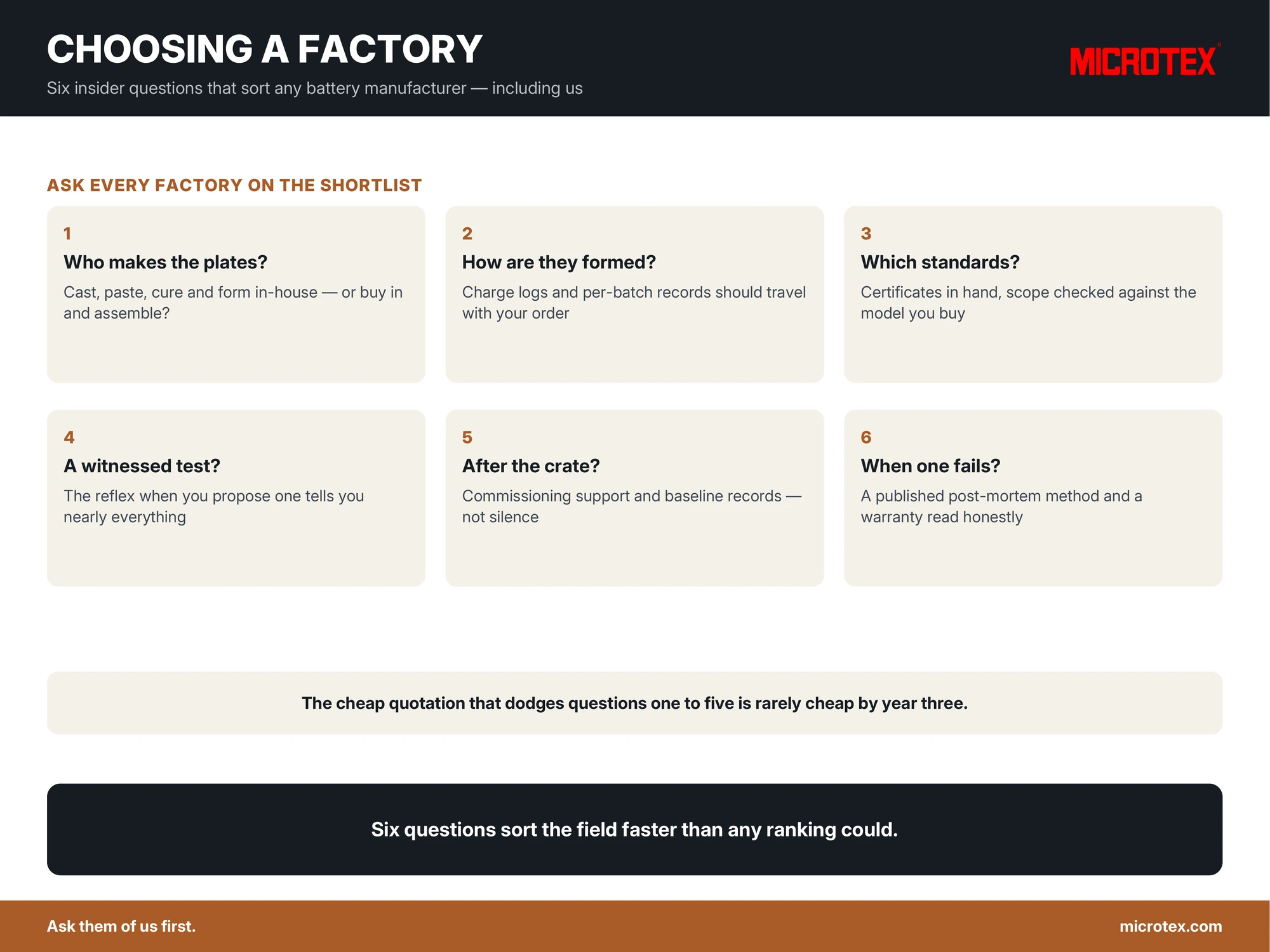
Six questions, then: who makes the plates; how are they formed and what records travel; which standards, with certificates whose scope you have checked; will they stand a witnessed acceptance test; what commissioning support comes after the crate; how do they investigate failures and what does the warranty really require. Ask them of every factory on your shortlist and the field will sort itself faster than any ranking could. Ask them of us first, if you like — our engineers answer these six for a living, and the ones about plates and formation are their favourites.