
Trickle charging and float charging are not the same thing, and the difference is measured in years of battery life. The two words get used interchangeably in shops, on packaging and across the internet, which is how perfectly good batteries end up quietly cooked by devices their owners trusted. The distinction is not pedantry. It is the difference between a charger that asks the battery what it needs and a charger that force-feeds it regardless. One of these philosophies keeps standby batteries healthy for decades; the other slowly destroys a battery precisely because it is full. This guide draws the line once, clearly, so you can tell which side of it any charger sits on — whatever its box says.
Two words, two control philosophies
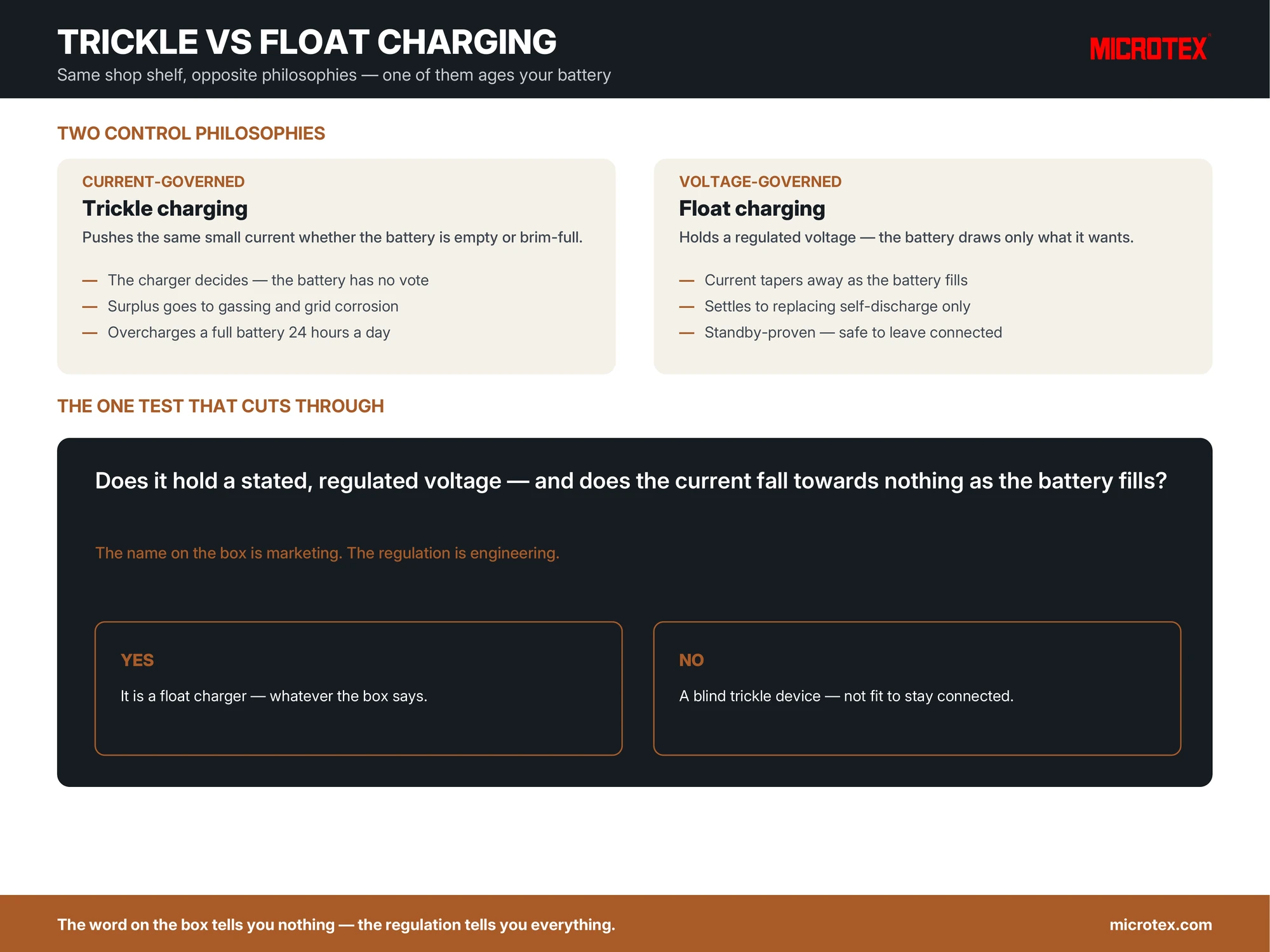
Strip away the marketing and there are only two ideas here. Trickle charging, in its original sense, means pushing a small, roughly constant current into the battery continuously — the same current whether the battery is empty, half-full or brim-full. The charger decides; the battery has no vote. Float charging means holding a fixed, regulated voltage across the battery and letting the battery draw whatever current it wants at that voltage. A discharged battery draws more; as it fills, the current tapers away on its own; a full battery settles down to sipping just enough to replace what self-discharge steals. The charger sets the table; the battery decides the portion. Our float charging guide covers the discipline in full — here, the one sentence that matters: float is voltage-governed and self-limiting, trickle is current-governed and blind.
Why constant current overcharges a full battery
A full lead-acid battery has nowhere to put extra charge. Feed it a fixed current anyway and the energy must go somewhere, so it goes into the side reactions: electrolysing water into hydrogen and oxygen, and corroding the positive grids. Every ampere-hour above the battery’s own tiny self-discharge demand is pure overcharge — delivered twenty-four hours a day, every day the device stays plugged in. That is why the damage from a crude trickle device is so insidious: nothing dramatic happens on any given Tuesday. The water level just falls a little faster than it should, the grids thin a little sooner, and the battery ages on fast-forward. Grid corrosion is the natural death our guide to how batteries die describes — a blind trickle simply buys it early. And the gassing is not free either: hydrogen accumulating in an enclosed space is exactly the arithmetic our battery explosion guide is built around.
Why float is the standby canon
Float charging earns its place in substations, telecom rooms and standby banks because it is self-correcting by design. Held at a properly chosen voltage, a healthy cell finds its own equilibrium: current falls until it just balances self-discharge, and there it sits — for years. The battery is never starved and never force-fed. The craft lies in choosing and maintaining that voltage correctly, which is genuinely its own subject: the right value depends on the battery’s design and moves with temperature, which is why serious installations compensate for it — the reasoning lives in our cold-weather charging guide and in the float guide itself. Note what float charging is not, though: it is a holding pattern for a battery that is already full, not a way to charge an empty one, and not a substitute for the proper charge sequence after real work.
The shop-floor confusion — and the one test that cuts through it
Here is the awkward truth about the words on the box: they are marketing vocabulary, not engineering vocabulary. Devices sold as “trickle chargers” range from crude transformer-and-rectifier units that genuinely push current forever, to well-behaved regulated units that are float chargers in all but name. Devices sold as “battery maintainers” or advertising a “storage mode” are usually voltage-regulated float-type devices — usually, not always. Ignore the label and ask the engineering question: does this device hold a stated, regulated voltage, and does its current fall towards nothing as the battery fills? If the answer is yes, it is a float charger, whatever the box says. If the maker cannot tell you the regulation voltage, or the device keeps pushing the same current into a full battery, it is a blind trickle device — fit for very short-term use under supervision, and not fit to be left connected for months. Our guide to battery chargers gives the fuller buying checklist.
What industry actually does
It is worth seeing where each philosophy belongs in real installations. Standby banks — the substation, UPS and telecom duty — live on float, full stop; that is what the whole float discipline exists for. Batteries in storage are a different case again: the honest practice is not to leave them on any charger at all, but to store them charged and give a refresh charge when the readings say so, as our battery storage guide explains. And cycling fleets — forklifts, traction duty — use neither philosophy between shifts: they take a proper full recharge after work, because their day is deep discharge, not standby idleness. Three duties, three answers, and none of them is “leave it on a cheap trickle device and hope”.
The one-paragraph verdict
Float charging holds a regulated voltage and lets the battery take only what it needs: self-limiting, standby-proven, safe to leave connected when correctly set. Trickle charging pushes a fixed current regardless of need: blind by design, and slowly destructive to a full battery. The word on the packaging tells you nothing; the presence of voltage regulation tells you everything. If you are specifying charging for a standby bank, or trying to work out whether the device keeping your stock topped up is helping or harming, ask our engineers — the difference between the two philosophies is one of the first things we check when a customer’s batteries are ageing faster than they should.