
In India, the law now follows your battery after it dies — and if you operate industrial batteries, part of that law is addressed to you. The Battery Waste Management Rules were notified by the Ministry of Environment, Forest and Climate Change in August 2022, replacing rules that had stood since 2001, and they quietly redrew who is responsible for every battery sold in the country once it reaches end of life. Most coverage of the Rules speaks to manufacturers and recyclers. This guide reads them from the other side of the invoice: what the framework means for the plant, fleet or facility that owns batteries and must one day let them go. One caveat before anything else, and it is load-bearing: this is a summary written in 2026 of rules that are amended regularly — verify the current text and targets with the Ministry and the Central Pollution Control Board before relying on any detail here.
What changed in 2022
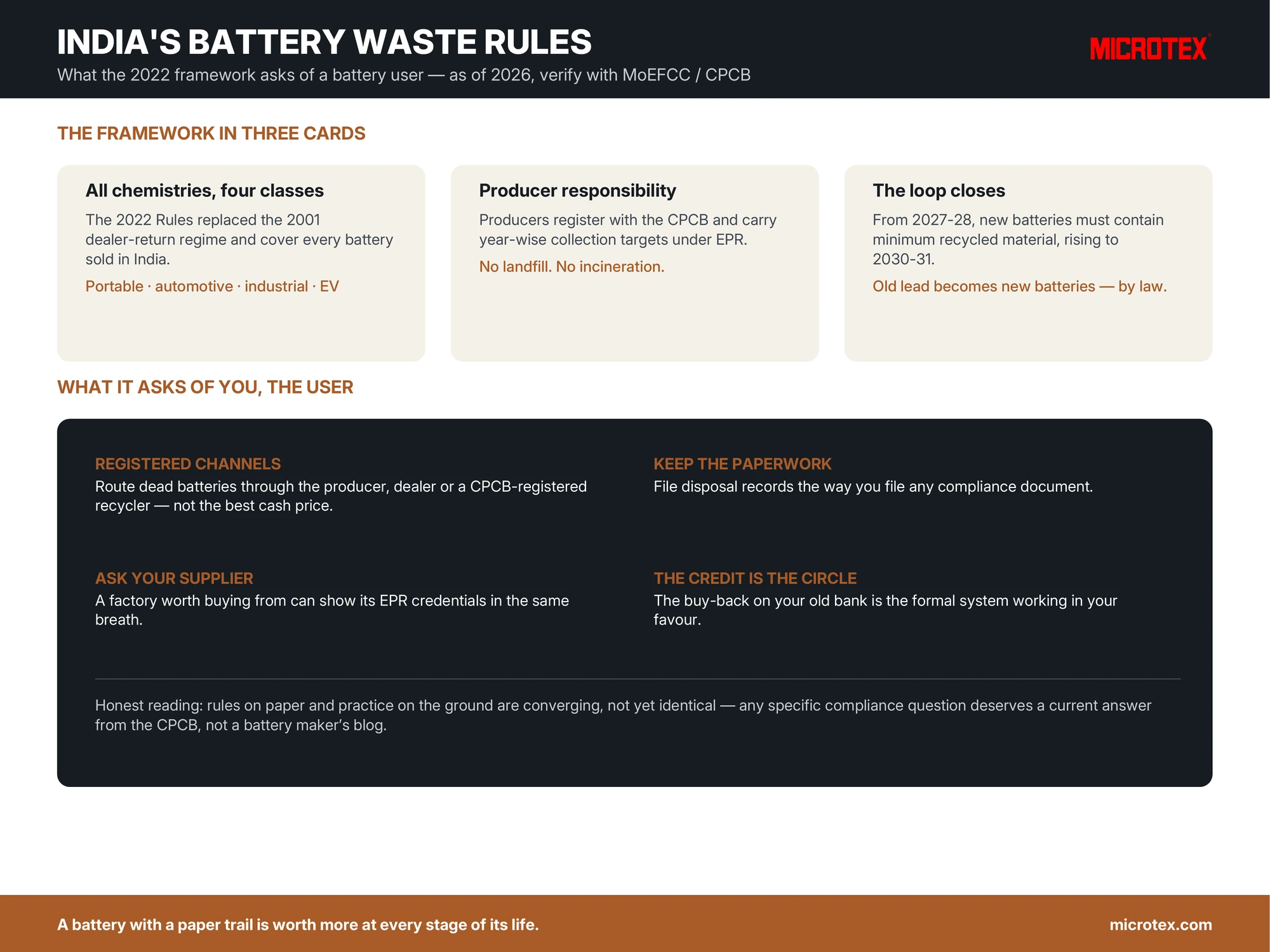
The old 2001 regime covered lead-acid batteries and ran on a dealer-level return system. The 2022 Rules widened the net to every chemistry and sorted all batteries into four categories — portable, automotive, industrial and electric-vehicle — with obligations attached to each. The centre of gravity moved too: the framework now runs on Extended Producer Responsibility, meaning the producer who places a battery on the market carries a legal obligation to see an equivalent quantity collected and recycled at end of life. Producers register on a Central Pollution Control Board portal, meet year-wise targets, and — a detail with teeth — collected batteries cannot be sent to landfill or incineration. Amendments since 2022 have kept tightening the machinery, including digital traceability: as reported in the trade press, a 2025 amendment requires the producer’s EPR registration number to appear on batteries as a barcode or QR code — one more thing to check on a crate, and one more reason the verify-with-CPCB caveat above is not decoration.
The targets, in one honest paragraph
Two families of numbers do most of the work. First, material recovery: recyclers must recover minimum percentages of the materials in the batteries they process, and the ladder climbs with time — as summarised by the International Energy Agency’s policies database, the Rules require 90% recovery for electric-vehicle and portable batteries by 2026-27, and 60% for automotive and industrial batteries on the same horizon. Second, recycled content: from 2027-28, new batteries must contain minimum percentages of domestically recycled material, starting around 5% and rising to 20% by 2030-31 on the IEA’s reading of the schedule. Sit with that second number for a moment, because it closes a loop elegantly: the lead in the battery you scrap this year is, by law, the raw material your next battery must increasingly contain. For lead-acid this is less revolutionary than it sounds — as our battery recycling guide explains, the industry already runs one of the most complete material circles in heavy manufacturing — but the Rules convert good metallurgical practice into enforceable obligation, with environmental compensation charged for shortfalls under the Environment (Protection) Act framework.
What the Rules ask of you, the user
Here is the practical translation for a battery owner. Your spent battery is a regulated waste stream, not general scrap: the Rules expect waste batteries to travel to registered channels — back through the producer or dealer, or to a CPCB-registered recycler — rather than to whoever knocks with the best cash price. That last sentence is where the law and the marketplace still argue, and our recycling guide is honest about the informal smelting the formal system exists to end: unregistered recovery pays well precisely because it skips the pollution controls the registered chain must fund. Under the 2022 framework, choosing the registered route is what puts your batteries inside the legal circle. In practice this asks four things of an industrial user: route end-of-life batteries to registered channels and insist on the paperwork; keep those records the way you keep any compliance file; ask your battery supplier for their EPR credentials — a factory that answers our six evaluation questions cleanly should answer this seventh in the same breath, and here is ours, laid face-up: Microtex Energy Private Limited holds Central Pollution Control Board registration as a Producer under the 2022 Rules, certificate no. 11041053, granted June 2024; and treat the buy-back or exchange credit on your old bank as the formal circle working in your favour — the scrap line in our total cost of ownership guide is that credit made visible.
An honest reading of where this stands
Radical honesty requires two more sentences. Rules on paper and practice on the ground are converging, not yet identical: the informal sector has not vanished because a notification said so, portals and amendment cycles are still settling, and any specific compliance question deserves a current answer from the CPCB or a qualified adviser, not a battery maker’s blog — including this one. But the direction is unambiguous, and it rewards exactly the habits this library keeps recommending for other reasons: documented purchases, documented maintenance, documented disposal. A battery with a paper trail is worth more at every stage of its life — at commissioning, at warranty time, and now, by law, at the end. If you are planning a battery replacement and want the old bank to exit through the registered route — with the paperwork and the scrap credit both done properly — talk to us when you buy; the disposal conversation belongs at the start of the purchase, not the end of it.