
In an underground coal mine, air is the scarcest utility there is. Every cubic metre must be pushed down a shaft, driven along kilometres of roadway by fans that never stop, shared between the men at the face and everything that burns, breathes or heats — and then hauled back out again carrying whatever the mine put into it. That is why the choice between a diesel-powered hauler and a battery-powered one is not an equipment preference. It is a decision about what the mine’s air will be asked to carry — and the published science on that question is unusually clear.
What a diesel engine puts into a coal heading
A diesel engine exhausts a mixture the mining-health literature knows in detail: diesel particulate matter (DPM) — sub-micron carbon particles with adsorbed organic compounds — together with oxides of nitrogen, carbon monoxide and hydrocarbons. The US National Institute for Occupational Safety and Health (NIOSH), in its guide Diesel Aerosols and Gases in Underground Mines, puts the exposure picture bluntly: underground miners can be exposed to more than one hundred times the typical environmental concentration of diesel exhaust, and more than ten times what is found in other diesel-using workplaces [1][2]. The reason is geometry. On a highway, exhaust disperses into the sky; in a heading, it disperses into the same few metres of air the crew is breathing, and the only way out is the ventilation circuit.
In 2012 the question of what that exposure does to people stopped being open. The International Agency for Research on Cancer — the WHO’s cancer agency — classified diesel engine exhaust as a Group 1 carcinogen: carcinogenic to humans, its strongest category, on the basis of sufficient evidence for lung cancer [3][4]. The evidence that tipped the classification came substantially from miners themselves: the Diesel Exhaust in Miners Study (DEMS), a joint National Cancer Institute/NIOSH investigation of 12,315 workers at eight underground mines, which found lung-cancer mortality rising steadily with cumulative diesel-exhaust exposure — with the most heavily exposed underground workers showing on the order of three times the lung-cancer mortality of the least exposed, and higher still in some analyses [5][6]. These are not modelled projections; they are the death records of underground miners, matched against measured exposure.
The regulator’s arithmetic
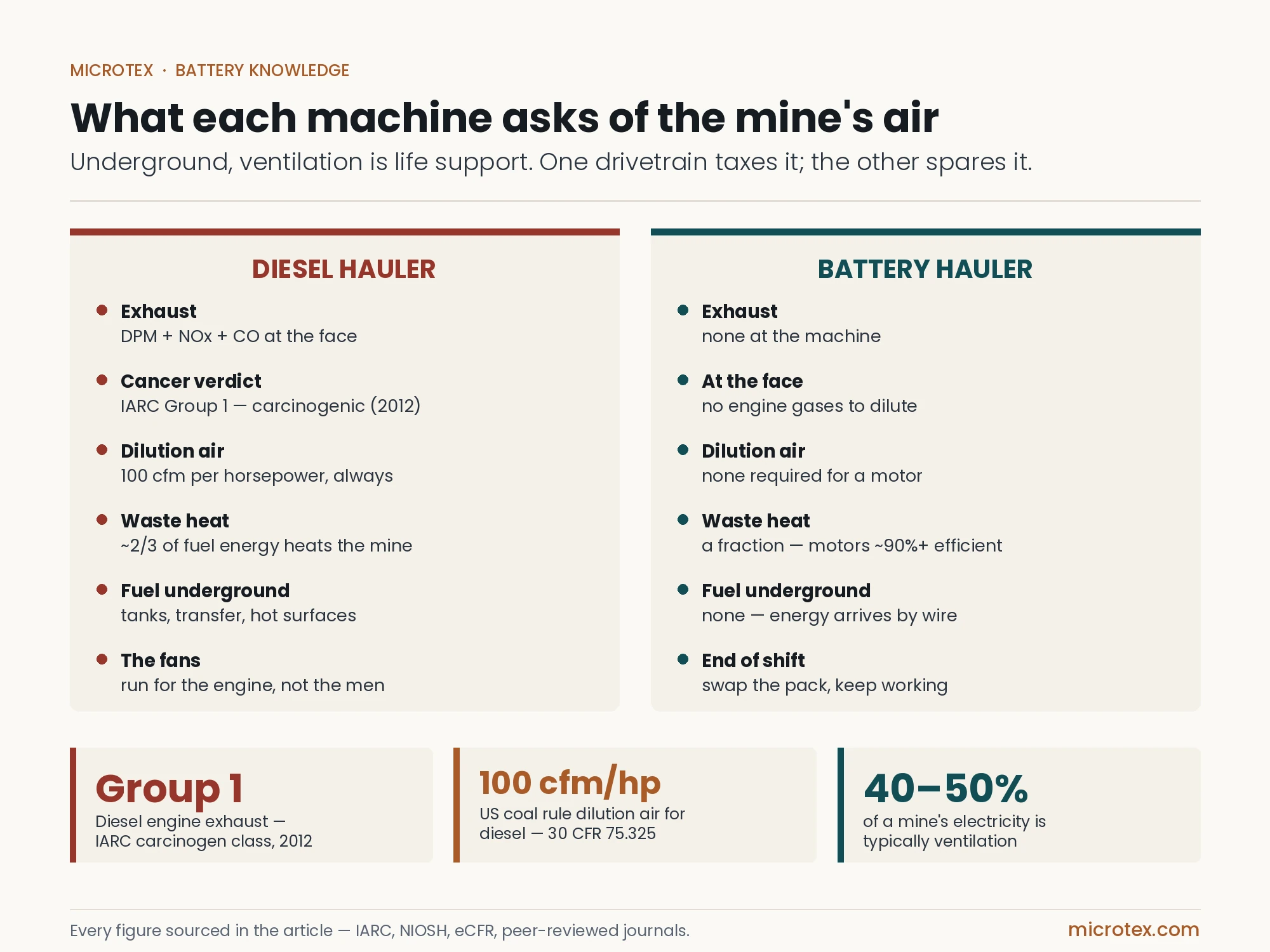
Regulators translated that science into numbers. In the United States, a miner’s full-shift exposure to DPM in underground metal and non-metal mines is capped at 160 micrograms of total carbon per cubic metre of air — 30 CFR 57.5060, in force since 2008 [7]. For coal mines, US law attacks the problem at the source and at the fan together: among its requirements, ventilating air must dilute the exhaust of unapproved diesel power at a default rate of 100 cubic feet per minute for every unit of brake horsepower — 30 CFR 75.325 [8]. Read that rule the way a ventilation engineer must: a single 150-horsepower diesel hauler creates a standing obligation of roughly 15,000 cubic feet — about seven cubic metres — of fresh air every minute it runs, air that exists for the engine, not the men. Research in the ventilation literature has questioned whether even these historical dilution rates remain adequate for modern duty [9].
Now scale it. A fleet of twenty such machines represents, under that arithmetic, an obligation in the region of 300,000 cubic feet — some 140 cubic metres — of dilution air per minute, before a single cubic metre has been assigned to the coal face, to methane dilution, or to the people. Indian coal mines operate under their own statutory framework administered by the Directorate General of Mines Safety [10], and the engineering logic is universal: every diesel horsepower taken underground is a permanent tax on the ventilation system. Replace those machines with battery equivalents and the same rule book asks for nothing at the machine — an electric drivetrain has no exhaust to dilute. The dilution obligation does not shrink; it disappears, freeing air quantity that can be redirected to the faces or saved at the fan. No other single equipment decision moves the ventilation ledger by as much.
The gases you smell — and the gas the mine already fears
Cancer is the slow harm; the working shift has faster ones. NIOSH lists the acute effects of elevated diesel exhaust in mine air plainly: eye and nose irritation, headache, nausea, and asthma-type respiratory symptoms, with diesel engines named a major contributor to underground concentrations of carbon monoxide, oxides of nitrogen and hydrocarbons [1][2]. Carbon monoxide is the mine’s oldest chemical enemy — the very gas the filter self-rescuer on every miner’s belt was designed against — and nitrogen dioxide attacks the deep lung. Every one of these arrives as a running cost of the drivetrain, shift after shift, in a workspace where dilution is never free.
A gassy coal mine adds its own dimension. The atmosphere already carries the risk of methane, which is why everything taken below ground is examined for its ignition potential — and a diesel machine is a package of hot surfaces and an exhaust stream that must be conditioned, flame-protected and maintained to stay within approval. A battery machine of equivalent duty simply has less to go wrong in this respect: no exhaust stream at all, no combustion, and drivetrain surface temperatures a fraction of an exhaust manifold’s. Neither machine escapes the mine’s approval regime; one gives the approval engineer far less to worry about.
Ventilation is the electricity bill
That tax is paid in power. Peer-reviewed studies of mine energy use consistently find ventilation to be the largest single electrical consumer underground — commonly 40–50% of a mine’s total electricity, and a quarter to two-fifths of its energy cost [11][12]. The fans, unlike the haulers, never take a shift off. Anything that reduces the contaminant load at the source reduces what the fans must move, and researchers surveying the industry’s move to battery-electric equipment identify precisely this — reduced ventilation and cooling demand, alongside the removal of exhaust — as a principal economic driver [13].
Heat compounds the argument. A diesel engine converts roughly a third of its fuel’s energy into useful work; essentially all the rest — exhaust heat, radiator heat, friction — enters the mine air, where in a confined working it must be managed by the same overworked ventilation circuit. An electric drivetrain, drawing on a motor efficiency above ninety per cent, rejects a small fraction of that heat for the same work delivered [13]. In a deep or hot mine, this difference is felt directly at the face — and in the fan bill. The same industry survey notes one more workplace gain that costs nothing: battery machines are quieter, in an environment where noise-induced hearing loss remains one of mining’s most widespread occupational diseases [13].
The fire question, asked in a coal mine
A diesel machine brings its fuel with it: tanks on the vehicle, storage bays and transfer points underground, hydraulic oil under pressure, and hot surfaces — exhaust manifolds and turbochargers — in continuous proximity to both. The US experience records more than 150 underground mine fires since 2000, with mobile equipment and flammable-liquid ignition prominent among the causes studied; NIOSH maintains an active research programme on diesel fuel storage-area fires and equipment fire suppression for exactly this reason [14][15], and MSHA has issued specific fire-safety alerts for underground diesel equipment [16]. In a coal mine, every one of those scenarios plays out surrounded by fuel that cannot be removed: the seam itself.
A battery hauler deletes this hazard chain at its root — no fuel tank, no underground diesel storage, no transfer point, no exhaust manifold. And the chemistry of the battery matters here. A flooded lead-acid battery’s electrolyte is dilute sulphuric acid — water-based and incapable of burning. Its one gas hazard, hydrogen at the end of charging, is generated on a known timetable at a known place — the charging station — where a century of standardised practice ventilates it by calculation, as we describe openly in our guide to battery-room hydrogen. A hazard with a schedule and an address is a hazard a mine can engineer for.
Why lead-acid, specifically, for coal
The battery-electric case underground is now made across chemistries in the peer-reviewed literature [13]. But for gassy, confined, conservative coal workings, the flooded tubular lead-acid battery holds a set of cards that matter:
It is the incumbent technology of underground electric traction. Battery locomotives and battery vehicles on lead-acid power predate every alternative by decades; the reference books of the 1950s already treated underground battery haulage as settled practice. The operating disciplines — charging bays in fresh air, ventilation sized by calculation, swap handling — are mature, standardised and taught, not experimental. Its failure modes are benign by comparison. A flooded lead-acid cell contains no flammable electrolyte and has no self-sustaining thermal-runaway failure mode of the kind that drives modern storage-fire test programmes; its hazards are managed with ventilation and discipline rather than suppression systems. It swaps in minutes. A discharged pack lifts out and a charged one lifts in — the working answer to the “charging takes hours” objection, proven over decades of practice (see our guide to battery swapping) — so the machine works shifts while packs charge in the bay. The bay itself is engineered, not improvised: sited in fresh air, ventilated by the calculation method international standards prescribe for battery installations, with charging controlled by a profile matched to the battery — the discipline that decides both safety and battery life, and one we have written about openly in charging at high current. It is deep-cycle by construction. Tubular-plate traction cells built and type-tested to IS 5154 / IEC 60254 deliver on the order of 1,500 cycles at 80% depth of discharge — years of daily shifts — with an end-of-life that is an asset, not a liability: lead batteries are the most recycled industrial product in existence, at a ~99% recycling rate in mature markets [17][18], with a domestic Indian recycling loop under the Battery Waste Management Rules, 2022. And its energy arrives by wire. No diesel logistics underground, no fuel price exposure at the face, and charging drawn from the mine’s own supply at night if the tariff favours it.
What diesel still does better — and what that costs
An honest comparison concedes the diesel machine’s advantages: it refuels in minutes anywhere, carries its range with it, and costs less to buy. Against that, the battery machine answers refuelling with the swap bay, and answers purchase price with operating cost: no fuel burned, motors with a fraction of a diesel’s moving parts and service items, no exhaust aftertreatment to maintain, and — the largest and least visible line — its permanent discount on the ventilation obligation, the mine’s biggest electricity account [11][13]. Total cost of ownership is the honest scoreboard, and we have published our method for computing it — ₹ per usable kWh-year, bounded by cycle and calendar life, with every input on the table.
The bottom line belongs to the man at the face
Strip away the engineering and one fact remains. The air in a coal heading is shared, and every machine sent underground either loads it or leaves it alone. The diesel hauler fills it with a Group 1 carcinogen whose dose-response curve was measured on miners’ own mortality records, taxes the fans that keep the mine breathable, heats the working, and brings its fuel with it into a fuel-lined environment. The battery hauler does none of these things, on a chemistry the coal industry has trusted underground for a century. For the mine operator weighing the two, the published evidence — from the WHO’s cancer agency, from NIOSH, from the US Federal Register, from the peer-reviewed ventilation literature — points one way. For the miner who spends his working life in that heading, it always did.
Microtex has built flooded tubular batteries for underground mining equipment — MUV and scoop packs and mining locomotive batteries — since 1969, with the matched charging system that decides battery life. Describe your fleet and duty cycle to us and we will put the arithmetic for your own mine on one page: ask our engineers.
References
- NIOSH, Diesel Aerosols and Gases in Underground Mines: Guide to Exposure Assessment and Control, Publication 2012-101. cdc.gov/niosh (PDF)
- CDC/NIOSH Mining Topic: Diesel Exhaust. archive.cdc.gov
- IARC (WHO), Press Release 213: Diesel engine exhaust carcinogenic, 12 June 2012. iarc.who.int (PDF)
- IARC Monographs Vol. 105: Diesel and Gasoline Engine Exhausts and Some Nitroarenes (2013). publications.iarc.who.int
- Attfield, M.D. et al., The Diesel Exhaust in Miners Study: A Cohort Mortality Study With Emphasis on Lung Cancer, JNCI 104(11), 2012. pmc.ncbi.nlm.nih.gov
- Möhner, M. & Wendt, A., Diesel exhaust in miners study: how to understand the findings?, J Occup Med Toxicol 7:10 (2012). pmc.ncbi.nlm.nih.gov
- 30 CFR §57.5060 — Limit on exposure to diesel particulate matter (160 µg/m³ TC). ecfr.gov
- 30 CFR Part 75, Subpart D — Ventilation (coal mines; incl. §75.325 air quantity, 100 ft³/min per brake horsepower provision). ecfr.gov
- Halim, A., Ventilation requirements for diesel equipment in underground mines — Are we using the correct values? (conference paper). diva-portal.org (PDF)
- Directorate General of Mines Safety, Government of India. dgms.gov.in
- Peer-reviewed analysis of coal-mine ventilation energy (ventilation ≈ 40–50% of underground mine electrical consumption). pmc.ncbi.nlm.nih.gov
- Peer-reviewed study of mining energy systems (ventilation ≈ 25–40% of mine energy cost). pmc.ncbi.nlm.nih.gov
- Battery electric vehicles in underground mines: Insights from industry, Renewable and Sustainable Energy Reviews (2024). sciencedirect.com
- NIOSH, Early fire detection for underground diesel fuel storage areas. pmc.ncbi.nlm.nih.gov
- CDC/NIOSH Mining Topic: Fire Detection (>150 US underground mine fires since 2000). archive.cdc.gov
- MSHA, Fire Safety Alert: Underground Diesel Equipment. msha.gov
- Battery Council International, National Recycling Rate Study (lead batteries ≈ 99% recycling rate). batterycouncil.org
- US EPA, Battery Collection in Action: The Lead-Acid Battery Collection Network. epa.gov
All exposure limits, ventilation quantities and epidemiological findings above are quoted from the linked primary sources; regulatory figures are US federal rules cited as engineering reference points — statutory requirements in India are governed by DGMS and the mine’s own approvals. Reviewed 19 August 2026.