
The most dangerous minutes in an industrial battery’s life are the ones it spends in the air. On the floor it is a heavy, patient object that hurts nobody who leaves it alone. Hanging from a hoist over a forklift compartment, or crossing a battery room on a strap, it is a tonne of lead with an acid bath inside and a circuit that cannot be switched off, and the people underneath it are usually in a hurry. Our battery safety guide gives lifting one paragraph — lift from the bottom, never by the terminals, and anything over about twenty-five kilograms is a machine’s job. This guide is the rest of that paragraph: what the injury record says, what two regulators require, how a forklift change-out and a stationary installation are done without anyone being hurt, and the list we would want on the wall of any battery room we supplied.
What actually goes wrong
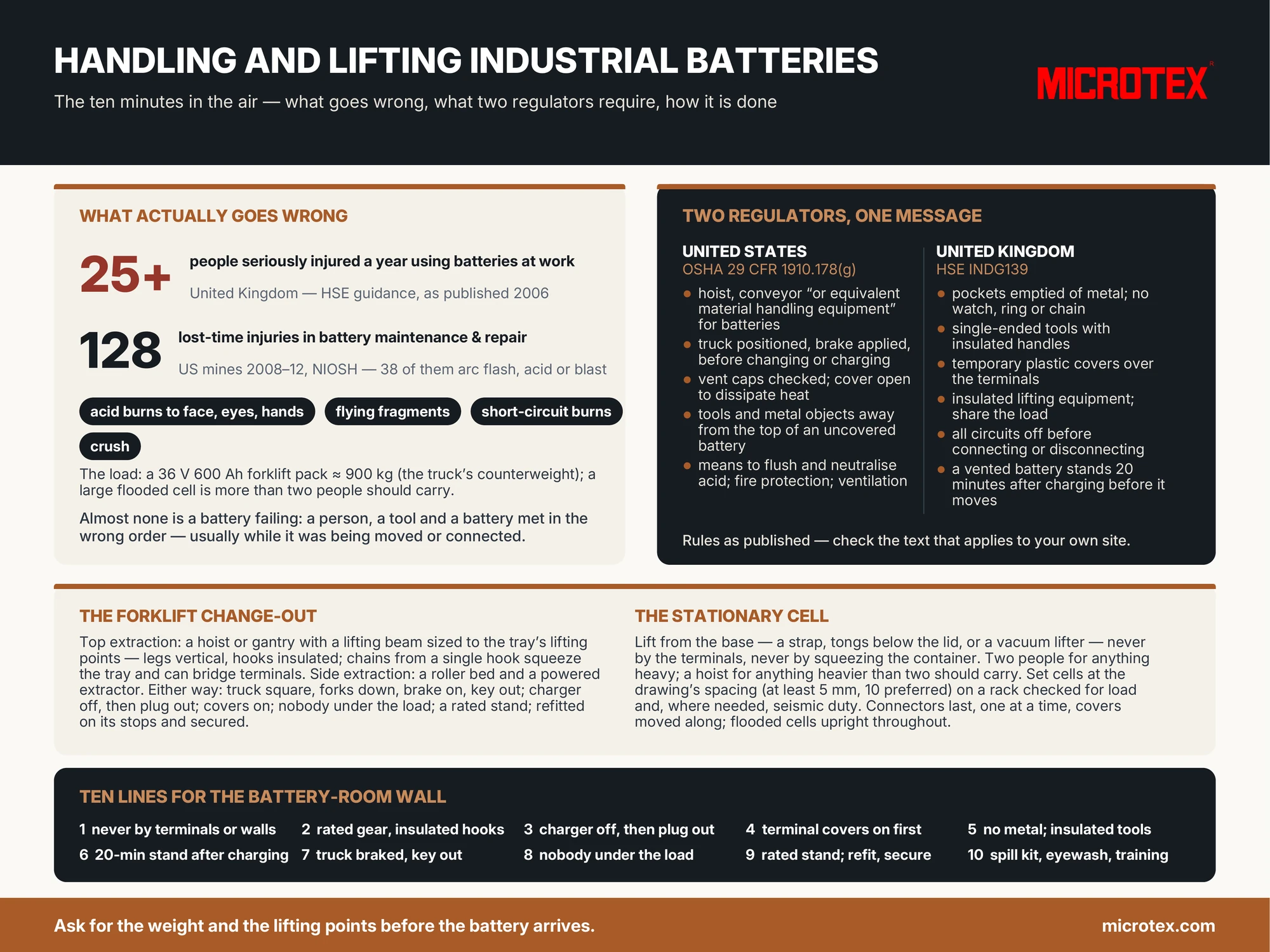
The British regulator’s guidance on storage batteries opens with a count: at least twenty-five people seriously injured every year in the United Kingdom while using batteries at work, as of the booklet’s publication in 2006. Its list of injuries is worth reading slowly — serious chemical burns to the face, eyes and hands; wounds from flying pieces of metal and plastic; and, “frequently”, burns from metal objects that became very hot or exploded after bridging a battery’s terminals. The United States mine-safety institute’s review of five years of mining injury data, which our guide to battery fires underground draws on, found a hundred and twenty-eight lost-time injuries from lead-acid battery maintenance and repair, thirty-eight of them arc flash, acid burns or explosions inside the battery box — a dropped spanner across two terminals being the classic. Almost none of these is a battery failing. They are a person, a tool and a battery meeting in the wrong order, and most happen while the battery is being moved, connected or disconnected rather than while it is quietly working.
What two regulators require
Two national rule-books say the same things in different words, and both are short enough to quote. The American occupational-safety regulation for powered industrial trucks has a dozen lines on changing and charging batteries. Among them: a conveyor, overhead hoist “or equivalent material handling equipment” shall be provided for handling batteries; reinstalled batteries shall be properly positioned and secured in the truck; the truck shall be positioned and its brake applied before anyone changes or charges a battery; vent caps shall be checked and the cover left open to dissipate heat; tools and other metal objects shall be kept away from the top of an uncovered battery; and the charging area shall have the means to flush and neutralise spilled acid, fire protection, protection for the chargers against trucks, and ventilation for the gas. The British guidance adds the personal rules: empty your pockets of metal, take off the watch, ring and chain, use single-ended insulated tools, fit temporary plastic covers over the terminals, use insulated lifting equipment and share the load, switch every circuit off before connecting or disconnecting, and — the one most often skipped — let a vented battery stand for at least twenty minutes after charging before it is moved, because gas trapped in the cells is released when the battery is disturbed and “a tiny spark is all that is needed”. These are two countries’ rules as published; check the text that applies to your own site, and where, as in much of India, no single clause covers the battery room, treat the two above as the floor rather than the ceiling.
The forklift change-out
A traction battery is heavy on purpose — it is the truck’s counterweight, and a 36 V 600 Ah pack weighs about nine hundred kilograms — so the change-out is a lifting operation first and an electrical one second. There are two ways to do it and both satisfy the “equivalent equipment” rule. Top extraction uses an overhead hoist or gantry with a lifting beam: a spreader sized to the tray’s lifting points so that the load hangs vertically from each corner. The beam matters. Chains or slings run from a single hook squeeze the tray inwards as they take the load, can crack cell containers and, worse, can lie across the cell tops and bridge terminals; a beam keeps the legs vertical and the metalwork away from the connectors, and its hooks should be insulated. Side extraction, on trucks built for it, uses a roller bed and a powered extractor — a magnet, vacuum pad or clamp — that draws the battery sideways onto a stand at the same height; it is faster, keeps the load low and is the normal method in multi-shift swap rooms. In either case the sequence is the same: truck parked square to the stand, forks down, key out and brake on; charger off before the plug is pulled, and the truck’s own circuit dead before the battery leaves; terminal covers on; nobody’s hands or feet under the load; the battery set down on a rated stand, not on the floor to be dragged; and, on the way back in, the tray seated on its locating stops and the retaining bolts or wedges actually tightened, because a battery that shifts under braking is the commonest hidden cause of the cracked trays our service engineers see.
The stationary installation
A stationary bank arrives as individual cells or blocks, each lifted by hand or by a small hoist onto a rack. Lift a cell from its base — a strap under it, purpose-made tongs that grip the container below the lid, or a vacuum lifter on a flat lid — never by its terminals, which are cast into the lid and will tear it, and never by squeezing the container walls hard enough to flex them against the plates. Two people for anything heavy, and a hoist for anything heavier than two people should carry; a large flooded cell exceeds that limit comfortably. Set cells down with the spacing the maker’s drawing shows — the stationary handbooks ask for at least five millimetres between cells, ten preferred, for cooling and so the connectors seat without strain — on a rack checked against the load and, where the site demands it, against the shaking our guide to seismic qualification describes. Fit the intercell connectors last, one at a time, with insulated tools and the terminal covers moved along as you go, so that at no point is there a long, exposed, live string in a room full of people and steel. Filled flooded cells stay upright throughout; gel and AGM blocks tolerate tilting within the maker’s limit, but the lifting rule is the same. The first readings once the string is connected begin the record our guide to battery commissioning describes, and they are also the last check that nothing was cracked on the way in.
Ten lines for the battery-room wall
One: no battery is ever lifted by its terminals or its container walls — from the base, by beam, strap, tongs or extractor. Two: the lifting equipment is rated for the weight on the drawing and its hooks are insulated. Three: charger off, then plug out; truck circuit dead before the battery moves. Four: terminal covers on before anything metal comes near. Five: pockets empty, jewellery off, insulated single-ended tools only. Six: a vented battery stands twenty minutes after charging before it is moved. Seven: the truck is parked square, forks down, brake on, key out. Eight: nobody under the load, and a clear floor between stand and truck. Nine: the battery is set on a rated stand, and on refitting it is seated on its stops and secured. Ten: acid spill kit, eyewash and water within reach, and everyone in the room trained — the first line of the British guidance and the one that makes the other nine work. Transport off site is a different discipline, covered in our guide to shipping batteries.
Ask for the weight before the battery arrives
The commonest handling accident we hear about begins with a battery heavier than the hoist that was waiting for it. Before any forklift battery or stationary bank we supply leaves the works, ask us for its weight, its lifting points and the recommended lifting method — and if you are laying out a new charging bay or battery room, send us the drawing and we will mark where the hoist, the stand and the twenty-minute parking place should go.
Sources quoted: U.S. Occupational Safety and Health Administration, 29 CFR 1910.178(g), Changing and charging storage batteries (public domain); UK Health and Safety Executive, INDG139(rev1), Using Electric Storage Batteries Safely (2006).