
A station charger has two jobs, and the cheap ones are usually sized for only the first. The first job is easy to see: carry the continuous DC load of relays, indication, SCADA and lamps, so that the battery never has to. The second is easy to forget: after a discharge, put back the ampere-hours that came out, inside a recharge window the station can live with, while that same continuous load is still drawing. A charger sized for the load alone leaves the battery perpetually part-charged; a charger sized for both leaves it ready for the next outage.
The sizing equation
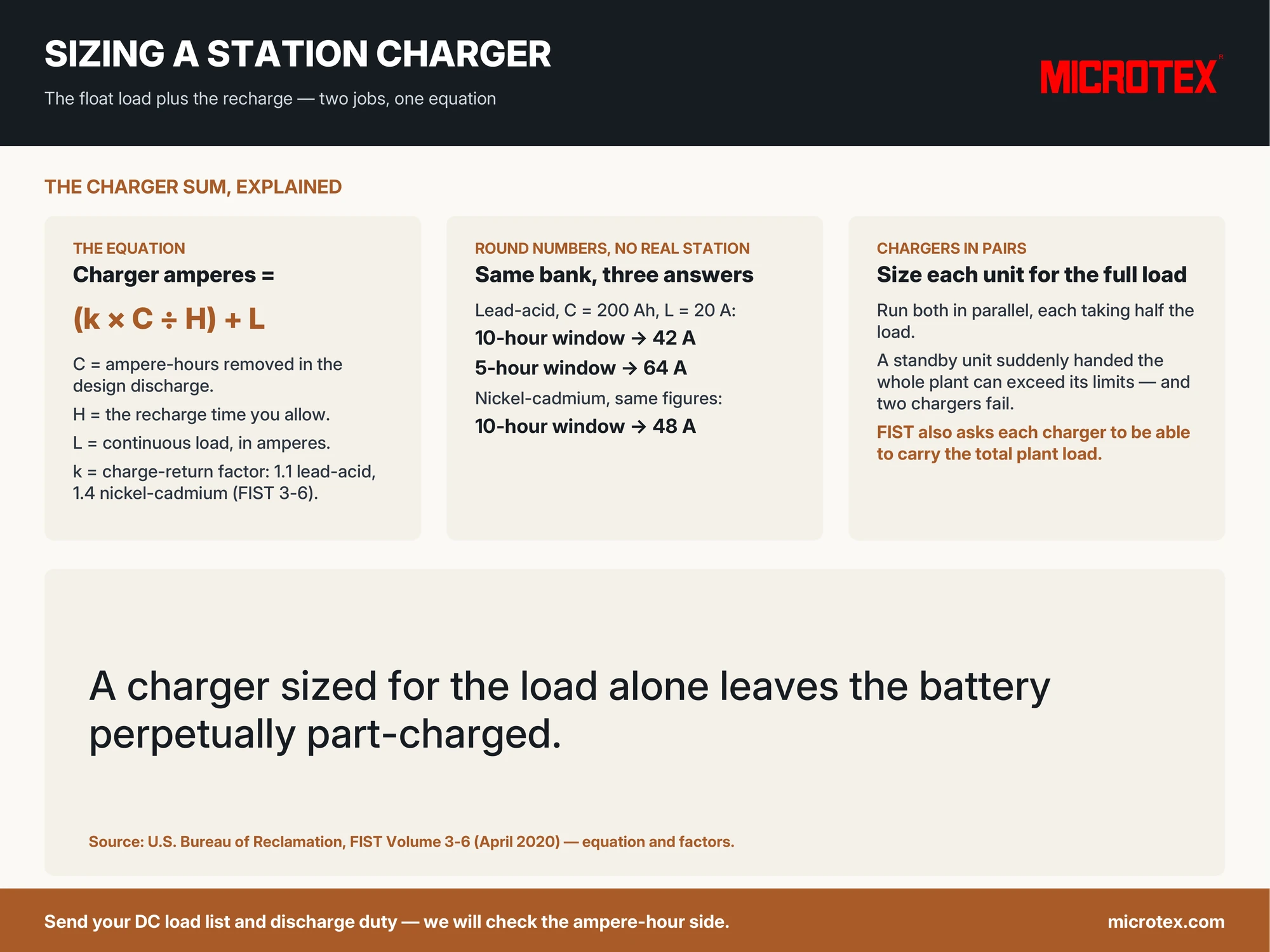
The United States Bureau of Reclamation’s FIST Volume 3-6, Storage Battery Maintenance and Principles (April 2020), adds the two jobs together in one line. In our notation: charger amperes = (k × C ÷ H) + L. Here C is the ampere-hours removed in the discharge you are designing for, H is the recharge time you allow, L is the continuous load in amperes, and k is an efficiency factor, because more charge must go in than came out. FIST uses 1.1 for lead-acid and 1.4 for nickel-cadmium, and sizes H as the time to bring the battery back to about 95 per cent of capacity.
Here is the arithmetic with round numbers that belong to no real station. A lead-acid bank has given up 200 Ah, you allow 10 hours, and the continuous load is 20 A: (1.1 × 200 ÷ 10) + 20 = 42 A. Halve the window to 5 hours and the answer becomes (1.1 × 200 ÷ 5) + 20 = 64 A, a charger more than half as large again, bought to save five hours. A nickel-cadmium bank with the same figures, at k = 1.4, needs (1.4 × 200 ÷ 10) + 20 = 48 A. Nothing in the equation is exotic; what matters is that every term has an owner.
Who owns each term
C belongs to the duty cycle. It comes from the discharge your protection and control engineers define, the subject of our guide to the substation battery duty cycle, and from the state the battery is actually in when the outage ends, not from the nameplate. k is the charge factor, the quantity explained in our guide to charge factor and charging efficiency. Real values vary with design, temperature and age, so use the battery maker’s figure where you have it and FIST’s as a cross-check.
H belongs to your specification. FIST’s own guidance for its hydro-power plants is a recharge window of roughly eight to twelve hours, and it advises against recharging a two-charger system much faster than about three. Treat those as one operator’s practice, not a universal rule: the battery maker’s catalogue for the exact type and your tender document set the real figure, and every hour taken off the window is paid for in charger size, as the arithmetic above shows. L is the sum of every continuous load that stays on while the battery recharges, including the ones nobody listed and the growth you already know is coming. An understated L is how a charger that looked adequate at commissioning ends up struggling years later.
What an undersized charger costs
FIST is blunt about the trade. The charger must have enough capacity to bring the battery fully up, including the gassing stage, and a charger with too little capacity shortens battery life; the smaller unit is cheaper on day one and can cost more over the years. The mechanism is simple. A battery that is never fully recharged spends its life part-discharged, and lead-acid cells lose capacity that way. Our guide to battery sizing shows how much battery a given duty needs; the charger equation shows how much charger it takes to keep that battery honest.
Chargers in pairs
Stations normally buy chargers in pairs. FIST advises running both in parallel at all times, each taking half the load, rather than keeping one in standby, because a standby unit suddenly handed the whole plant in an emergency can exceed its own current or voltage limits, and the plant ends up with two failed chargers. The sizing consequence follows. FIST’s own periodic check asks that each charger of a parallel set can carry the total plant load, so each unit in a pair is sized for the full duty, not for half of it.
Amperes are not the whole specification
Two more lines in the specification matter as much as the ampere rating. The first is the quality of the output. FIST warns that high ripple on the charger output can overheat a battery, and that VRLA batteries fed a ripple-laden supply can go into thermal runaway; see our guides to AC ripple and to thermal runaway in VRLA batteries. The second is temperature compensation. FIST describes a probe fixed to the battery that lets the charger adjust its float voltage as the battery temperature changes, and calls it critical where that temperature can wander by more than a few degrees Fahrenheit. We print no float figures here, because they belong to the battery maker’s catalogue for the exact type.
Which kind of charger
FIST names two main types. The silicon-controlled-rectifier (SCR) charger is usually the cheapest, smaller and lighter, but FIST puts its mean time between failures at about half that of the other type. The ferroresonant charger, built around a transformer that limits current by saturating, FIST considers more durable and so better suited to a power-plant environment. Read that as one operator’s experience as of 2020. Many stations today specify high-frequency switch-mode rectifiers, which that section of FIST does not cover, so whichever type is quoted, ask for the maker’s own reliability data and for the output ripple measured with the battery connected. Our overview of the types of battery chargers sets out the families.
Send us the discharge duty and the DC load list for your station and we will check the ampere-hour side of the arithmetic from the battery’s end. The charger itself comes from a charger maker, and the equation above will tell you whether their quotation is honest.
Sources quoted: U.S. Bureau of Reclamation, FIST Volume 3-6: Storage Battery Maintenance and Principles (April 2020).