
Hydrogen is energy’s most seductive storage idea — and physics has been quietly returning the same verdict on it for fifty years. Hydrogen is the most abundant element in the universe; feed it through a fuel cell and the exhaust is water vapour; a tank refills in minutes, like diesel, while a battery asks for hours. Governments have noticed — India’s National Green Hydrogen Mission is backing the molecule and Indian Railways is trialling hydrogen trains. The ambition is understandable; the arithmetic, we will show, is stubborn. We are battery engineers — hydrogen-as-storage keeps auditioning for our machines’ jobs — so here is our bias, declared, and our working, shown. If it is good, we say so; if not, we show the sums.
The round-trip arithmetic
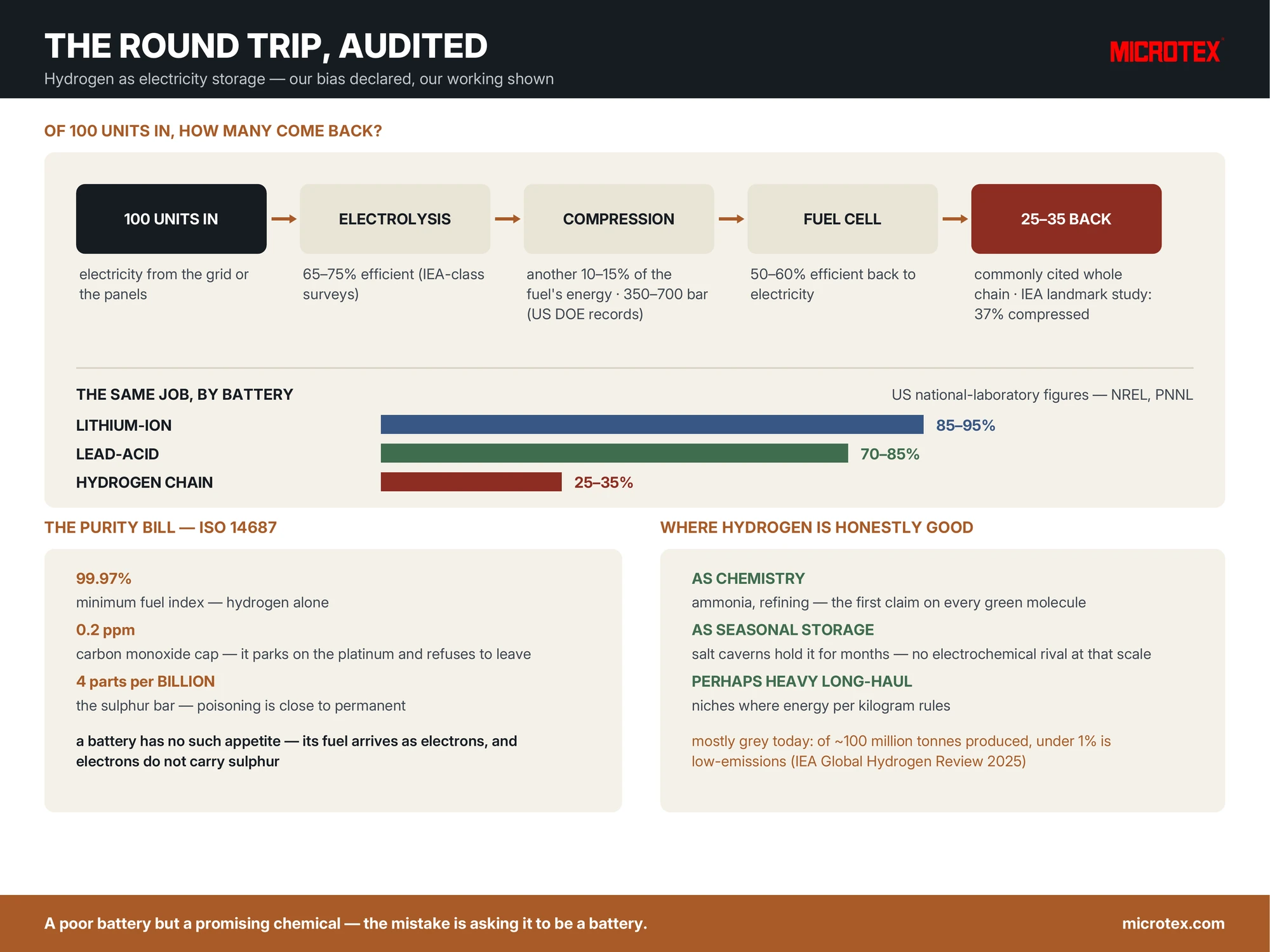
Storage has one ruthless metric: of a hundred units in, how many come back? Electrolysis first — today’s electrolysers turn roughly 65 to 75 per cent of the electricity into gas, per IEA-class industry surveys. Storing the gas usefully means squeezing it to 350 or 700 bar, which US Department of Energy records price at another 10 to 15 per cent of the fuel’s own energy — or liquefying it at minus 253 degrees Celsius, which the same records put at 30 to 40 per cent. A fuel cell then converts it back to electricity at 50 to 60 per cent. Multiply the chain: most of the electricity is gone — the IEA’s landmark hydrogen study carries a 37 per cent round trip for compressed hydrogen, and commonly cited whole-chain figures run 25 to 35 per cent. A battery does the same job at 85 to 95 per cent for lithium-ion, and — honestly declared — around 70 to 85 for lead-acid, per US national-laboratory figures (NREL, PNNL). The whole article in one sentence: hydrogen throws away most of the electricity it stores; a battery keeps most of it — the same thermodynamic bookkeeping the electrochemistry guide turns on our own chemistry.
The purity problem the brochures never mention
A PEM fuel cell — the type in the cars, trains and most storage proposals — does not run on “hydrogen”; it runs on hydrogen to ISO 14687 fuel-cell grade: a fuel index of at least 99.97 per cent, carbon monoxide capped at 0.2 parts per million, total sulphur at about four parts per BILLION. The reason is the platinum catalyst: carbon monoxide parks on its sites and refuses to leave — peer-reviewed contamination studies show cell voltage collapsing at exactly these exposures — and sulphur poisons the catalyst close to permanently. And every electrolyser, pipe, compressor seal, vessel, tanker and dispensing nozzle between the water and the fuel cell lives inside that quality system, forever. That is no footnote: a permanent industrial discipline, and a permanent cost line. A battery has no such appetite — its fuel arrives as electrons down a copper cable, and electrons do not carry sulphur.
A molecule with difficult manners
Hydrogen is the smallest molecule in existence, and behaves like it. It escapes through fittings and seals that hold natural gas without complaint; it seeps into ordinary steels and embrittles them; and it burns in air across roughly 4 to 75 per cent concentration — the widest flammable range of any common fuel. Industry manages all this — has for a century — but never free: 700-bar tanks and cryogenic plants are serious engineering, seriously priced. And every escape carries a second cost — leaked hydrogen is an indirect greenhouse gas, which a 2023 five-model study in Communications Earth & Environment priced at about twelve times CO2 over a century, kilogram for kilogram. Every storage medium has manners to manage — we have published an honest page on lithium’s fire behaviour — but hydrogen’s portfolio is uniquely broad.
Mostly grey: the colour problem
Almost none of today’s hydrogen is clean. The IEA’s Global Hydrogen Review 2025 counts world production at close to 100 million tonnes in 2024 — less than one per cent of it made by low-emissions routes. The rest comes overwhelmingly from natural gas and coal, and nearly all of it goes where it always has: refineries and fertiliser plants. So “green hydrogen storage” must first build its green supply. As of 2026, clean hydrogen remains mostly an aspiration — growing, but from under one per cent.
The train test
Rail is hydrogen’s most instructive test: both verdicts are on the record. The world’s first hydrogen fuel-cell passenger trains entered service in Germany in 2018, and by August 2022 a north-German region was running the world’s first all-hydrogen fleet of fourteen trains. Then came the ledger: within about a year, the region’s transport authority announced that its NEXT fleets would be battery-electric — around a hundred battery trains — citing its market research: battery trains are cheaper to operate. India now runs its own experiment: as of 2026, Indian Railways’ first hydrogen passenger service is in trial on the Jind–Sonipat line in Haryana, first of a “Hydrogen for Heritage” programme of thirty-five trains for hill and heritage routes wires struggle to reach. A trial is exactly how a railway finds out: the physics bill arrives in the operating accounts, and every operator reads its own. The pattern so far is consistent — where wires or batteries can reach, they win on efficiency and lifetime cost; hydrogen rail survives on the routes they cannot.
Where hydrogen is honestly good — and the verdict
Now the other half of the honesty. Hydrogen is genuinely good at three things. As CHEMISTRY — ammonia for fertiliser, refinery processing, perhaps steelmaking by direct reduction: that is where today’s hundred million tonnes already work, and the first claim on every green molecule. As SEASONAL storage — a battery asked to hold energy for months is an economic absurdity; a salt cavern full of hydrogen is not. Caverns in Britain and on the US Gulf Coast have stored hydrogen for decades, and at weeks-to-months scale it has no electrochemical rival. And perhaps in heavy long-haul niches where energy per kilogram rules. So the verdict: hydrogen is a poor battery but a promising chemical — the mistake is asking it to be a battery. For the storage jobs this site serves, the arithmetic keeps choosing electrochemistry: grid-scale battery containers, solar banks, the chemistry scorecard — and lead-acid’s real contest, as the ten-year outlook says plainly, is with other batteries, not with hydrogen. If hydrogen has been proposed for a job a battery room could do, ask us — we will put the round-trip arithmetic for both on one page, working shown.