
A station battery is bought once and judged for twenty-five years, so the construction you write into the specification matters more than the price on the first invoice. Three constructions compete for the DC systems of nuclear power stations and grid substations: the Planté cell that started the industry in 1860, the vented pocket-plate nickel-cadmium battery, and the flooded tubular OPzS cell. We build OPzS, so read what follows as the maker’s case. We have also put the other two constructions’ genuine strengths in writing, because a buyer sold a battery on half the facts stops trusting the seller the first time the logbook disagrees.
What the letters OPzS actually promise
OPzS is a German abbreviation for a stationary cell with an armoured positive plate and special separation. The German stationary-battery handbook we keep on the shelf explains the word “Panzerplatte”, armour plate: the positive active material is held inside tubes around a cast spine instead of being pasted onto an open grid, so the plate cannot shed what it is made of. The letters also carry a standard. DIN 40736-1 fixes the rated capacities, main dimensions and weights of OPzS cells in plastic containers, specifies a transparent container material, and reserves the suffix “LA” for cells whose antimony content is 3 per cent or less. The practical consequence for a buyer is interchangeability: a 6 OPzS 600 from one factory fits the stand, the connectors and the sizing calculation written for a 6 OPzS 600 from another. A battery you can second-source after fifteen years is a different purchase from one you cannot. The tests the cells must pass are set out in IEC 60896-11:2002, the international standard for vented stationary lead-acid batteries. Our OPzS range is built to these designations from 100 to 3000 Ah.
The duty: what a nuclear plant or a substation really asks
The duty is strange: years of doing nothing on float, then a few violent seconds and a few quiet hours in the dark. When the AC fails, the battery must pull the trip coils and recharge the breaker springs at currents many times its normal load, then carry the protection relays, SCADA and emergency lighting until supply returns; our guide to the substation duty cycle draws that curve. In a nuclear station the same bank also rides through a station blackout for the safety-classified loads, which is why our guide to nuclear plant batteries calls the industry the most conservative battery buyer on earth. The US Bureau of Reclamation’s battery manual, FIST Volume 3-6, treats the station battery as usually the last reliable source of power in a plant, and it sets the replacement rule the whole industry uses: a bank is worn out when it can no longer deliver 80 per cent of its rated capacity. IEEE 485-2020 sizes the bank so that it still carries the full duty cycle in that worn-out, end-of-life state.
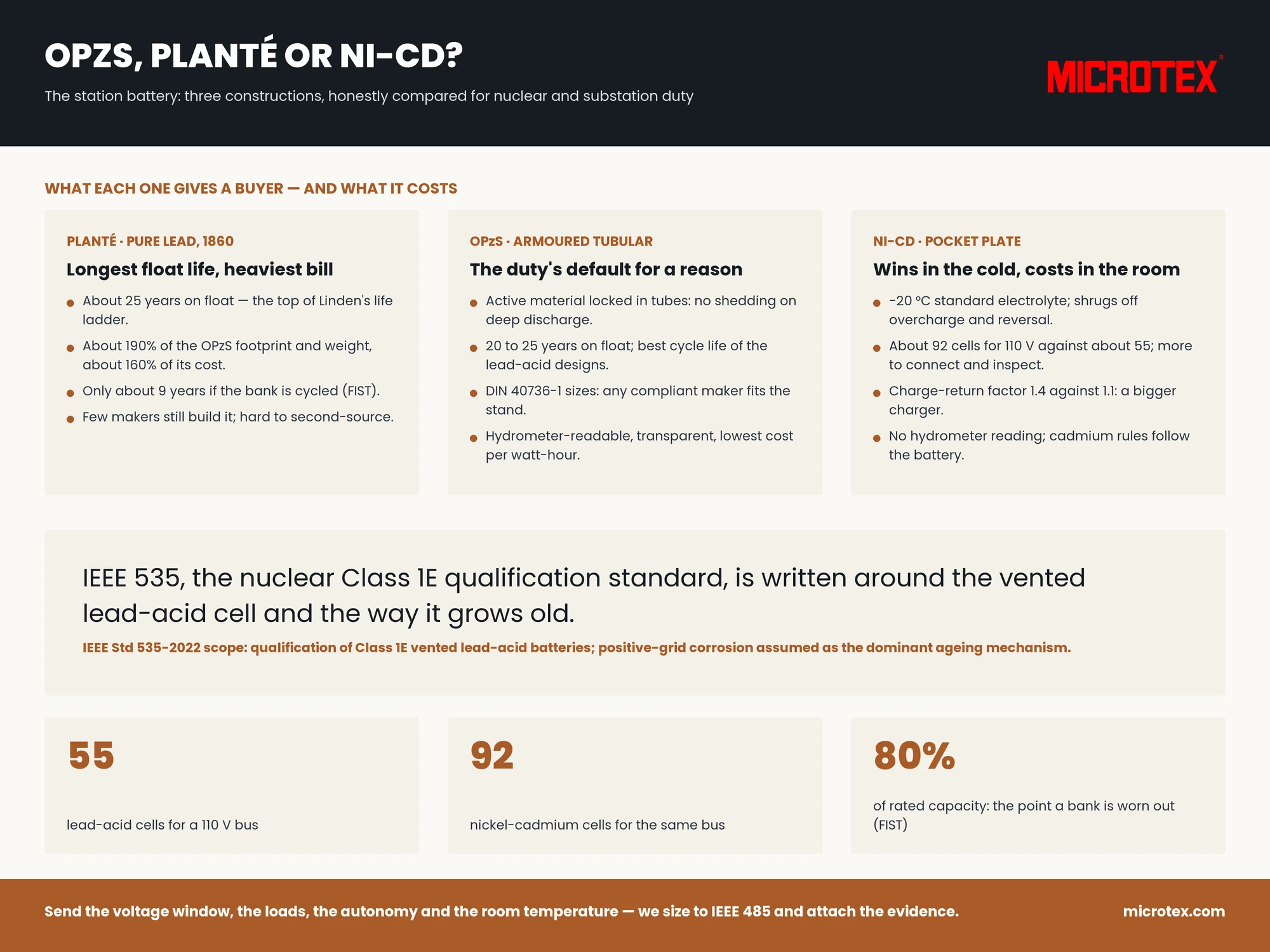
One fact about nuclear qualification deserves to be better known. IEEE 535-2022, the standard for qualifying Class 1E batteries in nuclear generating stations, is written for vented lead-acid batteries. Its method assumes that the dominant ageing mechanism is corrosion of the positive grid, and it names lead-calcium, lead-antimony and low-antimony lead-selenium cells as the technologies shown to age that way on full float. The nuclear industry’s own qualification procedure, in other words, was built around the flooded lead-acid cell and the way it grows old. Seismic qualification sits on top of that; our 2 V cells have been through resonance search and seismic testing on the shake table at CPRI Bengaluru with NPCIL quality assurance witnessing, and we hold approved-vendor registrations with NPCIL and BARC.
Six reasons OPzS wins this duty
1. An armoured plate does not shed. Rand’s Understanding Batteries describes the weakness of the ordinary pasted positive: on deep discharge the active mass expands and contracts, works loose and falls to the bottom of the cell, losing capacity and eventually shorting the plates. His remedy is the one the OPzS cell uses: pack the material into porous tubes around a central alloy spine. Linden’s handbook rates the tubular design as the best of the lead-acid constructions for cycle life. A station battery’s emergency discharges are deep and rare, and a plate that cannot lose its material survives them without comment. Our guide to flat plate versus tubular goes into the construction.
2. The spine alloy is chosen for the duty, not for the brochure. The handbook notes that the antimony in the OPzS spine is what bonds the active mass to the conductor and gives the plate its cycling ability, at less than 3 per cent. Berndt records that selenium as a grain refiner, first used for submarine batteries in 1949 and widespread in stationary cells from the 1970s, is what allowed the antimony to fall below 2 per cent without the grid cracking. The trade-off is honest. Williamson and Kim’s standby-alloy tests measured about 3.3 per cent self-discharge a month for a low-antimony selenium cell against 1.3 per cent for lead-calcium, with the selenium cell’s float current rising as it ages. FIST, on the other side of the ledger, gives lead-selenium cells a longer life expectancy than either lead-calcium or lead-antimony, without the plate-growth cracking of calcium cells or the antimony poisoning of the old high-antimony ones, and water consumption far below the antimony cell’s. A pure float duty with no cycling at all can argue for calcium; a duty that includes real discharges argues for the low-antimony selenium spine. In our alloy, copper and selenium are added to slow spine corrosion further, which matters most in a hot battery room.
3. The cell is designed for its own ageing. Berndt’s arithmetic is sobering: at a corrosion rate of 0.03 mm a year, typical of a 1.6 per cent antimony alloy, a 3 mm spine loses about half its cross-section in fifteen years, so a long-life battery must carry a corrosion reserve in its spine from the day it is cast. Linden adds that stationary cells are dimensioned so the positive plates can grow by up to 10 per cent before they touch the container wall. In our OPzS cells the spines are pressure die-cast to the reserve the twenty-year life needs, and the pole seal is designed to let the pillar rise with the plate as it grows instead of cracking the lid, which is the usual way an old flooded cell ends its life.
4. You can see it and measure it. The container is transparent, so the electrolyte level, the plates and any sediment are visible on the walk-round. The specific gravity of the acid tracks the state of charge, so a hydrometer tells the truth about each cell, and a discharge test proves the capacity outright. Ceramic funnel vent plugs let the operator top up, read the density and the temperature without removing the plug, and trap acid mist. Flooded construction is the one a trained maintenance crew can audit, which is why a utility with crews specifies it.
5. Life and cost per watt-hour. Linden’s life ladder for stationary designs, offered with his own warning that makers’ claims conflict, puts tubular batteries at 20 to 25 years and Planté at about 25. That is a rounding error of difference, bought at a fraction of the lead. Erbacher’s chapter in the same handbook states plainly that pocket-plate nickel-cadmium costs more than lead-acid per watt-hour. A 2 V cell also halves the cell count: a 110 V bus needs about 55 lead-acid cells against about 92 nickel-cadmium cells, with the connections, the stand length and the inspection points that go with them. FIST adds the condition every buyer should write down: for every 15 °F above 77 °F, the expected life of a lead-acid battery halves, so the room is part of the purchase.
6. The end of life is already organised. Lead is the most recycled industrial material there is, and a spent OPzS bank has a positive value at the gate; our guide to battery recycling gives the figures and their sources. A buyer who must account for the battery’s whole life under India’s Battery Waste Management Rules, or under the European battery regulation, starts with a chemistry whose loop already exists.
The Planté cell: what it did well, and the bill
Pavlov’s history records Gaston Planté demonstrating the first rechargeable lead-acid battery to the French Academy of Sciences on 26 March 1860, and notes that he never patented it. His positive plate is pure lead, and its active material is grown out of the lead itself by repeated charging. Pure lead corrodes slowly, which is why the Planté cell holds the top rung of Linden’s life ladder; Crompton’s reference book gives an average of 20 years, with some designs reaching 35, and notes that the working surface renews itself in service. The handbook adds that the active mass sits on the surface of the lamellar plate, in intimate contact with the lead beneath, which gives Planté cells excellent high-current performance, and its float-current figures for the Planté range are lower than for OPzS. We say all this because it is true, and because our guide to the Planté battery explains how to answer a tender that still names it. Here is the other side.
- Lead per ampere-hour. Linden puts the energy density of Planté cells below both pasted and tubular stationary cells. Dr Wieland Rusch’s comparison on our nuclear post puts the high-performance Planté at roughly 190 per cent of the OPzS footprint and weight and roughly 160 per cent of its cost, class figures rather than datasheet values.
- It must not be cycled. FIST gives Planté and similar formed plates 14 to 18 years on light float duty, but only about 9 years if they are cycle-charged. Rand reserves the design for standby duty that is occasional and light. A station that discharges its bank with any regularity is spending the Planté premium on a life it will not get.
- The formation chemistry. Culpin and Rand describe the active material being formed electrochemically from the plate in a mixture of dilute sulphuric and perchloric acids. Dr Rusch’s failure list on our nuclear post adds that chromate residue from the forming process, if not washed out completely, quietly shortened plate life. It is a demanding and environmentally awkward process to run well.
- The high-performance generation’s record. The 1960s to 1980s high-performance Planté, the battery that went into the nuclear plants built in that era, brought failure modes of its own: cracked container balconies, mixed alloys shedding conductive flakes, pillar bushings that let acid through, and plate spacing so tight that normal positive growth became a short circuit. The nuclear post sets them out one by one.
- Self-discharge. Linden gives about 3 per cent a month for Planté against about 1 per cent for a calcium-lead stationary cell; modest, but a real float load.
- Availability. As of 2026, few manufacturers still build Planté cells, so a bank specified by that name is harder to second-source and harder to spare than an OPzS bank built to a common DIN size.
Nickel-cadmium: where it genuinely wins, and the eight costs
First the honest column. John Erbacher’s chapter on industrial nickel-cadmium batteries in Linden’s handbook gives the pocket-plate cell a working range down to −20 °C with standard electrolyte and −50 °C with a concentrated one, with 45 to 50 °C the usual ceiling for extended operation. It withstands overcharge, reversal and short-circuit, it does not die suddenly the way a corroded lead grid can, and stationary standby batteries reach 15 to 25 years. FIST says the same in fewer words: nickel-cadmium is less affected by temperature and so suits rooms without environmental control, but typically costs more to buy. For an unheated kiosk on a cold plateau, that column can win, and we will say so. For a conditioned battery room in a power station or a substation, these are the costs.
- 1. Price per watt-hour. Erbacher: lower than other alkaline batteries, higher than lead-acid. FIST: typically more expensive to purchase.
- 2. Cell count and footprint. At a nominal 1.2 V a 110 V bus needs about 92 cells against about 55 lead-acid cells; more intercell connections, more stand, more to inspect.
- 3. No hydrometer. The potassium hydroxide electrolyte is not consumed in the cell reaction, so its density barely changes between charged and discharged; FIST states that specific gravity does not indicate a nickel-cadmium cell’s state of charge. State of charge has to be inferred from voltage behaviour or proved by discharge, which makes remote monitoring of an unmanned bank harder.
- 4. More charge for the same duty. FIST’s charger-sizing equation uses a charge-return factor of 1.4 for nickel-cadmium against 1.1 for lead-acid, so the charger is sized larger and every recharge puts back more energy; by our arithmetic roughly 27 per cent more.
- 5. Charging discipline. Erbacher’s table of disadvantages lists the need for a temperature-controlled charging system to reach the long life, and his charging section notes that charging efficiency falls at the extremes of the temperature range.
- 6. Caustic electrolyte. The same table lists the caustic alkaline electrolyte; good practice keeps alkaline and acid batteries, their tools and their water supplies apart.
- 7. Cadmium. Erbacher lists the presence of cadmium among the disadvantages, and the metal’s toxicity is why the European battery regulation of 2023 restricts it and why collection and recovery obligations follow the battery after death in most markets, India’s Battery Waste Management Rules included. As of 2026 the recycling infrastructure for cadmium is far smaller than the lead loop, and the recovery process is more demanding; check the current rules for every market you ship into before relying on any of this.
- 8. Energy density and self-discharge. Erbacher lists low energy density first among the disadvantages. On charge retention the books differ: Erbacher credits the pocket-plate cell with very good retention, while Berndt’s survey puts the nickel-cadmium system at 20 to 30 per cent a month against 2 to 20 per cent for lead-acid depending on antimony and age. On float the point is academic; in a warehouse before commissioning it is not.
One claim you will read elsewhere we will not make. The memory effect belongs to sintered-plate nickel-cadmium cells; Linden’s handbook and Crompton’s both state that pocket-plate cells do not show it. The vented pocket-plate battery that competes for a station duty is a sound, rugged product, and the case against it for a conditioned room is the eight points above, not folklore.
The three side by side
| What the buyer weighs | Planté (pure lead) | OPzS (tubular) | Pocket-plate Ni-Cd |
|---|---|---|---|
| Nominal cell voltage | 2 V | 2 V | 1.2 V |
| Cells for a 110 V bus (our arithmetic) | about 55 | about 55 | about 92 |
| Float life (Linden; Erbacher for Ni-Cd) | about 25 years | 20 to 25 years | 15 to 25 years |
| Tolerance of real discharges | poor: about 9 years if cycled (FIST) | best cycle life of the lead-acid designs (Linden) | good: over 2,000 cycles (Erbacher) |
| State of charge by hydrometer | yes | yes | no (FIST) |
| Charge-return factor for charger sizing (FIST) | 1.1 | 1.1 | 1.4 |
| Cold-room capability (Linden; Erbacher) | tolerates −40 °C, best at 20 to 30 °C | tolerates −40 °C, best at 20 to 30 °C | −20 °C standard, −50 °C concentrated electrolyte |
| Relative footprint and weight (Rusch, class figures) | about 190% | 100% | more cells for the same voltage |
| Relative cost | about 160% (Rusch) | 100% | higher per Wh than lead-acid (Erbacher) |
| Common dimensional standard | none across makers today | DIN 40736-1 | IEC 60623:2017 (cell requirements) |
| Nuclear Class 1E qualification method | IEEE 535-2022 (vented lead-acid) | IEEE 535-2022 (vented lead-acid) | outside IEEE 535’s scope |
| End of life | lead loop | lead loop | cadmium recovery, restricted |
Writing OPzS into a specification
Specify the duty and the proof, not the brand. State the cell designation and DIN 40736-1 dimensions, so any compliant maker can bid and any compliant maker can supply spares in year fifteen. Require low-antimony spines, the “LA” suffix, and name the alloy family. Require type-test reports to IEC 60896-11 with the laboratory and report numbers. Size the bank to IEEE 485-2020 with the ageing margin and the room temperature shown, and require the sizing calculation with the bid. For a nuclear or seismic site, require the qualification file: IEEE 535 where the duty is Class 1E, and shake-table evidence to the applicable seismic standard with the witnessing body named. Require a transparent container, ceramic funnel plugs and a factory acceptance test with your witness present. Our guide to writing a battery specification turns these into clauses.
Questions buyers ask
Our tender still says Planté. Can an OPzS bank comply?
Usually the clause is specifying an intent, verifiable condition and very long float life, in the vocabulary of the year it was written. Answer it with an equivalence statement that names the intent, shows the construction that delivers it today, and puts the life, footprint and cost arithmetic beside the compliance line. Where a specification strictly requires Planté with no equivalence clause, the honest bid says so.
When should we take the nickel-cadmium quotation seriously?
When the battery room cannot be held near the temperature the catalogue assumes, when the site is visited rarely and forgiveness of abuse is worth money, or when the duty includes sub-zero charging. In those cases ask for both quotations and compare them over the same life on the same room temperature. We do not make nickel-cadmium cells and have no stake in that column.
OPzS or OPzV gel for a substation?
The same tubular plate family, with the trade being transparency against freedom from watering. Where trained crews visit the room and the specification wants verifiable condition and the longest life, flooded OPzS. Where the room is unmanned and visits are rare, sealed OPzV gel, accepting that you lose the hydrometer and the view through the wall.
We have built flooded tubular stationary cells in Bengaluru since the group’s founding in 1969, with the alloys, oxide, plates, gauntlets and separators made in-house, and the test reports and vendor registrations a nuclear or utility tender asks for already on file. Send us the DC voltage window, the loads, the autonomy and the room temperature and we will size the bank to IEEE 485, attach the evidence, and tell you plainly if your site is one where another chemistry would serve you better.
Sources quoted: T. B. Reddy (ed.), Linden’s Handbook of Batteries, 4th ed. (McGraw-Hill, 2011), chapter 16 and chapter 19 (J. K. Erbacher); D. Berndt, Electrochemical Energy Storage, in Battery Technology Handbook, 2nd ed. (Expert Verlag / Marcel Dekker, 2003), chapter 1; R. M. Dell and D. A. J. Rand, Understanding Batteries (Royal Society of Chemistry, 2001), chapter 8; D. Pavlov, Lead-Acid Batteries: Science and Technology (Elsevier, 2011), chapters 1 and 4; T. R. Crompton, Battery Reference Book, 3rd ed. (Newnes, 2000), sections 19.1 and 32.1; B. Culpin and D. A. J. Rand, “Failure modes of lead/acid batteries”, Journal of Power Sources 36 (1991); A. J. Williamson and J. H. Kim, “Comparison of Positive Grid Alloys for Standby Lead Acid Batteries”; U.S. Bureau of Reclamation, FIST Volume 3-6: Storage Battery Maintenance and Principles (April 2020); DIN 40736-1 (1988); IEC 60896-11:2002; IEC 60623:2017; IEEE Std 535-2022; IEEE Std 485-2020; IEEE Std 450-2020.