
The nickel-metal hydride battery stores hydrogen without a tank — inside a metal alloy. For a decade it was the battery of the hybrid car; today it is the quiet professional of consumer cells and proven vehicle fleets. It also happens to be one of the best classrooms in electrochemistry, because its arithmetic is beautifully visible. Here is how it works, how it is built, and where it still makes sense.
What is a nickel-metal hydride battery?
In one breath: NiMH is a rechargeable alkaline-chemistry battery — a nickel positive electrode, a hydrogen-storing metal-alloy negative, and a potassium-hydroxide electrolyte that carries ions but is never consumed — delivering a nominal 1.2 volts per cell. It is the chemistry inside most rechargeable AA and AAA cells and inside the classic hybrid cars, prized less for raw energy than for toughness: it tolerates ordinary chargers, wide temperatures and everyday abuse better than most of its rivals. Where it sits in the family: dearer than lead-acid per stored unit, denser than lead, less dense than lithium — and simpler-tempered than either at the extremes.
| NiMH | Lead-acid | Lithium-ion | |
|---|---|---|---|
| Nominal cell voltage | 1.2 V | 2 V | chemistry-dependent (higher) |
| Signature strength | tolerance — chargers, temperature, abuse | cost, robustness, near-total recyclability | energy per kilogram |
| State-of-charge gauge | flat curve — meters, not voltage | the acid itself (hydrometer) | BMS arithmetic |
| Where it rules | consumer cells, proven hybrid fleets | industrial, standby, motive power | road EVs, portables |
The 1.35-volt arithmetic — a lesson in how ALL cells work
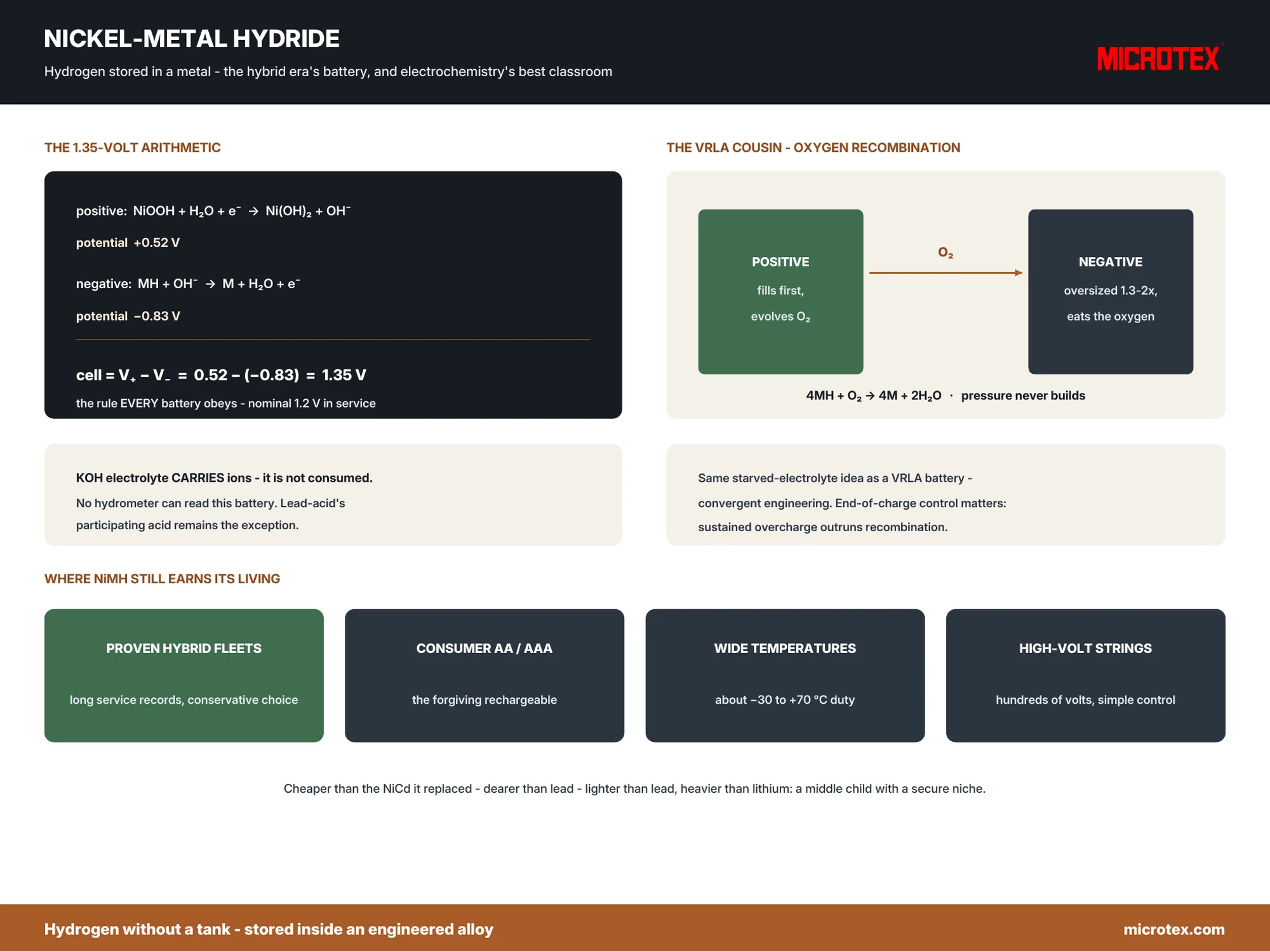
On discharge the positive electrode’s nickel oxyhydroxide is reduced: NiOOH + H₂O + e⁻ → Ni(OH)₂ + OH⁻ (about +0.52 V). At the negative, the metal hydride gives up its stored hydrogen: MH + OH⁻ → M + H₂O + e⁻ (about −0.83 V as a reduction potential). And here is the rule every battery obeys: cell voltage = positive potential minus negative potential — 0.52 − (−0.83) = 1.35 V, the NiMH cell’s familiar ~1.2 V nominal under load. Overall: MH + NiOOH ⇌ M + Ni(OH)₂. Notice what is missing: the water written in the half-reactions cancels out, and the potassium-hydroxide electrolyte appears nowhere in the net reaction. It is there for CONDUCTIVITY only — the exact opposite of lead-acid, whose acid is a consumed ingredient. That single difference is why a hydrometer reads a lead battery’s state of charge and nothing similar exists for nickel or lithium systems.
The VRLA cousin — oxygen recombination
Sealed NiMH cells stay sealed by the same trick as a VRLA battery: a starved-electrolyte design with a gas-permeable separator. Toward the end of charge the positive fills first and begins evolving oxygen; the oxygen diffuses to the negative and reacts with the hydride (4MH + O₂ → 4M + 2H₂O), turning back into water instead of building pressure. Design discipline supports the cycle: the negative is deliberately oversized — the NAM-to-PAM ratio runs about 1.3 to 2 — so it never reaches full charge and never evolves hydrogen in normal service, and a resealing safety vent stands guard for charger malfunction. The family resemblance to VRLA is no accident; starved-electrolyte recombination is one of battery engineering’s great convergent ideas. It also explains the rule every NiMH user learns: end-of-charge control matters, because sustained overcharge outruns recombination.
How the cells are built
The modern positive is a marvel of materials engineering: polyurethane foam is nickel-plated, the polymer burned away, and the resulting nickel foam loaded with high-density spherical nickel hydroxide paste plus conductive cobalt oxides — needed because nickel hydroxide, like lead sulphate, is a poor conductor. (Sintered positives, costlier but punchier at high rates, serve power-first designs.) The negative coats a hydrogen-storage alloy — the AB₅ class of engineered rare-earth alloys is the workhorse — onto perforated nickel foil. The electrolyte is about 30% potassium hydroxide with roughly 17 grams per litre of lithium hydroxide, an additive that suppresses premature oxygen evolution and improves charge acceptance at the positive. Separators tell their own cautionary tale: the first nylon separators slowly decomposed in the cell’s gas atmosphere, and their breakdown products poisoned the positive and fed self-discharge — modern cells use treated polypropylene composites, and self-discharge improved with them.
A short history, honestly told
The pioneering work began in 1967 at the Battelle Geneva Research Centre, growing out of both NiCd and the nickel-hydrogen cells used in satellites; two German carmakers sponsored nearly two decades of development. In 1992 a US Department of Energy programme under the USABC consortium pushed the technology to production maturity, and licensed cell makers supplied the great hybrid-vehicle programmes that made NiMH famous — by 2008 it held roughly a tenth of the world rechargeable market. Then lithium-ion’s energy density took the new designs. Today’s honest position: NiMH persists where its virtues rule — proven hybrid fleets with long service records, consumer AA/AAA replacements (a rechargeable that tolerates ordinary chargers and abuse), wide-temperature duty from about −30 to +70 °C, and strings to hundreds of volts with simple charge control. Cheaper than the NiCd it replaced and free of cadmium’s toxicity; dearer than lead per kWh; lighter than lead, heavier than lithium — a middle child with a secure niche.
Two questions everyone asks
Does NiMH have the memory effect? The pronounced memory behaviour of legend belongs to nickel-cadmium. NiMH can show a milder, largely recoverable voltage sag after long runs of shallow cycling, and an occasional full discharge-and-charge clears it — folklore beyond that is dealt with in our battery myths guide. How is NiMH charged? Its voltage curve is so flat that chargers cannot watch for a finishing voltage the way lead-acid chargers do; instead they watch for the end-of-charge signatures — the small voltage dip and the temperature-rise slope — exactly as described in our charging guide’s other-chemistries section. Which is also the standing warning: never use a charger across chemistries.
Where does it sit against the alternatives for YOUR duty? The chemistry chooser puts the four families side by side. Terms in the glossary; and if you are replacing a nickel bank and wondering whether lead or lithium should succeed it, ask us — we will answer for the duty, not for our catalogue.