
The solid-state battery is the most promised battery in the world. Swap the flammable liquid electrolyte of a lithium-ion cell for a solid, and a chain of good things is supposed to follow: no fire risk, lithium-metal anodes, more energy in less space. The physics is real. The engineering is hard. Here is the idea, the materials, and the honest distance between promise and product.
What actually changes
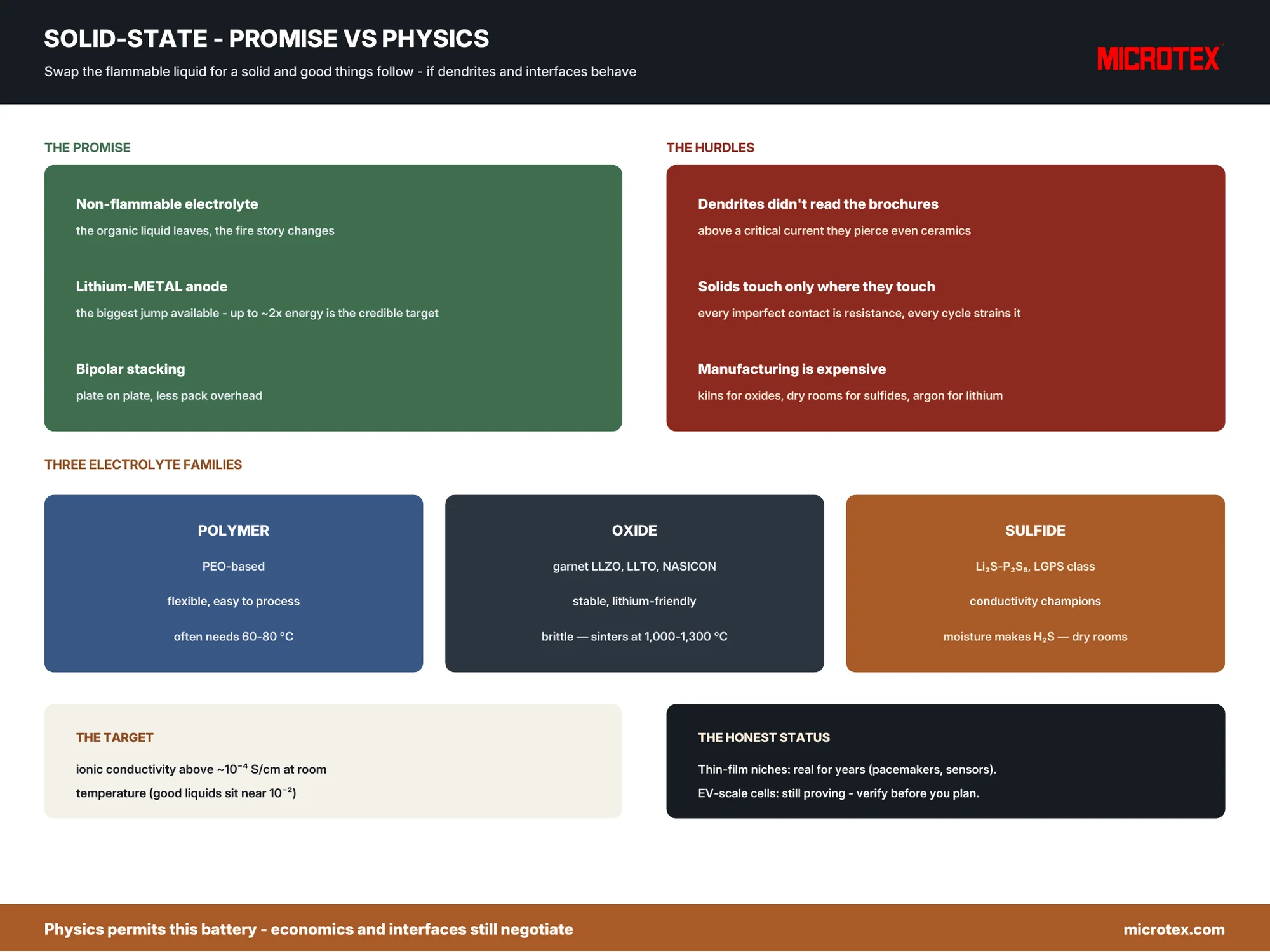
In a conventional lithium-ion cell, lithium ions swim through an organic liquid between the electrodes, with a porous polymer film keeping the electrodes apart. In a solid-state cell one solid material does both jobs — electrolyte AND separator: a ceramic, glass or polymer through which lithium ions migrate between cathode and anode while, as in every battery, the electrons take the long way round through your equipment. Three prizes motivate the swap. The organic liquid is the flammable ingredient — remove it and the cell’s fire story changes fundamentally. A solid electrolyte can physically resist the lithium dendrites that forbid metallic-lithium negatives in liquid cells — and a lithium-METAL anode is the single biggest available jump in energy density, with roughly up-to-double being the credible engineering target. And solid cells can be stacked bipolar — plate on plate in one package — saving the wiring, cooling and housing that dilute today’s pack-level energy.
The three electrolyte families
| Family | Examples | Character |
|---|---|---|
| Polymer | Polyethylene-oxide based | Flexible, easiest to process; modest conductivity, often needs 60–80 °C to perform |
| Oxide (ceramic) | Garnet LLZO, perovskite LLTO, NASICON-type | Stable and robust, friendly to lithium metal; brittle, and densifying it means sintering at 1,000–1,300 °C |
| Sulfide | Li₂S–P₂S₅ glasses, LGPS class | The conductivity champions — some rival liquids; ductile enough to press below 400 °C; but moisture attacks them, releasing H₂S, so manufacture lives in dry rooms |
The honest hurdles
Three problems have kept this battery “five years away” for a long time. Dendrites did not read the brochures: above a critical current density, lithium filaments find grain boundaries and microscopic flaws even in ceramics — so fast charging, the very selling point, is exactly where failure lurks. Interfaces: a liquid wets every crevice of a porous electrode; a solid touches a solid only where it touches, and every imperfect contact is resistance — maintaining intimate contact while electrodes swell and shrink each cycle is the central engineering fight. Manufacturing: brittle ceramics prefer flat stacked formats over wound cylinders, garnets demand kiln temperatures, sulfides demand dry rooms, and lithium metal demands inert atmospheres — all solvable, none cheap. Two production philosophies compete: an extrusion-and-lamination route (slurry-cast or extruded layers pressed together — natural for ductile sulfides and polymers) and a thin-film deposition route (sputtered electrolyte and cathode layers with evaporated lithium — superb, proven, but micrometres thin and priced accordingly).
The honest state of play
Small solid-state batteries are not futuristic at all — thin-film cells have powered pacemakers, sensors and similar micro-duty for years, and that is where the technology’s reliability reputation was earned. The open question is LARGE cells: EV- and storage-scale formats that must deliver the energy, the charge rate, the cycle life and the price at once. Serious industrial programmes are working on exactly that, and claims change quarter to quarter — so treat every announcement as “to be verified”, and if your planning depends on solid-state availability, verify the product, format and delivery date directly with the maker at the time you plan. Physics permits this battery; economics and interfaces still negotiate the terms. Meanwhile the chemistries you can actually buy are compared honestly in the chemistry chooser — including the 165-year-old one whose fire story is told in why batteries explode. Terms in the glossary; questions about matching any of this to a real duty, ask us.