
Start-stop technology saved fuel and murdered batteries — until the battery was redesigned. When cars began switching their engines off at every red light, conventional starter batteries started dying in months, and an entire battery category was engineered in response: the EFB, the Enhanced Flooded Battery. This is the story of why the old battery failed, the punishing standard test that now defines the duty, and the five design changes that fixed it.
EFB meaning: what the letters promise
EFB stands for Enhanced Flooded Battery — and each word carries weight. Flooded: it is still a conventional wet lead-acid battery with free liquid electrolyte, not a sealed AGM or gel type — the enhancement is internal, not a sealing. Enhanced: upgraded specifically to survive start-stop (micro-hybrid) duty — the relentless discharge-at-idle, snatch-charge-while-driving rhythm that destroys a plain starter battery — through the five design levers this article unpacks: lower internal resistance, more capacity, carbon-fortified negatives, stratification management and calcium-tin metallurgy. In practice, “EFB” on a label means: fit this where the vehicle maker specifies EFB, expect start-stop endurance a standard battery cannot give, at a price below AGM. What it does NOT mean is maintenance-heavy: EFBs are supplied as maintenance-free flooded designs for their service life. If your car’s old battery says EFB, that is the class — or better — you replace it with.
Why start-stop killed ordinary SLI batteries
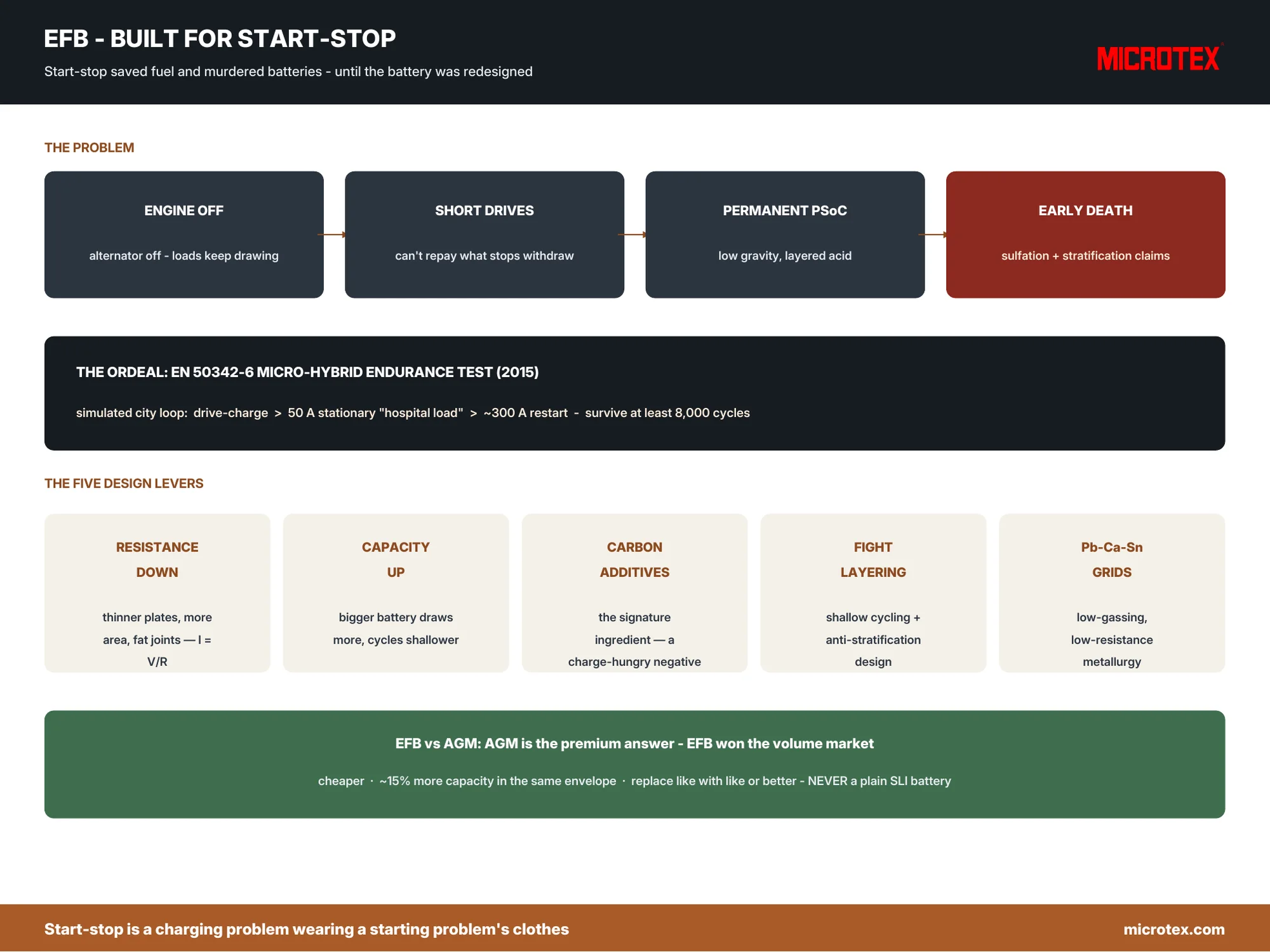
The arithmetic is unforgiving. Engine off at the lights means the alternator is off — but the radio, lights, climate fan, and engine management keep drawing. Every stop withdraws energy; the short drive between stops must repay it, and in city traffic it often cannot. So the battery slides into permanent partial state of charge: low gravity acid, plates never fully converted, dense acid settling into layers. The diseases followed on schedule — sulfation, active-material degradation, stratification-driven corrosion — and the first start-stop generation produced an unprecedented wave of warranty claims on nearly new batteries. The battery wasn’t defective; the DUTY had changed underneath it.
The test that defines the duty
In 2015 the European standard series gained a purpose-built ordeal: EN 50342-6, the micro-hybrid endurance test. It simulates congested urban driving on a loop: a charging period scaled to the battery’s capacity (the drive), then a stationary discharge at 50 amps — the so-called hospital load of lights, heating and electronics — then a restart pulse around 300 amps, and again, and again. A battery for start-stop duty is expected to survive at least 8,000 such cycles. The test’s real teaching is the quantity it stresses: not cold-cranking amps but Dynamic Charge Acceptance (DCA) — how much charge the battery can swallow in the short, irregular windows the duty offers. Start-stop is a charging problem wearing a starting problem’s clothes, which is why the general discipline in the charging guide matters even here.
The five design levers of the EFB
With the car’s alternator and management system fixed, only the battery could change, and five levers were pulled. Internal resistance down: at a fixed alternator voltage, current obeys I = V/R — so EFBs use optimised grid geometry, more and thinner plates for surface area, and generous welded cross-sections at every joint. Capacity up: a larger battery draws more current at any state of charge, recovers faster, and cycles shallower — which itself fights stratification. Carbon in the negative: the signature EFB ingredient — carbon additives (from flake graphite to nanotubes, every maker guarding its recipe) that keep the negative’s active material fine-grained and charge-hungry through partial-state-of-charge life. Electrolyte behaviour managed: flooded acid moves — good for cooling, bad for layering — so EFBs pair the shallower cycling above with design features against stratification. The alloy: lead-calcium-tin grids, the same low-gassing, low-resistance metallurgy the complete guide’s history chapter credits with enabling maintenance-free batteries. Even production settings matter: curing temperature steers the active material’s crystal form, and the coarser tetrabasic sulphate that suits some duties costs charge acceptance in this one.
EFB or AGM — the honest verdict
Carmakers first reached for AGM batteries, and for heavy start-stop duty with regenerative braking AGM remains the premium answer. But the EFB won the volume market for honest reasons: it is cheaper to make; a similarly sized AGM typically gives around 15% LESS capacity (thinner acid reserves), meaning deeper cycling in service; and AGM’s immunity to stratification is not absolute — cycled deep enough, around 80% depth of discharge, even immobilised electrolyte develops gradients. The AGM-versus-gel article covers that family properly. The practical buying rule: replace like with like or better — a start-stop car specified for EFB gets an EFB or an AGM, never a plain SLI battery, because the plain battery will re-run the warranty story of the early years at your expense. Check the vehicle’s battery code, not just its terminals. Terms in the glossary; unsure what your vehicle or fleet actually needs, ask us and we will read the duty before naming a battery.