
The battery is on float, the voltmeter reads exactly what the manual says it should, and the bank is quietly cooking. Nothing on the panel shows it, because a DC voltmeter averages away the thing doing the damage: a small alternating voltage riding on top of the direct one, left over from the charger’s rectifier. Engineers call it ripple, and it is the least-specified, least-measured and least-understood cause of premature battery death in float service. Linden’s handbook is blunt about it — AC ripple “can be a more significant factor in premature battery failure, especially in float or uninterruptible power systems” — and yet it appears on almost no battery-room inspection sheet and in almost no tender. This guide explains what ripple is, what it does inside a cell, how much is too much according to the institutions that have written it down, and how to catch it before the battery pays for it.
What ripple is, and where it comes from
Every charger that runs from the mains is a rectifier: it turns alternating current into direct current, and no rectifier does the job perfectly. What comes out is a direct voltage with a wobble on it at some multiple of the mains frequency — the ripple. A well-designed charger flattens the wobble with filter capacitors and, in float service, relies on the battery itself to absorb what remains. Linden notes that “most rectifiers produce some AC ripple with the direct current, which causes additional heating of the battery”, and that cheaper half-wave designs deliver a peak-to-average voltage ratio 50 percent higher than full-wave ones for the same average — the same nominal float, a much rougher ride. The wobble grows with age: the Electric Power Research Institute’s stationary-battery monitoring report records that “as the capacitors age and eventually fail, the battery charger tends to produce larger levels of output ripple”, and the US Bureau of Reclamation’s battery manual lists a failed thyristor and failed filter capacitors as the two usual culprits when ripple suddenly climbs. A ten-year-old charger is rarely the charger that was commissioned; the battery is the component that finds out first. Our guide to battery chargers covers the machine; this article covers the one thing it leaks.
What it does inside the cell
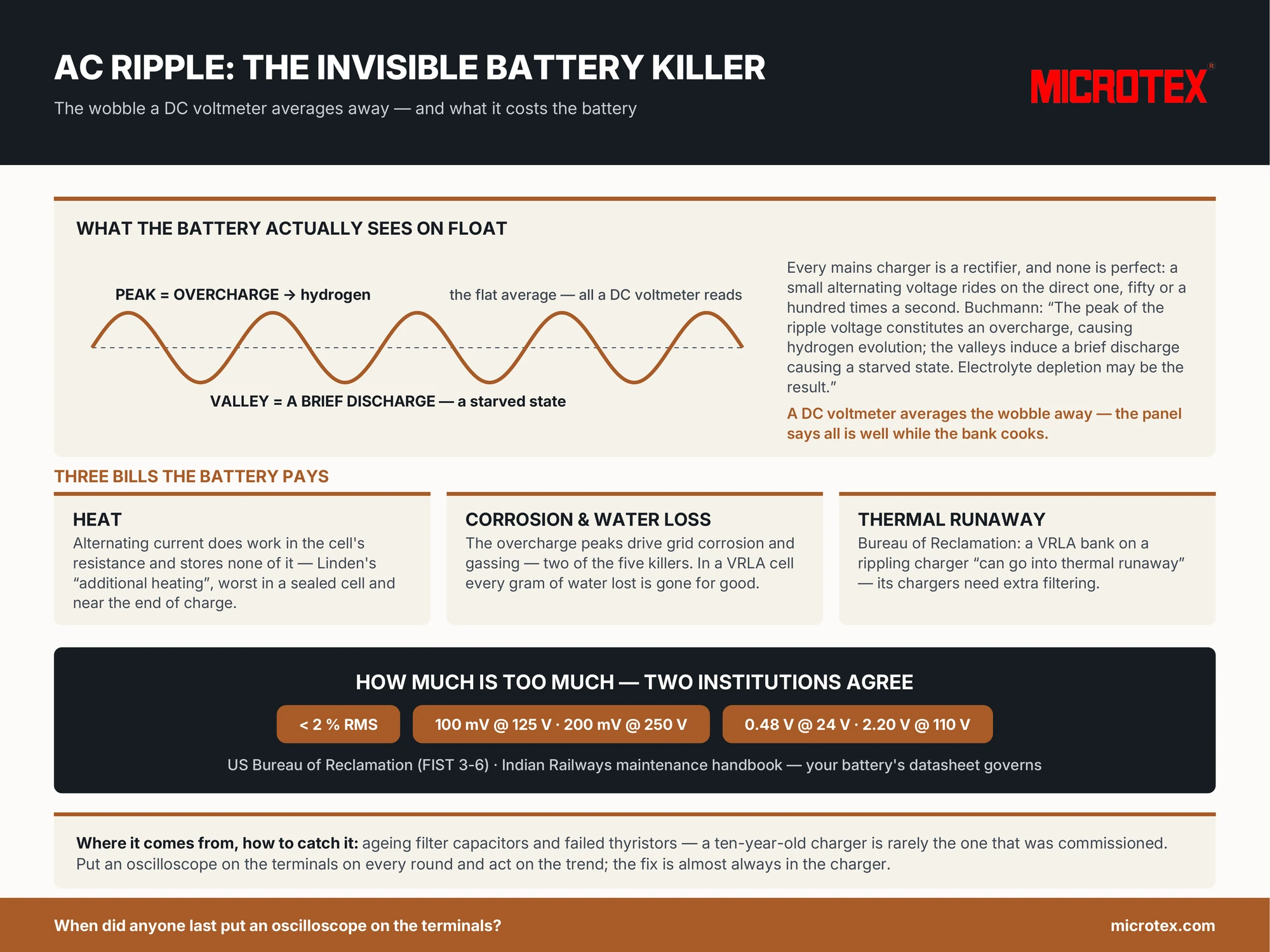
A battery on float is supposed to sit at one voltage, doing the small amount of work described in our float-charging guide. Ripple turns that stillness into a tremor. Buchmann’s description is the clearest: “The peak of the ripple voltage constitutes an overcharge, causing hydrogen evolution; the valleys induce a brief discharge causing a starved state. Electrolyte depletion may be the result.” Fifty or a hundred times a second, the cell is nudged into overcharge and then into a tiny discharge, and each nudge costs something. Three bills come due. The first is heat: the alternating current does work in the cell’s internal resistance and none of it is stored — Linden’s “additional heating” — which matters most in a sealed cell that cannot shed heat by gassing and in a bank whose ageing rate roughly doubles for every ten degrees. The second is corrosion and water loss: the overcharge peaks drive the grid-corrosion and gassing reactions that our guide to how batteries die lists among the five killers, and in a VRLA cell every gram of water lost to those peaks is gone for good. The third, for sealed batteries specifically, is the trapdoor: the Bureau of Reclamation warns that “if a large amount of ripple is present on chargers for VRLA batteries, the system can go into thermal runaway”, the self-feeding heat spiral our float-charging guide describes — which is why the same manual insists that a VRLA charger needs “extra electrical filtering to protect the cells from AC ripple”. Flooded cells forgive more, because they can vent the hydrogen and be topped up; they still pay in life.
How much is too much
Here the institutions have done the work, and two of them, on two continents, agree. The US Bureau of Reclamation’s manual for its own power stations puts charger ripple at “less than 2 % of the charger output for a filtered system without the battery connected”, and, with the battery connected, at typical terminal values of “less than 100 millivolts at 125 VDC or 200 millivolts at 250 VDC”, measured as RMS. Indian Railways’ maintenance handbook on valve-regulated batteries sets the same ceiling — ripple content in the DC voltage “should be less than 2 % rms”, which it works out as 0.48 V on a 24 V system and 2.20 V on a 110 V system. Two percent is therefore a defensible default for a tender clause; the number that actually governs is the one on your battery’s datasheet, and a good sheet states both a ripple-voltage and a ripple-current limit. Ripple current is the quantity the cell truly feels, and it can be startlingly large: the EPRI report notes that “ripple currents in excess of 30 amperes have been reported on large UPS systems”, and observes that among the applications it studied, utility generating stations and substations rarely showed ripple problems while “the most problems appear to be associated with the UPS industry” — a warning to anyone specifying batteries behind an inverter. The same report records a subtler cost: heavy ripple interferes with the ohmic test instruments used to trend cell health, so a bank with a dirty charger is also a bank whose resistance readings are harder to trust.
How to catch it
Ripple is invisible to the instrument most people carry. A DC voltmeter reads the average and reports that all is well; the wobble has to be looked for on purpose. The Bureau’s inspection procedure has it measured at the battery terminals with an oscilloscope as part of the routine round — the same round on which our maintenance walk-round guide has you log cell voltages and gravities — and logged so that a rising trend is seen before a failed capacitor becomes a failed bank. Three field signs should send you for the oscilloscope without waiting for the schedule: a float bank running noticeably warmer than the room with no discharge to explain it; a VRLA string whose cells are drying out or whose vents are working on float, which our VRLA maintenance guide treats as an alarm; and a charger that hums, buzzes or has recently had a control board or thyristor replaced. If ripple is high, the fix is almost never in the battery room — it is in the charger’s filter capacitors or rectifier, and the charger maker’s guidance governs. If the ripple is chronic and the charger cannot be fixed, the honest answer is a battery whose datasheet tolerates it and whose room can vent what the peaks produce — our guide to battery-room hydrogen explains why gassing on float is never “just a bit of fizz”.
Put it in the tender
The cheapest place to control ripple is the page where the charger is specified, and most tenders leave the line blank. Write it in: a ripple-voltage limit at the battery terminals, a ripple-current limit as a fraction of the battery’s capacity, both measured with the battery connected, both demonstrated at factory acceptance and again at commissioning — our guides to writing a battery specification and commissioning show where the clause sits. Then make the measurement part of the yearly round, so that a charger which was clean when new is caught when it stops being clean. We size and supply batteries for buses that float for decades, and the question we ask every customer who reports a bank ageing faster than it should is the same: when did anyone last put an oscilloscope on the terminals? If the answer is never, tell us the charger and the bus, and we will tell you what to measure and what a healthy reading looks like for your battery.
Sources quoted: T. B. Reddy (ed.), Linden’s Handbook of Batteries, 4th ed. (McGraw-Hill, 2011); I. Buchmann, Batteries in a Portable World, 2nd ed. (Cadex Electronics, 2001); U.S. Bureau of Reclamation, FIST Volume 3-6: Storage Battery Maintenance and Principles (April 2020); EPRI, Stationary Battery Monitoring by Internal Ohmic Measurements, Report 1002925 (EPRI, Palo Alto, 2002); Indian Railways, CAMTECH Maintenance Handbook on VRLA Batteries, CAMTECH/S/2003/VRLA/1.0 (2003).