
A battery warranty is a promise about manufacturing defects, not a promise about how long the battery will last — and almost every warranty dispute we have seen began with a buyer who believed it was the second. The document is usually two pages, arrives after the purchase order, and is read for the first time on the day a cell fails. Read before the order, it is one of the most useful things a supplier will hand you, because it tells you precisely what they think kills their battery. This guide is how to read one: the three words that are not the same, the anatomy of an industrial warranty, the clauses that void it, and the file to keep from day one if you ever want to claim.
Three words that are not the same
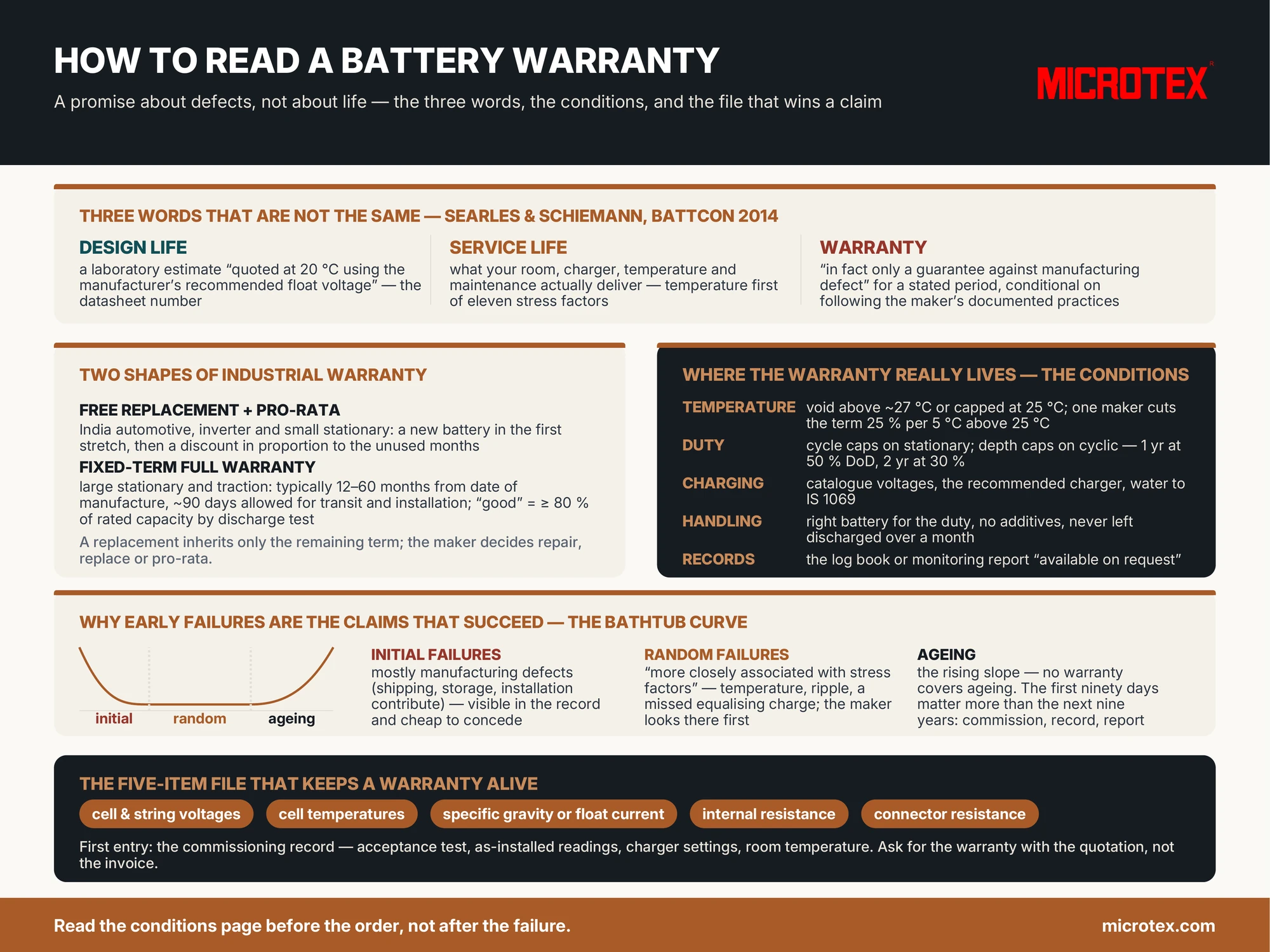
A 2014 Battcon paper by two stationary-battery engineers, Searles and Schiemann, exists because buyers confuse them. Design life is a laboratory number: the European battery-makers’ association definition the paper quotes is “the estimated life determined under laboratory conditions… quoted at 20 °C using the manufacturer’s recommended float voltage” — the figure our guide to reading a datasheet teaches you to find. Service life is what the same battery achieves in your room, under your charger, at your temperature, with your maintenance; the paper lists eleven things that shorten it, temperature first and an actual manufacturing defect last. Warranty, in the paper’s words, “is in fact only a guarantee against manufacturing defect”: a promise that, if you follow the maker’s documented practices, the battery is warranted against defects in material and workmanship for a stated period. A twenty-year design life, a twelve-year service life and a two-year full warranty can all be true of one cell at once, and the paper’s opening example — a “20-year” battery below eighty per cent capacity at year fifteen, and a maker declining the claim — is what happens when the three are read as one.
What a warranty actually covers, and until when
Industrial warranties come in two shapes, and both are in the documents on our shelf. Automotive, inverter and small stationary batteries in India typically carry a free-replacement period followed by a pro-rata period: a defect in the first stretch earns a new battery; a defect in the second earns a discount on a new one in proportion to the unused months. Large stationary and traction batteries more often carry a full warranty of a fixed term — the paper puts the usual range at twelve to sixty months from the date of manufacture, most makers allowing about ninety days beyond that for transit and installation — sometimes followed by a pro-rated tail towards a stated life. Read the start date carefully: “date of manufacture”, “date of shipment” and “date of commissioning” can differ by a year on a project battery, and the clock runs from whichever the document names. Read the end condition too. The paper records the industry convention that a battery is “good” while it delivers at least eighty per cent of its rated capacity — the threshold our guide to how batteries actually die uses for end of life — and a warranty that guarantees capacity guarantees it to that line, proven by a discharge test, not a voltmeter. A replacement cell usually inherits only the remaining term of the original, and the maker, not the buyer, decides between repair, replacement and pro-rata settlement.
The conditions: where the warranty really lives
The conditions page is the maker’s own list of what kills the battery, and it is worth reading as engineering advice rather than legal defence. Temperature comes first in every document we have. The paper quotes one maker voiding the warranty if average ambient exceeds about 27 °C and another capping it at 25 °C; one European maker’s renewable-energy terms cut the warranty period by a quarter for every five degrees above 25 °C and end it above 40 °C. None of that is arbitrary — it is the halving of life for every ten degrees that our guide to Arrhenius’ theory explains, written into contract form. Duty second: stationary warranties commonly cap the number of cycles, and cyclic ones cap depth of discharge — the same European document offers one year at fifty per cent depth or two years at thirty. Charging third: voltages within the catalogue, a charger of the recommended type, no charging beyond the stated rate, and — for flooded cells — topping-up with water to the standard, which in India is IS 1069. Handling and application fourth: the right battery for the duty per the maker’s application chart, no additives, no acid added to a filled cell, no unauthorised repair, no broken container, and no battery left discharged in a store — several documents void cover if a battery stands more than a month uncharged, which is why our guide to storing batteries in stock exists. And records last: one European maker requires the log book, or the monitoring system’s report, to be produced on request. A warranty with no conditions is not generosity; it is a maker who does not expect to be asked.
Why early failures are the claims that succeed
The paper draws the failure rate of a lead-acid battery as the familiar bathtub: a short period of initial failures, a long floor of random ones, and the rising slope of ageing. Initial failures — a cell that drops out in the first months — are mostly manufacturing defects, though shipping, storage and installation contribute, and they are what a warranty exists to cover; a good maker replaces them without argument because they are visible in the record and cheap to concede. Failures on the floor are, in the paper’s words, “more closely associated with stress factors” — temperature, ripple, the missed equalising charge — and the maker will look for those before conceding a defect. Failures on the slope are ageing, and no warranty covers ageing. So the first ninety days matter more than the next nine years: commission the battery properly, record everything, and report anything odd in writing at once. One maker’s terms give the user fifteen days to report a suspected defect; another voids cover if a safety defect is not reported immediately.
The file that keeps the warranty
Searles and Schiemann close with the observation that “proving a battery is defective is not always easy”, and the buyer’s only defence is a record the maker cannot dispute. The paper’s list is five items: individual cell and string voltages, cell temperatures, specific gravity or float current, internal resistance, and connector resistance. The first entry in that file is the commissioning record our guide to battery commissioning describes — the acceptance test result, the as-installed readings, the charger settings, the room temperature on day one — and every later entry is compared with it. Add the purchase documents, the date the clock started, the charger’s own log if it has one, and the room’s temperature history. A claim that arrives as “the battery has failed” gets a form letter; a claim that arrives as “cell 47 read low at commissioning, drifted further by month four at 24 °C average, and failed the capacity test we ran on the date attached” gets an engineer.
Buying a warranty that means something
Ask for the warranty document with the quotation, not the invoice, and read the conditions page against your own installation. If your room runs at 32 °C and the conditions say 25, the warranty is decorative, and the honest conversation is about a different battery or an air-conditioner, not a longer promise. Ask what the design life is based on — a test standard our guide to battery standards can decode, or a brochure — and whether the maker distinguishes design life from warranty in writing. Ask what records they will require at a claim, and build your maintenance routine to produce exactly those. Compare warranties on the same basis: the paper notes that the same European battery may carry a different warranty in Europe and in North America, and a longer number is not a longer life. And put the temperature and duty you actually have into the specification, so the battery is chosen for the conditions the warranty will later be judged against. Our own terms are in the offer document, and we would rather you read them before ordering than after.
Send us the conditions page
If you have a warranty document in front of you — ours or anyone’s — and a room, a charger and a duty to hold it against, send us the conditions page and the installation details. We will tell you, clause by clause, which conditions your installation meets, which it does not, and what record would put a future claim beyond argument.
Sources quoted: C. Searles and M. Schiemann, “Understanding and Differentiating Design Life, Service Life, Warranty and Accelerated Life Testing for Lead Acid Batteries”, Battcon 2014.