
Every few years a utility or railway specification asks why the battery bank is not nickel-cadmium, and sometimes the honest answer is that it should be. We build lead-acid, in OPzS flooded and OPzV gel form, so this guide is written by the party with the most to lose, which is the reason to read it. It sets out where nickel-cadmium genuinely beats lead-acid in a stationary battery, where it does not, and what to weigh before you write either into a tender.
What the two cells actually are
A nickel-cadmium cell has a nickel-hydroxide positive and a cadmium-hydroxide negative in a potassium-hydroxide electrolyte, at a nominal 1.2 V per cell against the lead-acid cell’s 2 V. John Erbacher’s chapter on industrial nickel-cadmium batteries in Linden’s Handbook of Batteries calls the vented pocket-plate design the oldest and most mature of the family. Two consequences follow from the chemistry. The alkaline electrolyte barely changes in density between charge and discharge, so there is no acid stratification and no way to read state of charge from a hydrometer, a point the Bureau of Reclamation’s FIST Volume 3-6 makes explicitly. And the steel plate structure is not used up by the cell reaction, whereas a lead grid is both structure and reactant and slowly corrodes.
Where nickel-cadmium genuinely wins
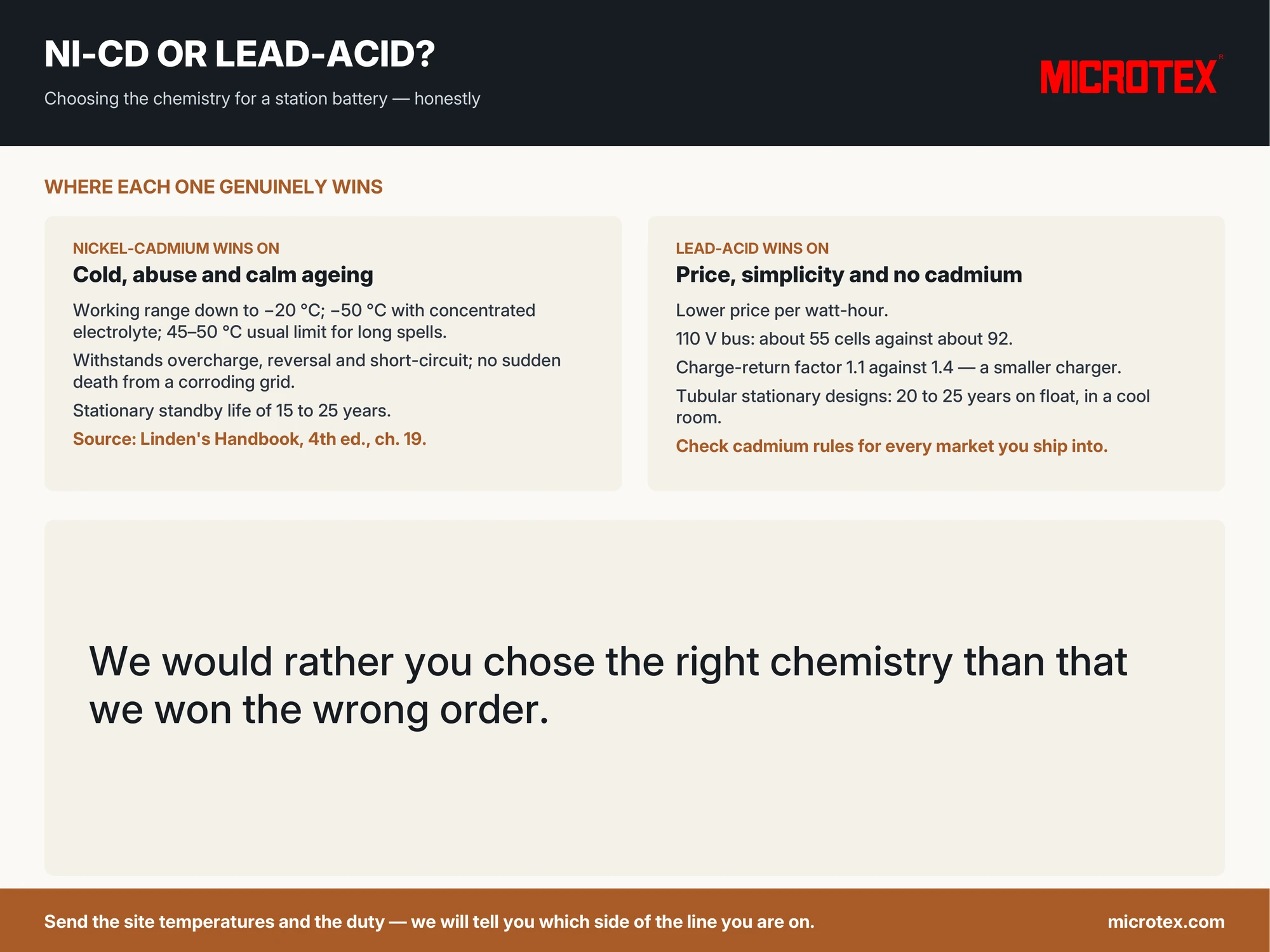
Temperature. Erbacher gives the working range of the standard electrolyte as down to −20 °C, and down to −50 °C with a more concentrated one, and treats 45 to 50 °C as the usual limit for extended operation, with occasional higher excursions not harmful. For an unheated outdoor kiosk on a cold plateau, or a battery room that cannot hold its temperature, that is a real advantage. Abuse and sudden death. Erbacher says the pocket-plate battery withstands severe mechanical abuse and electrical maltreatment, meaning overcharge, reversal and short-circuit, and that because the alkali does not attack the steel it does not suffer the sudden failure a corroded lead grid can. FIST says much the same in its own words. For a remote site visited twice a year, predictability is worth money. Life. Erbacher reports more than 2,000 cycles and total lifetimes of 8 to 25 years or more depending on service, with stationary standby batteries at 15 to 25 years.
Where lead-acid wins
Price. Erbacher is plain that pocket-plate nickel-cadmium costs less than other alkaline batteries but more than lead-acid per watt-hour. The life gap narrows against a good lead design. Linden’s lead-acid chapter puts tubular stationary batteries at 20 to 25 years and Planté designs at about 25, while noting that makers’ life claims are at times conflicting. Float life also falls with temperature, so the comparison depends on the room you will actually have; our guide to Arrhenius’ theory explains why. Cell count. At nominal voltage a 110 V DC bus needs about 55 lead-acid cells but about 92 nickel-cadmium cells, and FIST’s own example is a 92-cell bank, so the nickel-cadmium bank has more cells, more intercell connections and more places to look at inspection.
Charging. FIST’s charger equation, which we walk through in our guide to sizing a station battery charger, uses a charge-return factor of 1.4 for nickel-cadmium against 1.1 for lead-acid, so for the same duty the nickel-cadmium bank asks more of its charger. Erbacher’s table of disadvantages also lists the need for temperature-controlled charging to get the long life, with lower energy density, a caustic electrolyte and a memory effect. Cadmium. Cadmium is toxic, and Erbacher lists its presence among the disadvantages. In the European Union, Regulation (EU) 2023/1542 limits cadmium in portable batteries to 0.002 per cent, a limit written for portable rather than industrial batteries, but the regulation’s wider rules on collection, recovery and due diligence reach across categories, and India’s Battery Waste Management Rules put end-of-life responsibility on the producer; see our guide to India’s battery waste rules. Regulations change, so check the current text for every market you ship into before relying on any of this.
A four-question test
First, what are the hottest and coldest temperatures the battery room will honestly see? If you can hold the room near the temperature the maker’s catalogue assumes, lead-acid keeps its price advantage; if you cannot, ask for a nickel-cadmium quotation beside it. Second, how often will anyone look at the battery? An unattended site rewards forgiveness. Third, are you comparing purchase price or whole-life cost? Run both on the same horizon; our guide to battery total cost of ownership shows the method, and it cuts both ways. Fourth, who carries the end-of-life burden, and under which country’s rules?
What we will tell you
We do not make nickel-cadmium cells, so we have no stake in that column. For an air-conditioned station or substation battery room with a maintained float, a tubular bank from our OPzS range or, where sealed cells suit, our OPzV gel cells is often the economic answer, but often is not always. If your specification is for an unheated outdoor kiosk, a sub-zero site or a railway duty with abusive handling, ask for a nickel-cadmium quotation beside ours. We would rather you chose the right chemistry than that we won the wrong order. Send us the site temperatures and the duty and we will tell you which side of the line you are on.
Sources quoted: T. B. Reddy (ed.), Linden’s Handbook of Batteries, 4th ed. (McGraw-Hill, 2011), chapter 19 (J. K. Erbacher) and chapter 16; U.S. Bureau of Reclamation, FIST Volume 3-6: Storage Battery Maintenance and Principles (April 2020); Regulation (EU) 2023/1542 of the European Parliament and of the Council on batteries and waste batteries.