
A dry-charged battery is a charged battery with its acid taken out, and that one change lets a battery travel and wait without going flat. It is useful, it is not universal, and it passes a job to whoever receives the battery. This post explains the idea, outlines what activation involves, and lists what a buyer should ask. We draw on Linden’s Handbook of Batteries and on Dell and Rand’s Understanding Batteries; the activation procedure for your battery is your maker’s to give, and we do not state one.
Why the acid comes out
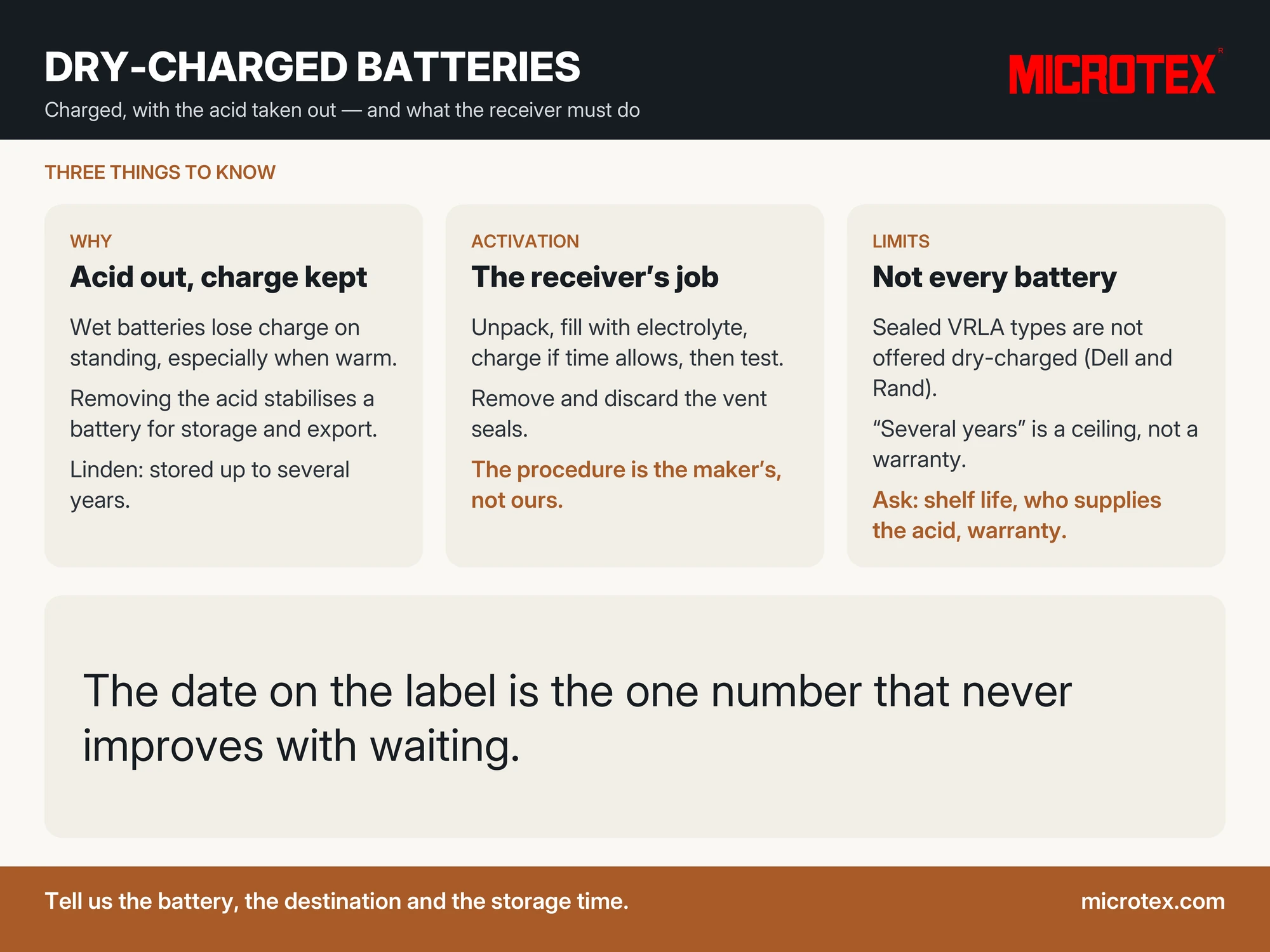
Linden states the problem plainly: the performance of a wet battery degrades with long periods of inactivity, especially in warm storage. For starter batteries with antimonial grids he says a loss of 1 to 3 per cent of capacity a day is possible, and for maintenance-free types as little as 0.1 to 3 per cent a day. Those are automotive figures; an industrial cell will differ, so read them as a direction and not as a promise for any traction or stationary cell. When a battery has to be stored for a long time, or shipped for export, Linden says its performance can be stabilised by removing the electrolyte, and a battery held in that state can be stored for up to several years before reactivation.
How a battery is made dry-charged
Linden describes two routes. In one, the plates are tank-formed, washed in water and dried in an inert gas before the element is welded and assembled. In the other, the welded element is formed, washed and dried, which is simpler but needs separators that rewet easily afterwards. In both, the case is then sealed. The reason for the care is chemical: tank-formed plates are somewhat unstable, because the negatives oxidise spontaneously in air, which is why they are dry-charged before use. Our reading is that the process is a production step whose quality decides whether the battery wakes up properly; our guide to battery formation explains the step that comes first.
What activation involves
Linden’s outline is short. Unpack the battery, fill the cells with electrolyte, which sometimes arrives in a separate package, charge the battery if time is available, and test its performance. The materials used to seal the vent holes must be removed and discarded. Every specific, such as the acid strength, its temperature, the wait before charging and the charge itself, differs by type and maker, so we state none. Our guides to filling a lead-acid battery and to battery commissioning cover the practice and the records.
What dry-charging cannot do
Sealed valve-regulated batteries keep their electrolyte inside the cell. Dell and Rand’s comparison table lists “not available in dry-charged state” among their disadvantages, together with a shelf life of two years at most; those are the book’s words as of its edition, so check current figures with the maker. Our guide to the VRLA battery explains why the electrolyte is held where it is. Dry-charging also does not stop the clock. A stored battery still has a manufacturing date, and “several years” is a ceiling Linden quotes for the process, not a warranty for your battery. Our guide to storing lead-acid batteries covers the conditions that matter.
Where it helps, and where it costs
It helps with long supply chains, export containers and dealer stock that may wait months. It costs effort at the destination, because someone there must handle acid, fill each cell correctly, charge and test. A mistake in that step, such as the wrong acid, an overfilled cell or a skipped first charge, becomes the user’s problem and can become a warranty argument. Transport rules can also differ between a filled battery and an unfilled one; check the current rules with your forwarder, and see our guides to dangerous-goods status and to shipping lead-acid batteries. We state no classification here. Whatever the type, rotate dealer stock by manufacturing date, oldest first, because the date on the label is the one number that never improves with waiting. On arrival, check the vent seals: a broken or missing seal, or a damp pack, means the battery has been exposed, so photograph it before you accept it.
Five questions before you buy dry
Ask whether the type is offered dry-charged at all. Ask how long, counted from the manufacturing date, it may be stored, and under what conditions. Ask who supplies the acid and to what specification. Ask for the maker’s activation and first-charge instruction for this exact type. And ask what the warranty says if the activation is done by a third party. Ask also whether the activation instruction and the seals’ removal note travel with the battery in the box. Write the answers into the purchase specification, so that nobody discovers them on the day the container is opened.
Tell us the battery, the destination and the storage time you expect and we will say plainly whether dry-charged supply suits the job.
Sources quoted: T. B. Reddy (ed.), Linden’s Handbook of Batteries, 4th ed. (McGraw-Hill, 2011), chapter 16, sections on formation, dry charge and activation of dry-charged batteries; R. M. Dell and D. A. J. Rand, Understanding Batteries (Royal Society of Chemistry, 2001), chapter 8, table of advantages and disadvantages of VRLA batteries.