
A vent plug is the one deliberate hole in a lead-acid battery, and a good deal of design goes into what it lets out and what it keeps out. This post explains the vent plugs of flooded cells and the valves of sealed ones, using Linden’s Handbook of Batteries, Crompton’s Battery Reference Book and a genericised German stationary-battery handbook. The part you should fit to your battery is the maker’s to specify, and we print no pressure or setting for your cells.
Why gas leaves at all
This is our reasoning from the basic chemistry. Near the end of a charge, and in any overcharge, the current no longer converts active material and goes largely into splitting water into hydrogen and oxygen. Those gases have to go somewhere, and in a flooded cell they go through the vent plug.
Flooded cells: gas out, acid back
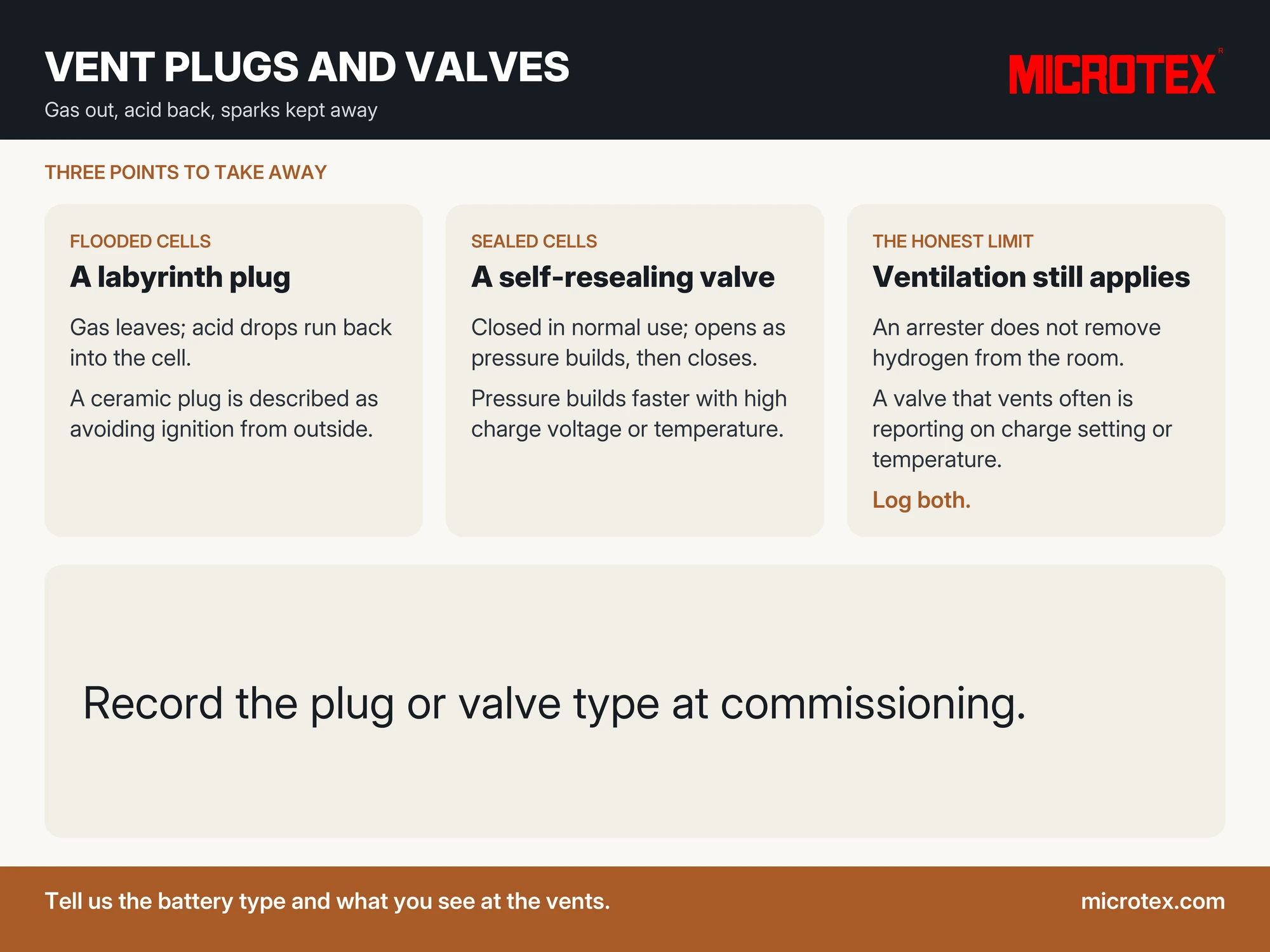
A charging cell makes gas, and the gas has to leave. The handbook describes a labyrinth inside the vent plug: drops of acid carried on the gas bubbles settle there and run back into the cell. Crompton’s chapter on lead-acid batteries labels a cell design feature in the same terms, vent plugs designed to eliminate spray but give free exit of gases. The idea is old and simple. A plug that lets gas out and keeps acid in keeps the cell top dry, and a dry top matters; our guide to heat on charge shows what wet tops can do.
The ceramic plug
The handbook also describes a ceramic vent plug, through which the gas escapes, and which it says avoids ignition from outside into the cell. A version with a funnel lets you top up the water, read the electrolyte density and take the temperature without removing the plug. Linden makes the matching point that cells can be fitted with flame arrestors in the vents so that outside sparks do not ignite the explosive gas inside the case, and that many reported battery explosions come from uncontrolled charging in non-automotive uses. Here is the honest limit: an arrester protects the inside of the cell from an outside spark. It does not remove hydrogen from the room, so ventilation and the rule of no sparks near the battery still apply. Our guide to battery-room hydrogen ventilation covers the room.
Sealed cells: a valve, not a hole
A valve-regulated battery has a self-resealing valve instead. The handbook says it stays closed in normal operation, opens when the gas pressure inside the cell builds up, and closes again once the pressure has equalised, so the cell is tight to the outside. Pressure builds faster in abnormal conditions, and it names a high charge voltage and high temperature. For one maker’s gel valve it gives an opening pressure of 60 to 180 millibar and describes the valve and its labyrinth as flame-arresting. Treat that as one product’s figure, not a rule for other designs.
What a venting valve is telling you
This is our reasoning. Each time a valve opens, a little gas leaves, and in a sealed cell the water that left cannot be added back, so repeated venting uses up the life of the battery. A sealed battery that vents often is therefore reporting on its charge setting or its temperature. Do not rely on listening for a hiss; check the charger’s setting and the battery’s temperature against the maker’s figures, and write both down. Our guides to thermal runaway in VRLA batteries and to VRLA battery maintenance explain what to check, and the housing around the valve is covered in our guide to container and lid materials.
Which plug the specification names
The plug is part of the cell design, so it belongs in the specification and not in the spares box. Some specifications ask for a ceramic plug, some for a funnel version so that the watering round needs no tools, and some for neither; ask which your type is supplied with and whether the alternative is offered. A valve-regulated battery has no choice to make, because its valve is part of the lid.
What to do about plugs and valves
Record the plug or valve type at commissioning, so that a later replacement matches it. Keep every plug fitted and every valve cap in place. Check that the plug openings are clear, and clean them only by the maker’s method. Replace a damaged plug with the maker’s part, since a plug is matched to its cell. Never prise open or tamper with a sealed battery’s valve. And log any plug top that is wet, because that points to overfilling, spray or a charge that is too hard; our guide to battery water covers the watering round that goes with it. Tell us the battery type and what you are seeing at the vents and we will say whether it looks normal.
Sources quoted: T. B. Reddy (ed.), Linden’s Handbook of Batteries, 4th ed. (McGraw-Hill, 2011), chapter 16, section on safety and hydrogen; T. R. Crompton, Battery Reference Book, 3rd ed. (Newnes, 2000), chapter 50; Handbook for Stationary Lead-Acid Batteries, Part 1, 3rd ed. (December 2008), section on vent caps and valves.