
“Maintenance-free” is the most expensive phrase in the battery trade. It is true in exactly two respects: a valve-regulated battery never asks for topping up, and it gives you no vent plug to dip a hydrometer through. Everything else a battery needs — clean connections, sensible temperature, a healthy charger, and somebody who notices drift before it becomes damage — a VRLA bank needs just as much as its flooded grandfather. Arguably more: sealing the cell also seals away the evidence. The flooded battery’s most honest witness, specific gravity, is simply not available to you. What follows is the VRLA companion to our maintenance walk-round guide — same rhythm, different instruments.
What sealing removes — and what it quietly keeps
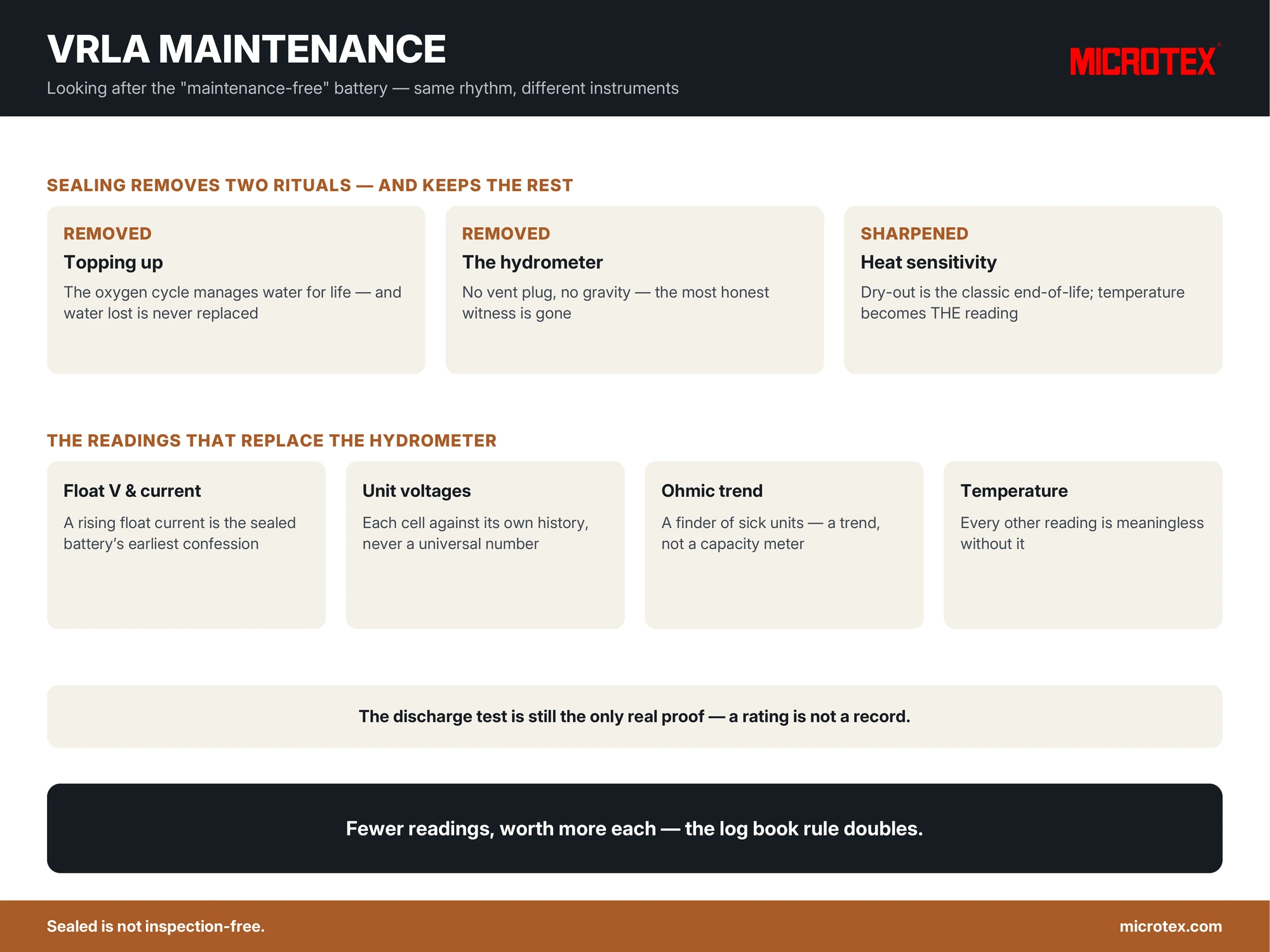
Sealing removes the two flooded rituals: no water, no hydrometer. It keeps everything else, and adds one sensitivity of its own. A VRLA cell manages its water for life through the internal oxygen cycle, which means water lost to heat and overcharge is never replaced — dry-out is the classic true end-of-life for the class. That single fact reorganises the maintenance job: temperature stops being one reading among many and becomes the reading. The cheapest life-extension for a VRLA bank is the same as for any battery, only more so — shade, ventilation, spacing and cabinet sense, the discipline our battery room design guide teaches. The trade’s formal rulebook acknowledges the same shift: IEEE 1188, the VRLA sibling of the vented battery’s IEEE 450, is built around inspections and measurements rather than electrolyte rituals, on the familiar monthly-quarterly-yearly shape (recently revised; your specification and maker’s manual own the exact schedule).
The readings that replace the hydrometer
Four instruments carry the sealed battery’s story. First, float voltage and float current at the charger — a bank on float charge develops habits, and a rising float current is the sealed battery’s earliest confession: more heat, more oxygen cycle, more water gone, in a loop that wants catching young. Second, individual cell or monobloc voltages — against their own history, never against a universal number. Third, the ohmic reading — conductance or impedance — which is the VRLA trade’s substitute witness. Use it the way our internal resistance guide teaches: as a trend and a finder of sick units, not as a capacity meter; a stable trend is comfort, a moving one is a summons. And fourth, temperature — of the room, and of a pilot unit — because every other reading is meaningless without it. A fifth check costs nothing: confirm the charger’s settings against the commissioning record — temperature compensation quietly disabled at a service visit is a classic slow killer of sealed banks. Above all four stands the only real proof: the discharge test, exactly as our battery testing guide ranks it. A sealed battery that has never been discharge-tested has a rating, not a record.
The failure modes worth watching
Know what you are looking for and the readings organise themselves. Dry-out announces itself as the float-current creep described above, and it is driven by the two things a walk-round can actually control: heat and overcharge. The uglier staircase — a shorting cell dragging its neighbours into overwork until heat feeds heat — belongs to the same float-current story, and our float charging guide walks through it in detail. Connection corrosion behaves exactly as it does on flooded banks, except that a sealed battery in a cabinet is usually a battery nobody visits, so a warming lug gets longer to do its work. The case itself is evidence too: a swollen or distorted unit, a greasy film at a post seal, or the sharp smell of a valve that has been venting are all physical testimony that the pressure story inside has changed — none of them wait for the quarterly numbers, and all of them belong in the log the day they are noticed. And the class’s one cruel habit is worth naming plainly: where a flooded cell’s decline is usually legible for months in its gravity readings, a neglected VRLA unit is likelier to fail abruptly from the owner’s point of view — not because the physics is sudden, but because nobody was reading the fewer channels it had. The killers are the same five our guide to how batteries die describes; sealing just changes which witnesses will testify.
Fewer readings, worth more each
So the VRLA walk-round is shorter than the flooded one — no levels, no water, no gravity — and every remaining line in the log matters more, because it is all the evidence there is. Monthly: eyes, temperature, overall float voltage and current. Quarterly: unit voltages and the ohmic sweep, written down, compared backwards. Yearly: connections checked, and the discharge test where the duty justifies it. The log book rule from the walk-round guide does not merely carry over; it doubles. If your sealed bank’s float current has started climbing, or its ohmic trend has developed an opinion, put the log to our engineers — we build both flooded and VRLA batteries, and we will tell you honestly which story yours is telling.