
A VRLA bank is replaced by its specification, not by the name on the old label, and most of that specification is printed on the battery you are about to throw away. When the sealed bank in a UPS hall, control room or telecom shelter needs replacing, work in this order: read the old battery, ask whether the duty has changed, choose AGM or gel and cells or monoblocs, insist on a proper datasheet, and send us a list we can price at once. New to the type? Start with what a VRLA battery is.
Read the old battery first
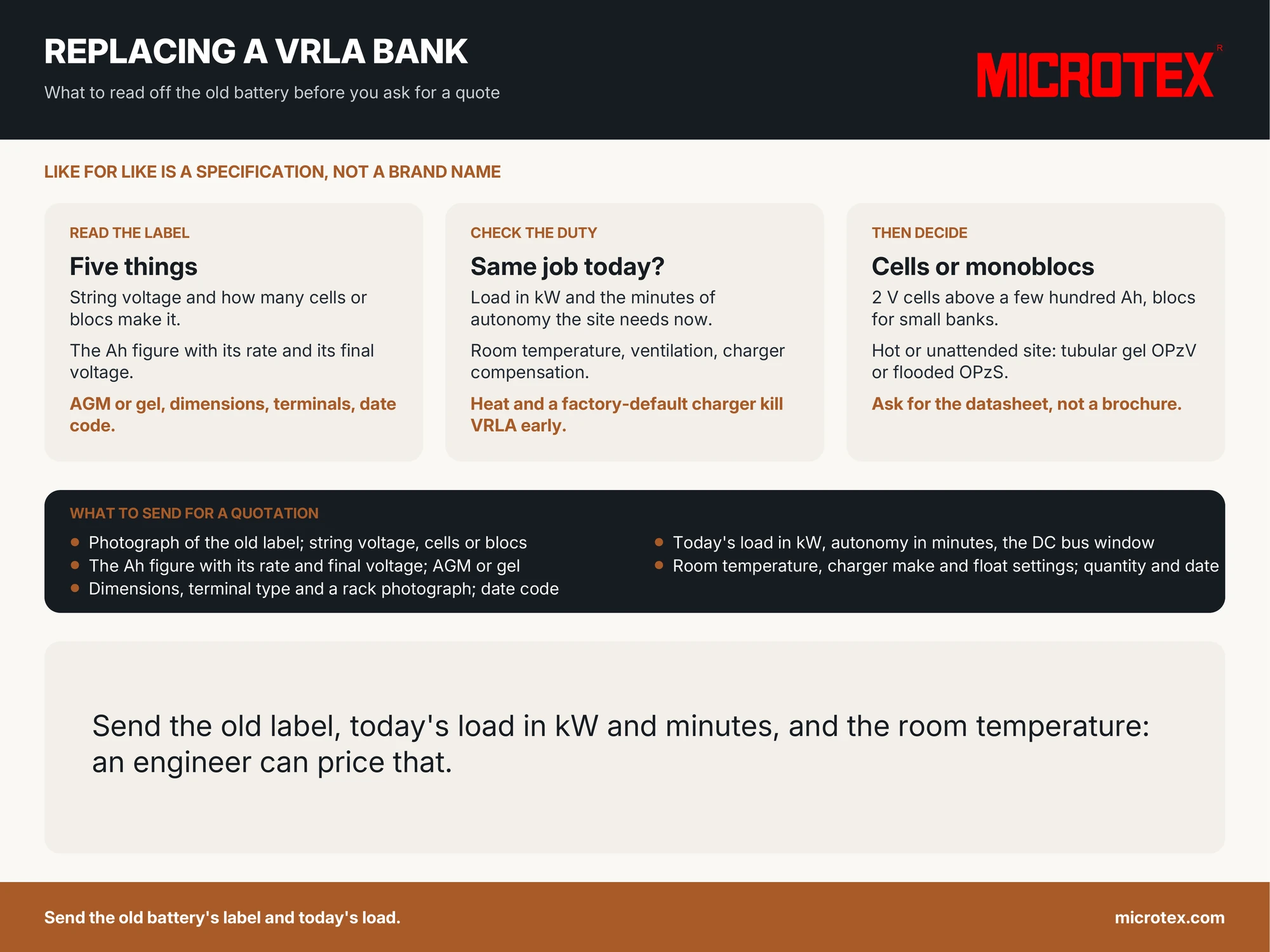
Five things come off the label and the old datasheet. First, the string voltage and its make-up: how many 2 V cells or 12 V monoblocs in series. Second, the ampere-hour figure with its rate and its final voltage. The Handbook for Stationary Lead-Acid Batteries separates the nominal capacity that names a type, a 10, 20, 100 or 120 hour figure by range, from the rated capacity delivered at a set rate to a permissible final voltage; one cell carries several Ah numbers, and a figure read to 1.75 volts per cell, Linden’s typical end point, is not the figure read to 1.80, which our OPzV catalogue uses. Third, the construction: AGM or gel, cell or bloc, terminal type and position. Fourth, dimensions, weight and the rack or cabinet. Fifth, the date code and the years served.
Did the old bank reach its life, or die early?
Years served against the maker’s design life tells you whether to blame the battery or the room. Bullock and Salkind, in Linden’s handbook, give the primary failure mode of a VRLA cell on float as growth of the positive plate, whose rate rises with temperature; for the small cylindrical cells their performance section describes, they put the expected float life above eight years at room temperature, from accelerated tests, and define end of life as failure to deliver 80 per cent of rated capacity. A bank that died in half its design life in a hot room, or on a UPS left at factory charger settings with no temperature compensation, will die again if you reorder the same type. Our page on thermal runaway in VRLA batteries explains the mechanism.
Has the duty changed?
Today’s UPS load is seldom the original sizing load. Write down the kW the inverter carries now, the minutes of autonomy the site needs and the DC bus window the UPS accepts; UPS duty is sized on minutes at high rate, and if racks have been added, like-for-like is short from day one. Then check the room: normal and worst-case temperature and ventilation; the stationary handbook asks for a gap between cells or blocs and at most 3 K of temperature difference across the bank.
AGM or gel
Both are valve-regulated; they age differently. In an AGM cell the acid is held in a glass-microfibre mat that is also the separator; in a gel cell the acid is set with silica and the cell holds nearly as much electrolyte as a vented one. The same handbook draws the consequence: vented batteries are practically immune to thermal runaway because of that volume, gel behaves much like vented, and AGM, with less electrolyte and more recombination heat, runs away when the room is hot, the cooling fails or the charger lacks temperature compensation. AGM delivers current faster and suits the air-conditioned UPS room on float; gel suits the hot, unattended or daily-cycled site. Our AGM versus gel comparison has more.
2 V cells or monoblocs
The same chapter’s table of advantages counts availability from single 2 V cells to large 48 V batteries, and side-mounting of some designs. Our rule of thumb: above a few hundred ampere-hours, or where one weak unit must be replaceable alone, specify 2 V cells; for a small cabinet bank, monoblocs. Microtex builds 2 V AGM cells to 5,000 Ah, and the 1000 Ah cell has been type-tested at CPRI to IS 15549:2005. The cells-or-monoblocs guide has the full argument.
What the datasheet must show
Do not accept a brochure. The datasheet must state capacity at several rates to a named final voltage and temperature; dimensions, weight, terminal type and bolt torque; internal resistance and short-circuit current for protection sizing; float and boost voltages for that type with the temperature-compensation coefficient; design life at its reference temperature, stated as a design value and not a warranty; and the type-test report for your tender file. Our guide to reading a battery datasheet shows how to compare two makers’ sheets, and the warranty guide explains why design life and warranty differ.
Acceptance and commissioning
VRLA batteries should not be stored discharged, so ask for the manufacture date and refresh-charge record of what arrives. On commissioning day record every cell’s voltage, internal resistance and temperature as the lifelong baseline, and run or witness a capacity test to the datasheet’s rate and final voltage. Our commissioning guide gives the sequence.
When VRLA is the wrong answer
VRLA is a battery for a cooled room with a competent charger; greater sensitivity to high temperature than a conventional lead-acid battery heads the disadvantages Bullock and Salkind list. If the site is hot and cannot be cooled, unventilated or rarely visited, the honest replacement is tubular gel OPzV, which Microtex builds from 200 to 3000 Ah with a recommended operating band of 10 to 35 °C and delivers in 60 days from order confirmation, or flooded OPzS where a trained maintainer will water and read specific gravity. Where floor space and weight are the constraint, or the duty is frequent cycling at partial state of charge, lithium with its management system can be the better buy. That is our view, provided the UPS maker supports the chemistry and the site’s fire rules allow it.
What to send for a quotation
Send us, in one message through the contact page: a photograph of the old label; the string voltage and the number of cells or blocs; the Ah figure with its rate and final voltage; AGM or gel; dimensions, terminal type and a rack photograph; the date code and years served; today’s load in kW and autonomy in minutes, with the DC bus window; room temperature, normal and worst case; the UPS or charger make and its float settings; the standard your tender names; quantity, site and the date you need the bank. The enquiry reaches an engineer who replies within the working day. The 2 V AGM VRLA and OPzV product pages describe each range.
Sources quoted: K. R. Bullock and A. J. Salkind, “Valve Regulated Lead-Acid Batteries”, chapter 17 in T. B. Reddy (ed.), Linden’s Handbook of Batteries, 4th ed. (McGraw-Hill, 2011); Handbook for Stationary Lead-Acid Batteries, Part 1, 3rd ed. (December 2008), sections on capacity terms, thermal runaway and fixed electrolyte; Microtex product pages for the 2 V AGM VRLA and OPzV ranges, as of October 2026.