
A code such as 6 OPzS 420 or 24 OPzV 3000 is a short specification: it gives the number of positive plates, the plate family and a nominal capacity, and it leaves out almost everything else a quotation needs. This guide reads the OPzS cell designation part by part, shows why a 12 V block code reads differently, and ends with the lines to send so that we can quote the matching cell.
The three parts of an OPzS cell designation
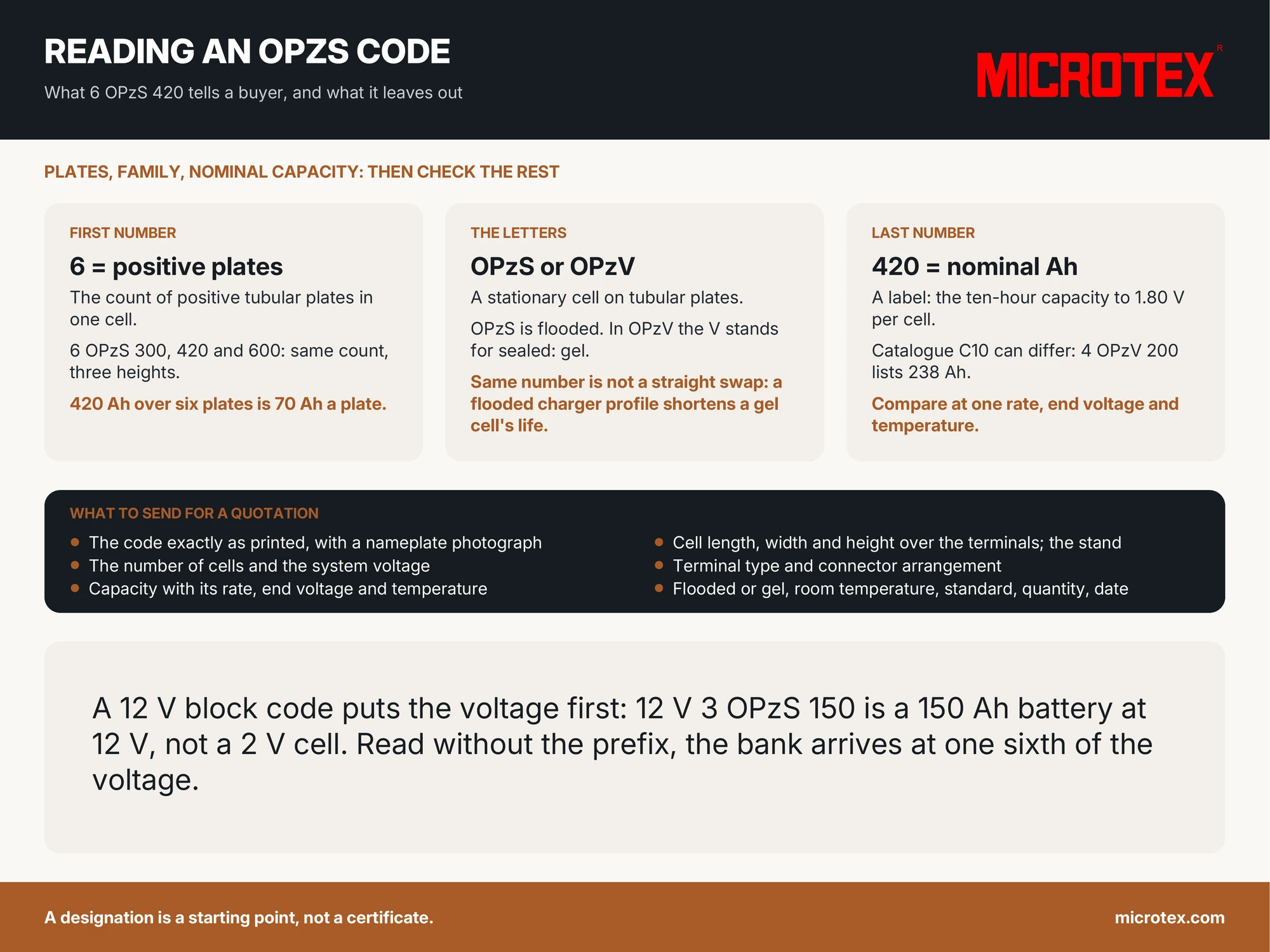
Take 6 OPzS 420. The first number is the count of positive tubular plates in the cell. The letters name the family: the Handbook for Stationary Lead-Acid Batteries gives the German behind them, Ortsfeste Panzerplatte Sonderseparation, a stationary cell on armoured, that is tubular, plates. In OPzV the last letter stands for verschlossen, sealed. The last number is the nominal capacity in ampere-hours.
DIN 40736-1, the German standard for flooded tubular stationary cells in plastic containers, builds its designation in this order. Its example is a cell with six positive plates and a ten-hour capacity of 300 Ah, shortened to 6 OPzS 300. Our OPzS cells are built to these designations, and our OPzV gel cells are named on the same pattern, for which that page cites DIN 40742.
Why the plate count alone does not size the cell
Divide the capacity by the plate count and you have the size of one plate. 6 OPzS 300 is six plates of 50 Ah, 6 OPzS 420 is six of 70 Ah and 6 OPzS 600 is six of 100 Ah, so three cells with the same plate count stand at three different heights. The text of DIN 40736-1 on our shelf, an English translation headed July 1988, works with four plate sizes, 50, 70, 100 and 125 Ah, in a series from 4 OPzS 200 to 24 OPzS 3000. That is why 12 OPzS 1200 and 12 OPzS 1500 are different cells: twelve plates of 100 Ah against twelve of 125 Ah. DIN lists a September 2015 edition as current, so check the edition your tender names before relying on any figure.
The capacity in the name has a rate, an end voltage and a temperature
The number in the code is a label before it is a measurement. The same handbook treats nominal capacity as the figure that identifies a cell, and notes that it may be the 10-hour, 20-hour, 100-hour or 120-hour capacity depending on the range. For OPzS the DIN text makes it the ten-hour capacity, C10, taken down to 1.80 V per cell.
Faster discharges are stopped at lower voltages: the 1988 text takes the five-hour discharge to 1.77 V, the three-hour to 1.75 V and the one-hour to 1.67 V per cell. Temperature is the third condition: the 1988 text takes 20 °C as its rated temperature, our OPzV capacity table 25 °C. An ampere-hour figure quoted without all three cannot be compared with one that carries them; how to read a battery datasheet explains the rate notation.
The nominal figure and the catalogue C10 are two numbers
A maker may tabulate more than the label says. Our own OPzV catalogue is the example: the cell named 4 OPzV 200 is listed at 238 Ah at C10 to 1.80 V per cell at 25 °C.
So when two offers both say 12 OPzV 1200, compare the C10 lines at the same end voltage and temperature, not the names, and size the bank on the tabulated figure for your own autonomy. If the duty is still open, choosing a 2 V cell starts from the room and the load.
Why a 12 V block code reads differently
Small tubular batteries are also sold as blocks, three or six cells in one container, and the code then begins with the block voltage: 12 V 3 OPzS 150, or 6 V 4 OPzS 200. The plate count is still per cell, and the capacity is that of the whole block at its voltage. A 12 V 3 OPzS 150 is a 150 Ah battery at 12 V, not a 2 V cell. Read without its voltage prefix it looks like a small single cell, and the bank arrives at one sixth of the voltage.
The OPzS and OPzV ranges on our product pages are 2 V cells. If your nameplate carries a block code, send it as printed and we will say plainly whether 2 V cells are a sensible replacement; 2 V cells or monobloc batteries explains what the shared box changes.
Same designation, four things still to check
The standard fixes the outside of the cell and leaves the inside to the maker, which is what lets one maker’s cell stand in for another’s. It does not promise a fit.
Dimensions. The standard gives its dimensions as maximum values, so makers differ inside them. Measure the cell you have, over the terminals, and the free space on the stand.
Terminals. Bolted or welded connectors, the number of terminal pairs and their spacing, because the existing connectors must reach. In the 1988 text a suffix a or b marks welded or bolted terminals, and LA a positive alloy with less than 3 per cent antimony.
The stand. Tiers, rows, the mass of each cell and any seismic requirement. Ask for the mass with the offer.
The capacity line. The catalogue C10 with its end voltage and temperature, as above.
An OPzS and an OPzV of the same number are not a straight swap either: our OPzV page is blunt that a flooded-battery charger profile shortens a gel cell’s life. What an OPzV battery is covers the difference.
The lines to send for a quotation
Turn any maker’s designation into these lines and send them to us: the code exactly as printed, with a photograph of the nameplate; the number of cells and the system voltage; the capacity you need with its rate, end voltage and temperature, or the load profile; the cell’s length, width and height over the terminals, with a sketch of the stand; the terminal type and connector arrangement; flooded or gel, the room temperature, the standard the tender names, the quantity and the date.
Our OPzS and OPzV pages state delivery in 60 days and a first reply within the working day, and the offer carries the datasheet for the exact cell. A designation is a starting point, not a certificate: the tests behind a cell are listed in the offer.
Sources quoted: DIN 40736 Part 1, Lead acid batteries, stationary cells with tubular plates, cells in plastic containers, read in an English translation headed July 1988 (Deutsches Institut für Normung; the current edition in DIN’s catalogue is DIN 40736-1:2015-09), for the designation pattern, the plate sizes and the rated conditions; Handbook for Stationary Lead-Acid Batteries, Part 1, 3rd ed. (Industrial Energy, Product Application, Büdingen, December 2008), section 2.1.1.2 on tubular plates and section 4.1 on nominal capacity; the Microtex OPzV catalogue (ME/OPzV/2023) and the Microtex OPzS and OPzV product pages. No table or clause of any standard is reproduced.