
If you already know you want 2 V cells, the decision left is not which battery is better but which duty the room will impose on it. Microtex builds six lines of 2 V stationary cell: five on the tubular positive plate, one a sealed absorbed-glass-mat design. This guide takes them by the job, what each asks of the room and gives back, and ends with the six lines that make an enquiry priceable.
What the five share, and where they part
Tubular plates lock the active material inside woven gauntlets around cast spines, so it cannot shed and the cell survives years on float broken by occasional deep discharges. The Handbook for Stationary Lead-Acid Batteries explains the fork: a flooded tubular cell uses a low-antimony spine, because antimony binds the active material to the conductor; a sealed gel cell must use lead-tin-calcium, since antimony would drive a water loss no valve-regulated design could tolerate.
Twenty years and earthquakes: HDP
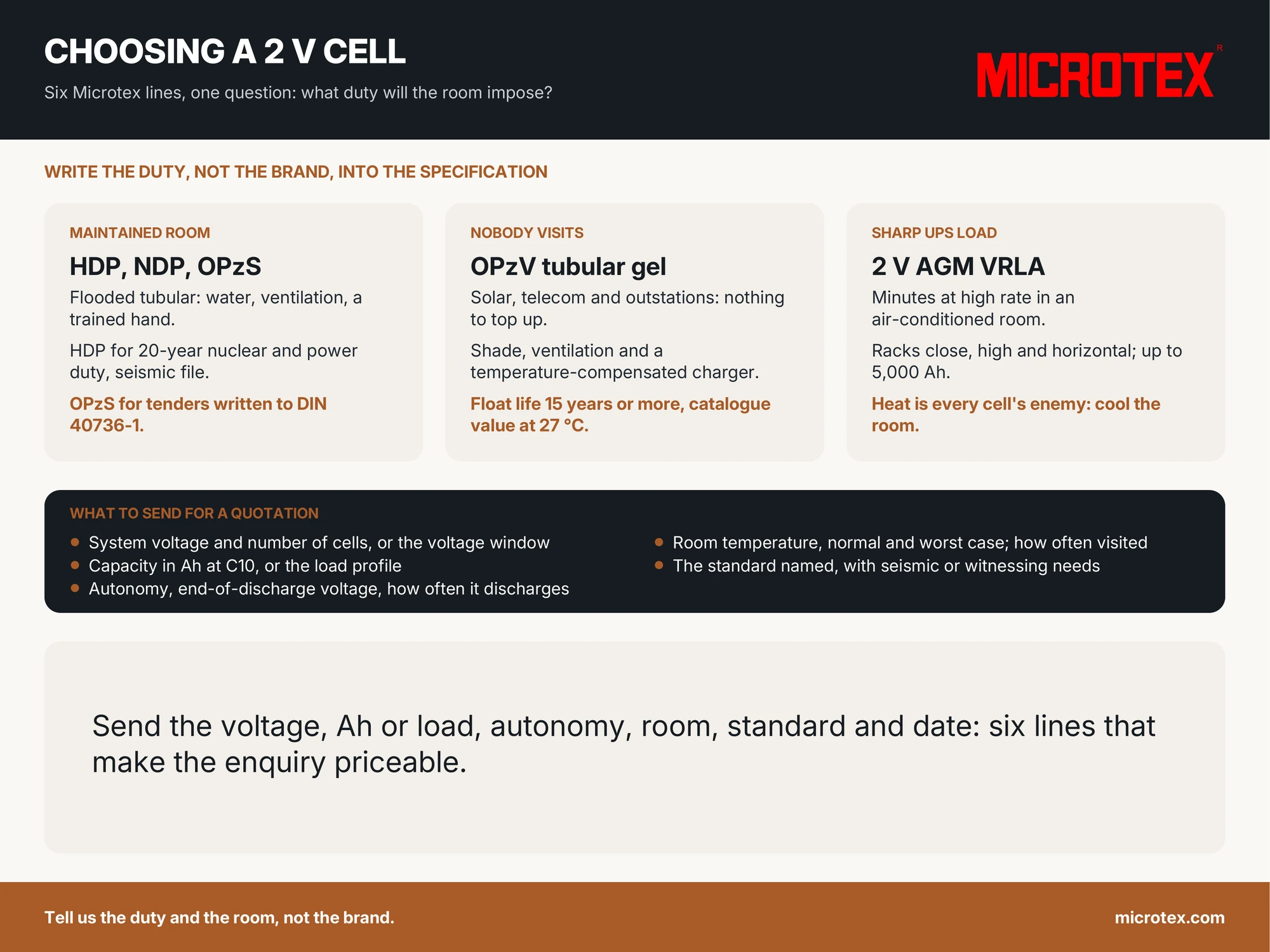
Where the station cannot fail — nuclear, thermal and hydro power, oil and gas — the 2 V HDP range is the premium flooded line: 100 Ah to 3000 Ah in transparent SAN containers, calcium-tin tubular plates, a 20-year design life, built since 2007. It asks for trained hands, ventilation for the hydrogen of charging and a top-up typically once in 12 to 15 months. It gives back plates, sediment and electrolyte level in plain sight, the seismic file, and a registered vendor with NPCIL, BARC, ONGC, BPCL and IOCL behind it, as of 2026. Our 2V HDP cells are seismically qualified to IEC/IEEE 60980-344:2020 — five OBE and one SSE on CPRI’s triaxial shake table at RRS+10%, discharging without interruption throughout, with zero damage and zero acid spillage, witnessed by NPCIL QA (report CPRIBLREVRC26T0049).
The tender that names IS 1651: flooded, then NDP
When the tender reads “stationary lead-acid cells with tubular positive plates conforming to IS 1651”, the economical IS 1651-class flooded range answers it: 40 Ah to 1100 Ah since the 1970s, in PPCP or legacy ebonite. Where the same maintained site wants a 10-year design life, the 2 V NDP range, built since 1984, steps up: 20 Ah to 1100 Ah on tin-selenium low-antimony plates in heat-sealed PPCP containers. Both want a maintained, ventilated room and a topping-up round, typically once in 12 to 15 months for NDP and as much as 18 months for the flooded range. Both give back the GTPs, drawings and clause-by-clause compliance statements government procurement expects, and a witnessed factory acceptance test in Bengaluru. A 20-year expectation or transparent-container clauses mean HDP.
Nobody visits: OPzV tubular gel
Solar fields, telecom towers and oil-and-gas outstations get the OPzV range: the same tubular plate sealed into silica gel, 200 Ah to 3000 Ah in DIN 40742 types, CPRI type-tested against customer specification, nothing to top up; the catalogue float life, rated at 27 °C and not a warranty, is 15 years or more. It asks for a shaded, ventilated room inside −20 to +45 °C, 10 to 35 °C recommended, and a charger set to the datasheet with temperature compensation: the page is blunt that the charger, not the battery, kills gel cells. It gives back no watering, no acid handling, cells that can lie on their side, and no stratification; you give up the hydrometer, so health is read from voltage, ohmic trend and a periodic capacity test. See what an OPzV battery is and tubular gel against flooded.
Minutes at high rate, cooled room: 2 V AGM
A UPS hall or a low-ceilinged switchgear room with a sharp load is 2 V AGM VRLA territory: sealed cells up to 5,000 Ah, CPRI type-tested to IS 15549:2005 on a 1000 Ah cell, racking close, high or horizontal. Dell and Rand’s Understanding Batteries credits the AGM type alone among sealed designs with good high-rate discharge capacity. It asks for an air-conditioned room, float duty with occasional discharge and a temperature-compensated float voltage. The stationary handbook explains why the air-conditioning is part of the battery: an AGM cell holds much less electrolyte than a flooded or gel cell, so recombination heat has less liquid to soak into, and in a hot room or on a wrong charger it tends more readily to thermal runaway. For hot or unmanned sites and deep daily cycling, gel serves longer; see AGM or gel.
Specifications written to DIN: OPzS
International tenders written to DIN 40736-1 designations get the OPzS range, 100 Ah to 3000 Ah, delivered in 60 days. A cell built to a DIN size fits the stand, connectors and sizing written for that size, so the bank can be spared years later. A Microtex 2 V 800 Ah tubular stationary cell was type-tested to IS 1651:1991 at CECRI, Karaikudi, in 2012, and our 2V OPzS cells are seismically qualified — Resonance Search, OBE and SSE testing per IEEE Std 344:2013 at CPRI Bengaluru, witnessed by NPCIL QA. It asks for a maintained room and a watering round, and gives back a capacity a discharge test can prove outright. Heat is every cell’s enemy: the US Bureau of Reclamation’s battery manual (FIST Volume 3-6) halves expected life for roughly every 8 °C above 25 °C. Its duty is the substation duty cycle.
Where lithium or nickel-cadmium is the better buy
Two cases leave lead-acid behind. Linden’s handbook credits industrial nickel-cadmium with long cycle life, ruggedness and no sudden death, and the vented sintered-plate type with superior low-temperature and high-rate performance, against a higher cost and the cadmium it contains: at temperature extremes a lead cell will not tolerate, where the budget accepts the price, nickel-cadmium earns it. In our own view, deep daily cycling with floor space and weight at a premium, and a battery management system acceptable, makes lithium-ion the better buy. For long-float standby, maintained or unattended, 2 V lead-acid remains the economical choice; OPzS, Planté or nickel-cadmium works it through.
The six lines to send for a quotation
Write the duty, not the brand, into the specification — see writing a battery specification — then send us these six lines: the system voltage and number of cells, or the voltage window; the capacity in Ah at C10, or the load profile; the autonomy, end-of-discharge voltage and how often the bank is really discharged; the room temperature, normal and worst case, and how often anyone visits; the standard the tender names, with any seismic or witnessing requirement; the quantity, site and date needed, with the tender reference and annexures. The product pages promise a first reply within the working day, and the offer carries the datasheet, the sizing and the evidence.
Sources quoted: Handbook for Stationary Lead-Acid Batteries, Part 1, 3rd ed. (Industrial Energy, Product Application, Büdingen, December 2008), §2.1.1.2 on tubular plates and their alloys and §1.7 on thermal runaway; T. B. Reddy (ed.), Linden’s Handbook of Batteries, 4th ed. (McGraw-Hill, 2011), chapters 19 and 20 on nickel-cadmium batteries (Tables 19.1 and 20.1); R. M. Dell and D. A. J. Rand, Understanding Batteries (Royal Society of Chemistry, 2001), chapter 8; US Bureau of Reclamation, Facilities Instructions, Standards and Techniques, Volume 3-6, Storage Battery Maintenance and Principles (April 2020 edition), as quoted on the Microtex OPzS product page; the six Microtex product pages named in the text; the 2018 seismic qualification of the OPzS cells (IEEE Std 344:2013, CPRI Bengaluru) was held by Mysore Thermo Electric Pvt Ltd, a Microtex group company, as the OPzS product page states.