
The newest battery chemistry in mass production is built around the sixth most abundant element in the Earth’s crust. A sodium-ion battery works almost exactly like the lithium-ion cell in your phone — the same rocking-chair principle, ions shuttling between two electrodes as the cell charges and discharges — but with sodium playing lithium’s part. And sodium is everywhere: seawater, soda ash, salt deposits on every continent. No lithium brine, no cobalt mine and, as we will see, no copper either. After a decade in the laboratory the chemistry crossed into real factories in the mid-2020s, and its makers are admirably candid about where it is aimed: not at the premium end of the market, but at the cheap seats. That deserves this site’s full attention — because the cheap seats have a long-standing occupant, and it is the chemistry we build. Here is how sodium-ion works, where it honestly stands as of 2026, and what it means for lead-acid.
How it works — and the aluminium trick
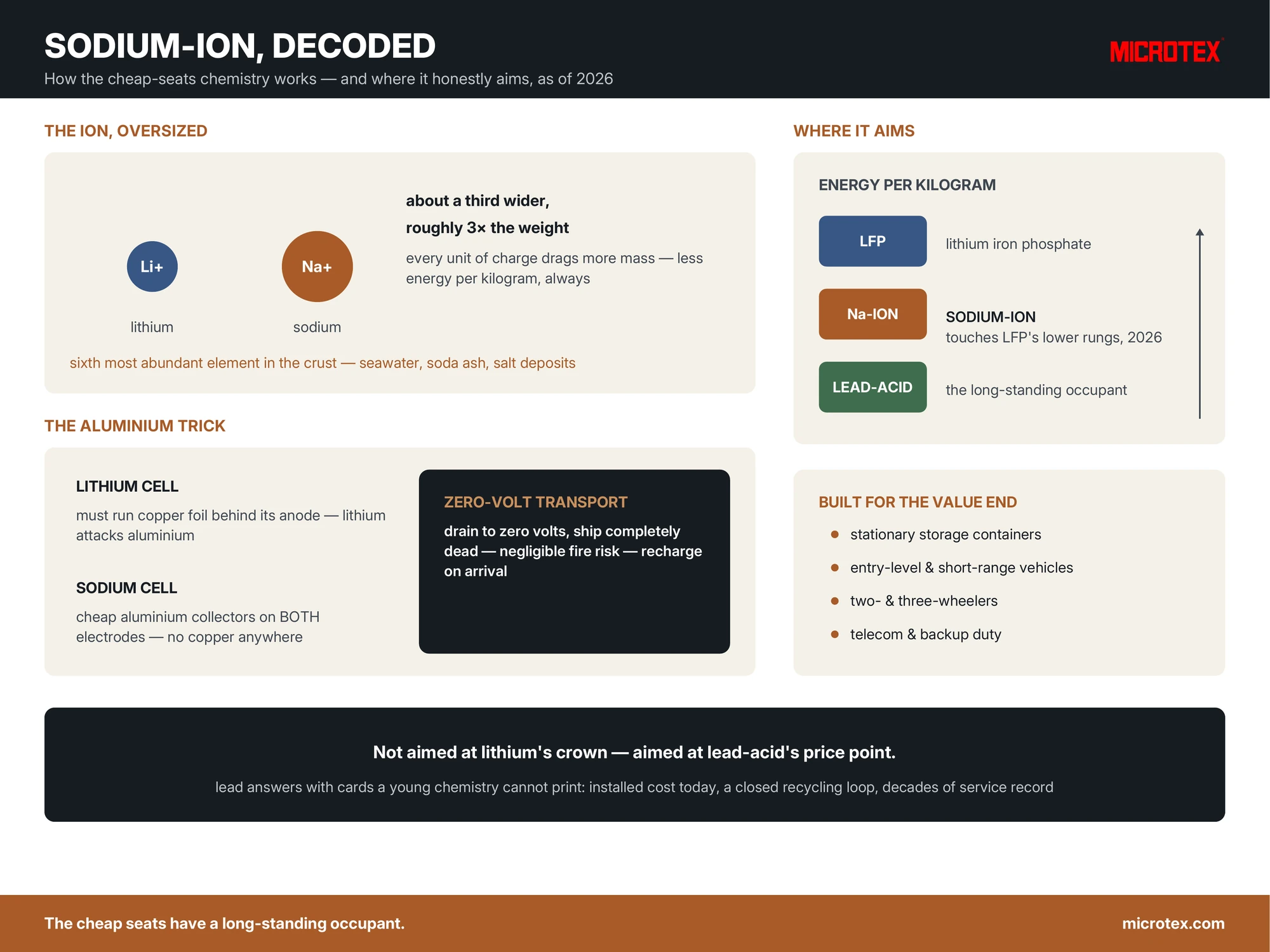
Chemically, sodium sits one row below lithium in the periodic table and behaves like its bigger sibling: it gives up one electron willingly, which is the whole job description of a battery metal (the electrochemistry guide explains why). The catch is size. A sodium ion is about a third wider than a lithium ion and roughly three times heavier, so every unit of charge drags more mass and needs more room in the electrode — which is why sodium-ion cells store less energy per kilogram, and always will. The anode is hard carbon rather than graphite (sodium ions do not slot neatly between graphite’s layers), and the mainstream cathodes run on iron and manganese — no lithium, no cobalt. Then comes the elegant twist. A lithium cell must use copper foil behind its anode, because lithium attacks aluminium at low potentials; sodium does not, so a sodium-ion cell uses cheap aluminium current collectors on BOTH electrodes. That saves copper money — and buys a genuine safety convenience: with no copper to dissolve, a sodium-ion cell can be drained to zero volts, shipped completely dead with negligible fire risk, and recharged at the destination. Anyone who has read our guide to shipping batteries will appreciate what a gift a legally boring battery is to a freight forwarder.
The honest state of play, as of 2026
Sodium-ion is past the press-release stage. Leading Chinese cell makers now produce sodium-ion cells in series, and industry press reports the first mass-production passenger car built around them reaching the Chinese market in 2026, with cell energy density around 175 watt-hours per kilogram claimed in the maker’s published figures. On the grid side, sodium-ion storage stations at the hundred-megawatt-hour scale have been operating in China since 2024. But the road has not been smooth, and honesty requires the other half: a prominent US sodium-ion developer shut its doors in 2025 when funding ran out, with trade press pointing at certification delays and — tellingly — at the collapse in lithium prices, which erased much of sodium’s promised cost advantage before the technology could scale. Sodium-ion’s business case was written when lithium was dear; per BloombergNEF, lithium-ion pack prices instead kept falling through 2025. The chemistry is real and manufacturable. The economics are still being argued about, in public, with casualties.
Where sodium-ion aims
Follow the energy density and the target market names itself. Sodium-ion sits between lead-acid and lithium iron phosphate on the weight scale, with the best 2026 cells touching LFP’s lower rungs — which rules out long-range flagship EVs and rules in everything where cost matters more than kilograms: stationary storage containers sitting on concrete, entry-level and short-range vehicles, two- and three-wheelers, telecom and backup duty. Its makers also claim notably better behaviour in severe cold than LFP manages, which is why cold-climate markets keep appearing in sodium roadmaps. Add the abundance argument — no geopolitics of lithium, cobalt or copper — and the zero-volt transport trick, and you have a chemistry engineered, quite deliberately, for the value end of the market. Where the full scorecard of chemistries stands today is kept honest in our chemistry comparison.
What it means for lead-acid — honestly
We said it plainly in our future-outlook post and repeat it here: sodium-ion is not aimed at lithium’s crown; it is aimed at lead-acid’s price point. If it reaches its cost targets at scale, it will press hardest in exactly the stationary markets we serve. Against that, lead-acid holds cards that a young chemistry cannot print: an installed cost that exists today rather than on a roadmap; a recycling system that already returns almost every battery to the furnace and back as a new one, while sodium’s loop is not yet built; a service record in solar, telecom and switchgear duty measured in decades; and a robust simplicity that asks for no electronic guardian to stay safe. Our position is the same one we took on lithium: respect, not denial. Sodium-ion has earned a place on the board, and the price war it promises will be good for buyers. If you are weighing chemistries for a stationary project today, ask us — you will get the honest comparison, including the chemistries we do not make.