
This guide is written by a lead-acid battery maker, and we are naming that interest in the first sentence so you can hold us to the standard it demands. Scare stories about a rival chemistry would be cheap, and we will not sell them: lithium-ion cells power billions of phones, tools and vehicles through billions of safe charge cycles, and engineered lithium systems have earned their place in the world. But the chemistry has a failure mode that deserves clear-eyed respect rather than myth — and clear-eyed is a house speciality, because we write with the same bluntness about our own chemistry’s explosion risk. What follows is thermal runaway explained honestly: what happens, why the incident statistics look the way they do, what fire services ask of households, and how professionals engineer the risk down.
What thermal runaway actually is
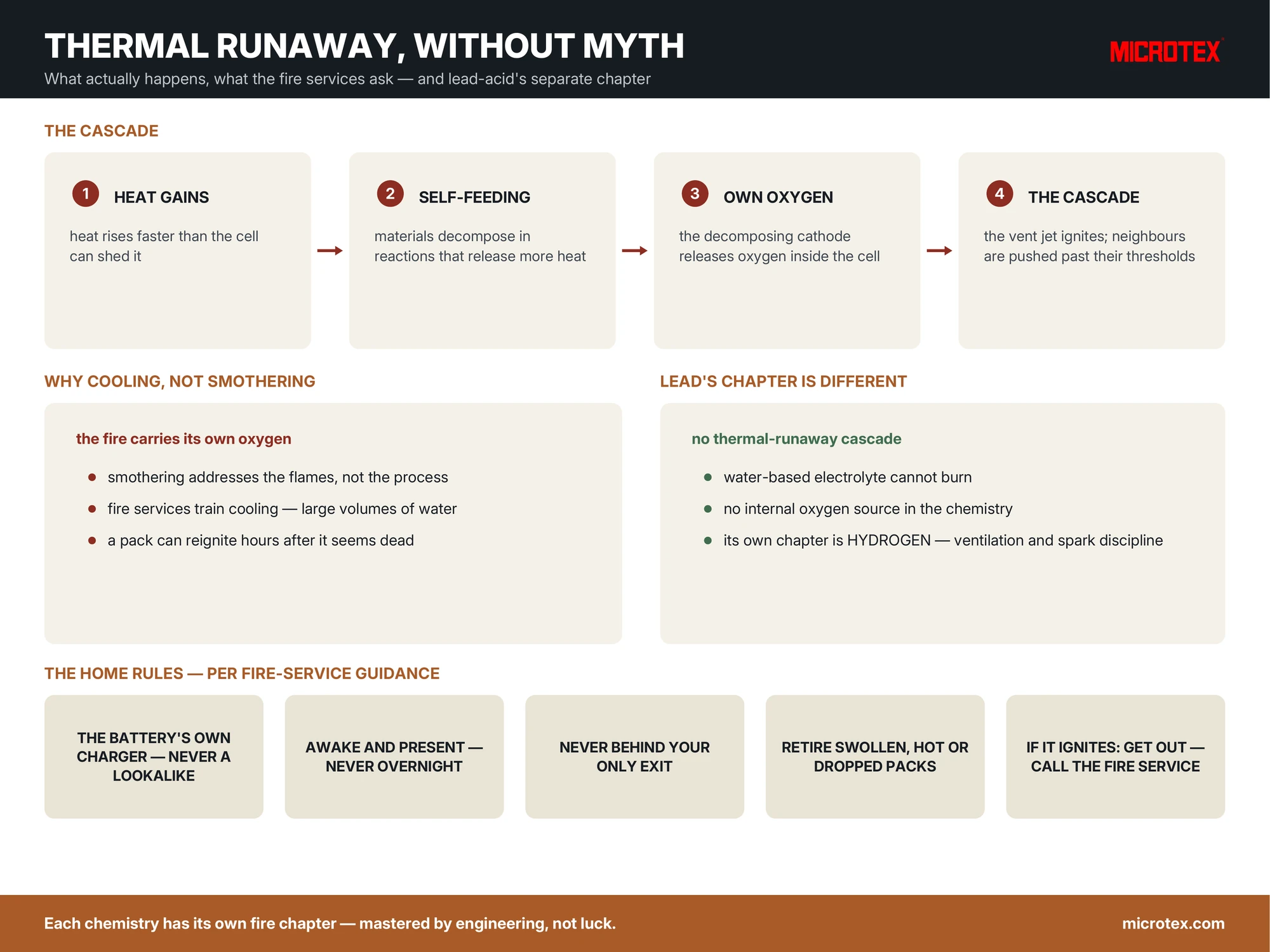
A lithium-ion cell packs a great deal of energy behind a thin polymer separator, bathed in a flammable organic electrolyte — three facts that define the failure mode. The trigger is anything that starts heat rising faster than the cell can shed it: an internal short from manufacturing defect or physical damage, overcharge from a mismatched charger, or external heat. Past a threshold, the cell’s own materials begin to decompose in reactions that RELEASE heat — the runaway of the name — and then comes the detail that changes the firefighting: the decomposing cathode releases OXYGEN inside the cell. A runaway cell partly feeds its own fire. Hot flammable vapour vents in a jet, ignites, and the heat pushes neighbouring cells past their own thresholds — the cascade that turns one failed cell into a burning pack. Because the fire carries internal oxygen, SMOTHERING cannot fully stop it; blankets and small extinguishers address the flames, not the process. Fire services therefore train a different logic: COOLING — large amounts of water to pull heat out of the cascade and protect neighbouring cells — plus respect for a pack’s ability to reignite hours after it seems dead. None of this is exotic chemistry; it is simply what dense energy in a flammable house does when its discipline fails.
Why small packs dominate the fire news
Here is the pattern the statistics actually show, and it is not the one intuition suggests. The incident numbers are dominated not by electric cars or grid farms but by the small end: e-bikes, e-scooters and their chargers. The London Fire Brigade reports attending an e-bike or e-scooter battery fire roughly every two days; New York’s fire department counted roughly 270 lithium-battery fires and 18 deaths in 2023 — and, encouragingly, saw deaths fall sharply in 2024 after certification rules and enforcement took hold. Fire-service analysis keeps finding the same ingredients: no-name packs of unknown provenance, mismatched or counterfeit chargers, damaged or salvaged cells, and charging parked in hallways and exits while households sleep. The lesson is precise, and it is not “lithium is reckless”: a premium car pack and a bargain e-bike pack share a chemistry but not an engineering culture — and the fires cluster where the engineering culture is thinnest.
The home charging rules, per fire-service guidance
Fire-service guidance in several countries — Britain’s brigades and the US National Fire Protection Association among them — converges on a short list worth printing. Use the charger that came with the battery, or the manufacturer’s approved replacement, never a lookalike. Charge while awake and present; never overnight, never behind your only exit — a battery fire in a hallway removes the escape route faster than a household can use it. Charge on a hard, flat surface away from beds, sofas and sunlight, with a smoke alarm in the room. Retire any pack that is swollen, hot, rattling or has been dropped, crashed or flooded — and buy certified packs from reputable makers in the first place, because the certification mark is precisely the engineering culture the fire statistics reward. And if a lithium battery does ignite: do not fight it. Get everyone out, stay out, call the fire service. That last line is the entire disagreement between amateur confidence and professional experience.
How professional packs engineer the risk down
Everything above describes failure at the cheap end; the professional end is a different world, and honesty requires saying so. Quality cell manufacture drives defect rates to parts-per-million; the battery management system stands guard over every cell’s voltage and temperature with authority to disconnect; packs are designed with propagation barriers between cells, engineered vent paths, and enclosures that contain a single cell’s failure rather than share it. At grid scale, storage installations add gas detection, ventilation, suppression and spacing under codes written specifically for battery plants, such as the NFPA’s energy-storage standard. Engineered lithium is a MANAGED risk — which is the only kind of risk industrial energy has ever been.
Lead-acid’s own fire chapter — different, not absent
We end where a fair guide must: on ourselves. Lead-acid has no thermal-runaway cascade — its water-based electrolyte cannot burn, and its chemistry carries no internal oxygen source — but it has its own chapter: HYDROGEN. Every lead-acid battery gasses hydrogen near full charge, and hydrogen confined with a spark is how batteries explode — a mechanism this site documents about its own products without flinching. The defences are equally different: ventilation that never lets the gas accumulate, proper vent fittings, spark discipline, and rooms designed for the duty — the full practice lives in our safety guide. So the honest summary of the whole subject: each chemistry has its own fire chapter, each is mastered by engineering and discipline rather than by luck, and a battery maker who mocks the other side’s chapter has simply not read his own. If you are designing a battery installation — either chemistry — and want the risks answered straight, ask us.